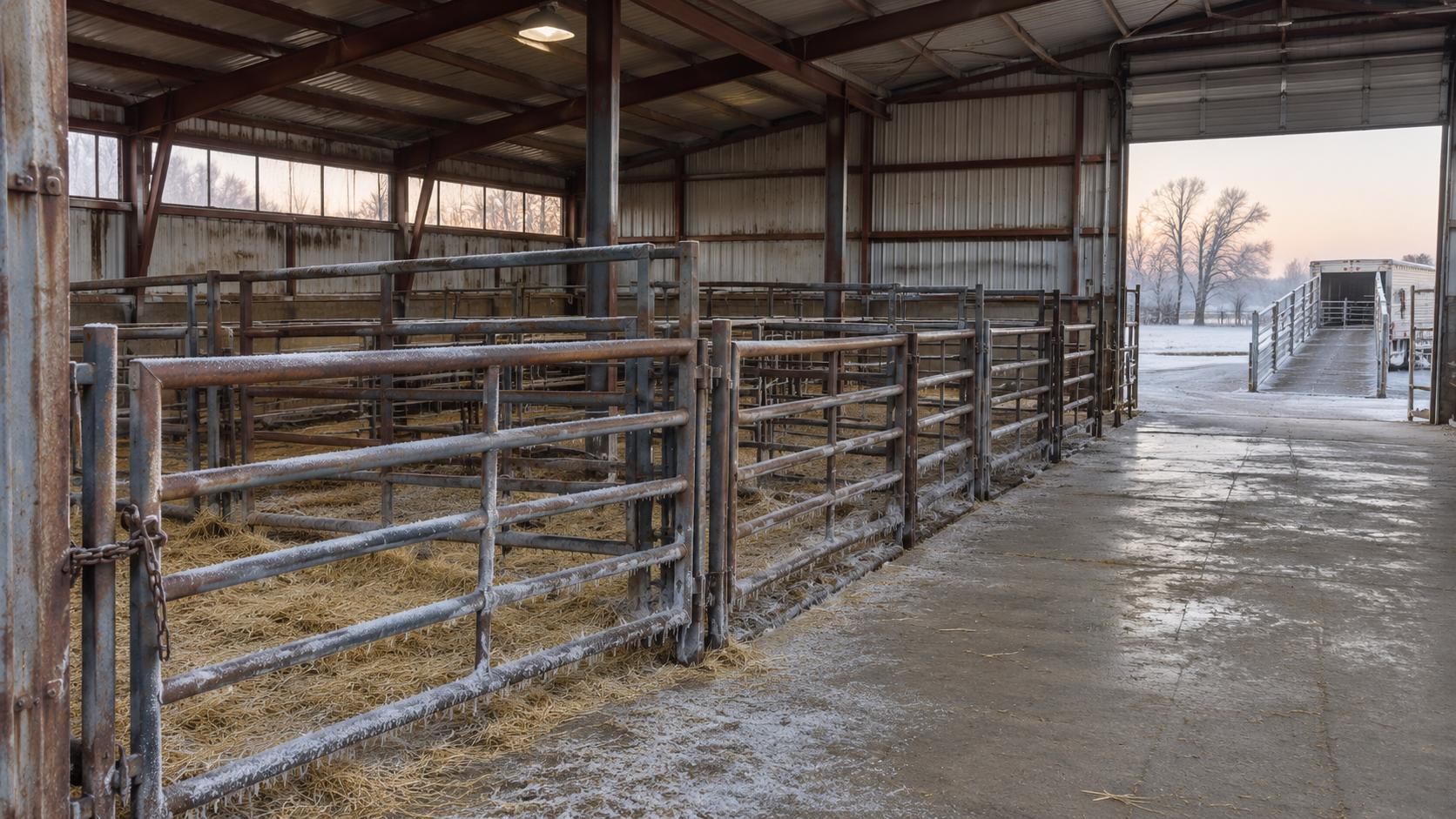
CEDAR PRAIRIE, Nebraska — The Cedar Prairie Livestock Exchange has postponed Tuesday's auction after frost remained on gates and bedding in the shapes of cattle that had left the barn two days earlier. Managers said the condition has not affected animals at neighboring farms, but they will keep the holding wing empty while its heat and water systems are inspected.
The outlines appeared after Thursday's feeder-calf sale, when employees swept the alleys and opened the south doors to air the building. Night foreman Paula Wynn said narrow bands of white frost formed against the rails in seven pens, each at the height of an animal's flank. Patches on the straw showed four-legged depressions, although the bedding beneath them had already been raked level.
Wynn initially treated the patches as ordinary condensation from warm animals meeting cold steel. By Friday morning, the rest of the barn had warmed to 41 degrees, while a rail in pen 12 measured 19 degrees where the white band crossed it. Frost melted above and below that band. A portable heater placed six feet away dried the gate except for the same curved section.
The exchange reviewed sale tags and found that the forms roughly matched the number of cattle held in each pen Thursday. Pen 12 had contained six black steers from the Hollen place. Wynn counted six overlapping cold areas along the rail, including one shorter outline near the latch where a smaller steer had stood apart during sorting.
The cattle had reached their buyers without incident, exchange manager Orin Beck said. He contacted the consignors and four receiving farms, which reported normal feed intake and no unexplained injuries. Beck said the calls were precautionary and that the barn has made no finding about whether the marks correspond to particular animals.
A leaking drinker, a damaged slab or air moving through an uninsulated wall can keep part of a livestock building below freezing, said Trina Moss, an agricultural building specialist who inspected the wing Saturday. Her team shut off the water branch, checked the floor with an infrared camera and traced air around the door seals. The cold areas did not follow pipes, drafts or structural seams.
They also did not remain still. During the inspection, a band of frost in pen 8 shifted from the north gate to the sorting panel over about 12 minutes. The change was not continuous. Moss said one patch thinned as another appeared, leaving the impression that the cold outline had turned in place. No hoof marks formed in the clean bedding during the shift.
Beck has arranged for Tuesday's 214 head to be sold at an exchange 38 miles west. Trucking costs will be shared by the Cedar Prairie barn and three consignors, and employees will help redirect trailers from the county road. The cafe and feed counter will stay closed until the next scheduled sale, but office staff will be available for settlement checks.
Employees removed straw from the affected pens and sealed it in an unused grain wagon outside. The metal floor of the wagon developed eight pale patches by Saturday evening, despite afternoon sunlight and an air temperature of 47 degrees. Beck covered the wagon rather than spread the straw, pending advice from the county extension office.
On Sunday, Wynn walked the emptied wing with the Thursday pen sheet. She said the faint outlines gathered close to the gates when she read the lot numbers aloud and receded when she stopped. No response followed the names of buyers or prices. At pen 12, the shorter patch remained beside the latch after the other five had faded.
The smaller steer from the Hollen group had been held back at the buyer's ranch for a sore hoof, records show. At noon Sunday it was standing in a sunlit recovery lot 54 miles away. In Cedar Prairie, a white rim continued to form around the empty pen latch at the height of its lowered head.