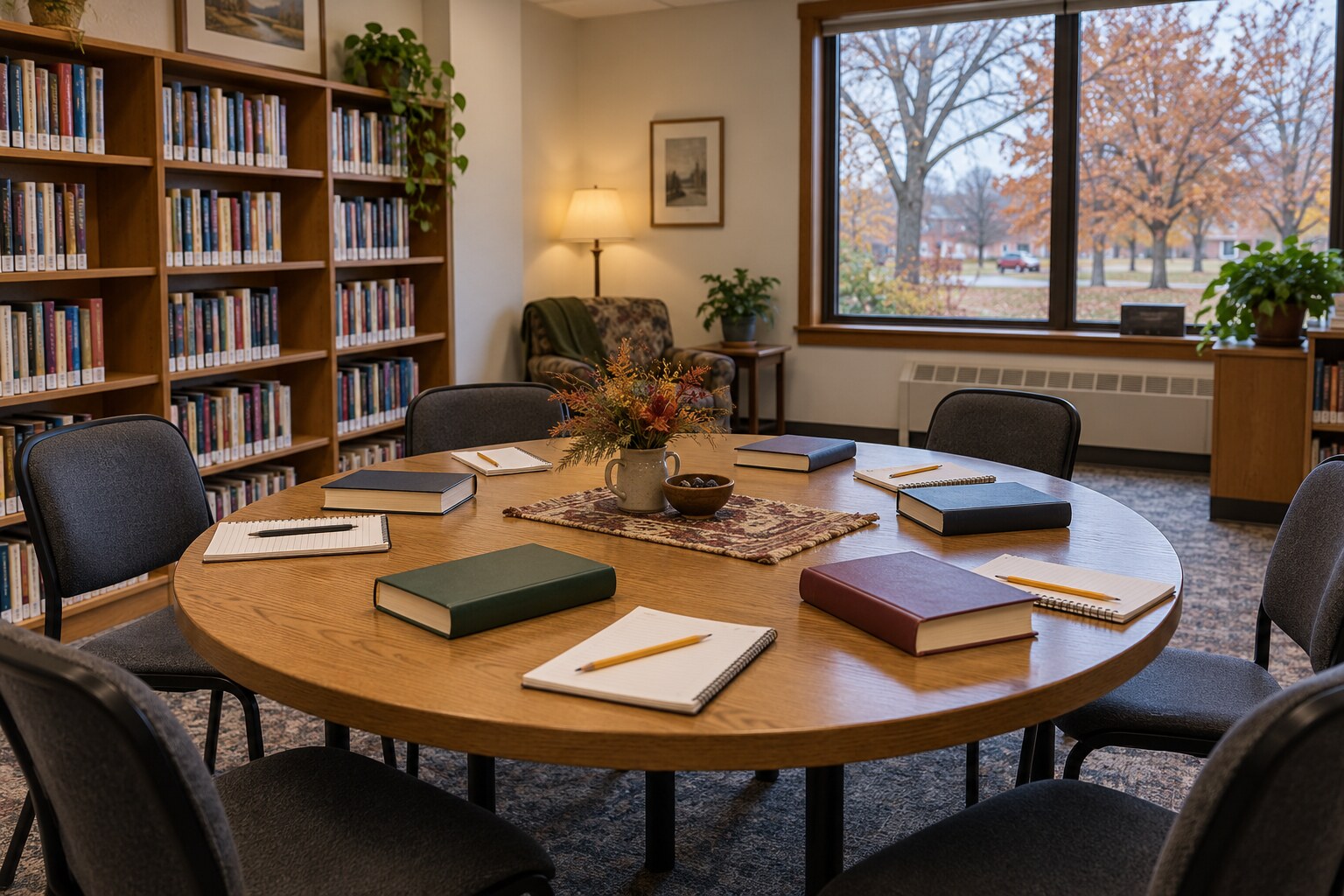
ALDEN ROW, Minnesota — The public library has scheduled a second discussion of its citywide reading selection after 23 participants cited scenes from the same chapter, although none of the library's editions contains that chapter. The program will continue, and no books have been withdrawn.
This year's selection is The Measure of an Orchard, a 1968 regional novel by the late Nell Arbour about two sisters maintaining a family apple farm. The library bought 86 new paperbacks and distributed older donated copies in September. Thursday's final discussion was intended to cover the last four chapters and the book's brief epilogue.
About halfway through the meeting, retired nurse Avis Lorne referred to a chapter she called 'The North Room.' In her account, the sisters carry their father's winter coats upstairs, find seed catalogues sewn into the linings and argue over whether to plant an orchard they will not live to harvest. Five readers began adding details before facilitator Sima Voss could find the passage.
The group agreed on the chapter's place between Chapters 11 and 12 and on several incidents, including a kettle boiling dry and one sister sleeping with an apple in each pocket. They disagreed about the room itself. Some remembered wallpaper with green bars; others remembered unfinished boards. No participant could quote more than a short phrase without another person correcting it.
Voss checked nine copies in the room, including a 1974 school edition and a large-print version. Chapter 11 ends with the sisters closing the packing shed. Chapter 12 begins the next morning in the orchard. Page numbers and signatures run continuously between them, with no missing leaves, reset type or change in paper.
The library then compared 17 editions supplied by patrons and neighboring systems. A university archive reviewed the author's surviving typescript, two sets of proofs and correspondence with her publisher. Library director Nella Wirth said none contains a north-room scene, a coat lining or the phrase several readers remembered as the chapter's last sentence.
The recollection is not limited to people who attended Monday's meeting. Four patrons completed written summaries separately Tuesday morning. A former Alden Row teacher said she assigned the chapter in 1989 and remembered students debating the catalogues. One current student said he skipped it last week because the description of stored clothing made him uneasy.
Shared reading can make scenes from discussion, reviews and other books feel attached to a familiar text, said Mira Sol, a cognitive psychologist who spoke with library staff. Readers also reconstruct omitted events where a narrative jumps forward. Sol said a detailed group recollection can become more consistent as people repeat it, but several written accounts were submitted before the library described the disputed material publicly.
The dispute has changed the program in ordinary ways. Wirth asked staff not to label any reader's account false in the circulation record and extended return dates through Friday. The library will record the additional discussion with participants' consent but will not ask anyone to demonstrate a memory test or surrender a personal copy.
Lorne said the chapter mattered because the sisters decide that care for a place does not require ownership of its future. She remembers reading it aloud to her mother during an illness in 2004. Her copy, purchased years later at a church sale, moves directly from the packing shed to the orchard. A flattened paper apple she used as a marker rests between those pages.
At Thursday's meeting, Voss read the final paragraph of Chapter 11 and turned the page. The room remained quiet for 11 minutes, according to the recorder and wall clock. Participants later said they had heard her read the north-room chapter in full, each in her ordinary speaking voice. The audio contains chair movement, one dry cough and the sound of a page turning at the end. No one in the room recalled the silence until Voss played it back.