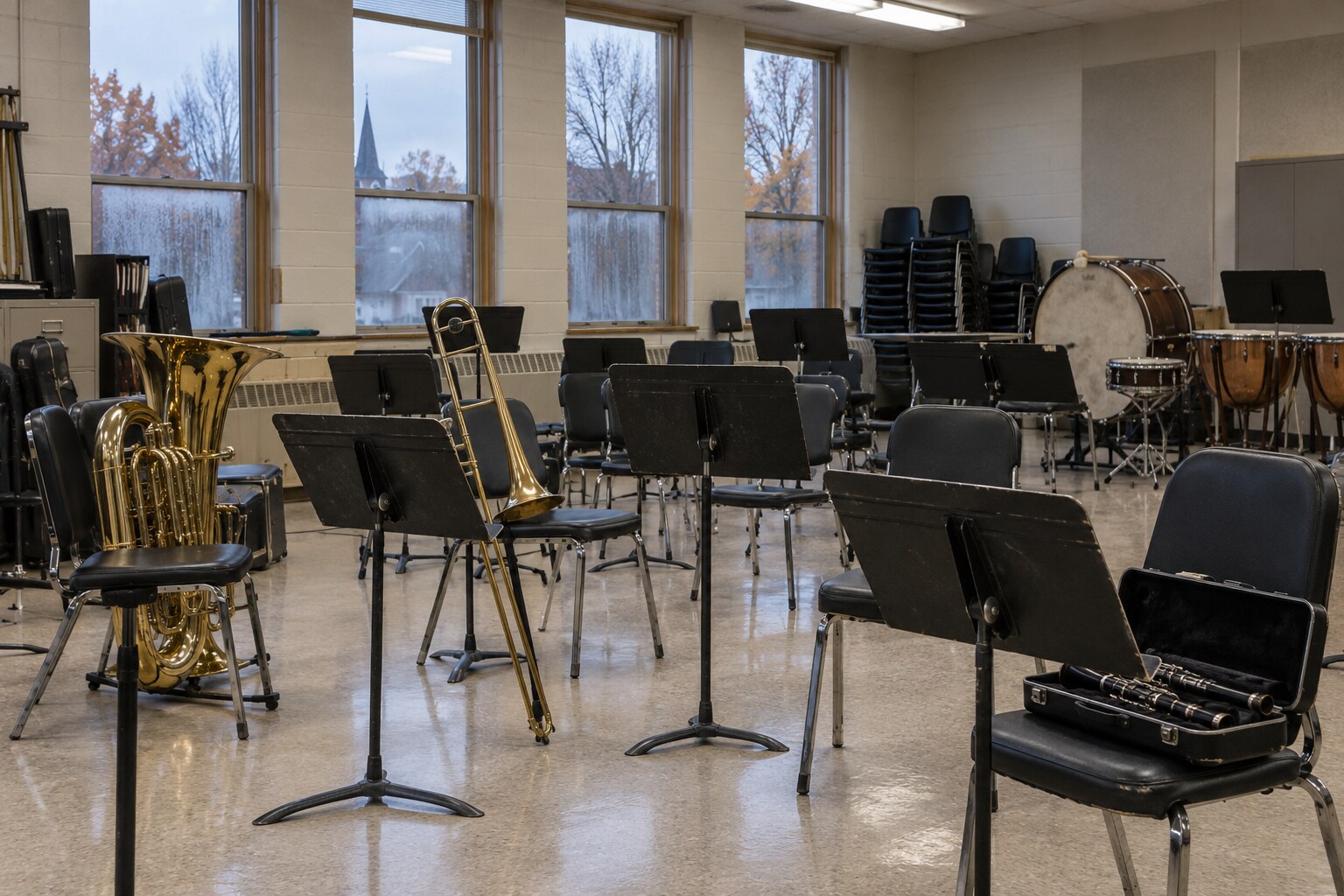
ALDENMERE, Minnesota — The Aldenmere Civic Band has moved its next two rehearsals to the high school after moisture formed in narrow bands around the municipal hall while musicians held notes in a new winter program. Saturday's concert remains scheduled, but the band has removed instruments and paper scores from the hall for drying.
Seventeen volunteer musicians were rehearsing a short work commissioned for the town's December tree lighting. Near the end, brass and woodwinds enter one at a time on sustained pitches while percussion stops. Director Lena Orr said the passage sounded balanced during its first run Tuesday, though the room's west windows clouded before anyone opened an outside door.
On the second run, clear strips of moisture appeared at different heights on the windows, painted walls and metal storage cabinets. Each strip formed as a section entered and stopped spreading when that section released its note. Drops associated with the flutes remained near the ceiling, while the tuba's strip ran along the baseboard behind three empty chairs.
The room was warm and held more people than usual, so members first treated the moisture as condensation. They wiped the windows, switched on two ceiling fans and waited 20 minutes. The surfaces dried. When the group played the passage again without changing seats, the same horizontal bands returned, including one across the closed door of an unheated supply closet.
Orr ended rehearsal after water reached a box of march folios stored below the windows. No musician reported breathing trouble or electrical trouble, and the instruments played normally when taken outside. The city opened the larger high-school room at no charge, while volunteers separated damp pages and borrowed replacement stands from the school music department.
Warm breath and brass instruments release substantial moisture, especially when outside temperatures fall, said Tomas Pell, an instrument repairer who inspected the room Wednesday. Air currents can layer humid air at different heights. Pell said those layers ordinarily follow temperature and ventilation, not musical entrances, and would not begin simultaneously on opposite walls behind closed cabinets.
Band members tested the hall once more with no instruments present. Orr played a phone recording of the passage through the room's speaker at the same measured volume. The walls stayed dry. Four players then returned and performed separate long tones; each produced a short damp line nearest the player, but the lines lengthened only when the pitches were played together as written.
The relocation has required ordinary compromises. The high school is unavailable during basketball practice, so Thursday's rehearsal will begin at 8:30 p.m. Three older members have arranged carpools for the later hour. The band will use photocopies rather than move its full music library, and the city has offered fans and dehumidifiers for the municipal hall.
Composer Iva Noll attended Wednesday's test and asked that the passage not be cut merely to keep the room dry. She said the accumulating lines made the harmony easier to understand but did not believe they belonged in a public performance. Orr plans to rehearse an alternate ending at the school and decide Friday which version the band can play safely.
Custodian Cal Rusk left the municipal hall empty overnight with the heat lowered and the fans running. By morning, the windows and walls were dry. A covered clarinet case forgotten beneath the last row held no water inside, but a narrow damp band crossed its closed lid from hinge to latch. Rusk opened the case and left it on a towel. The line remained on the lid after the rest of the room had warmed.