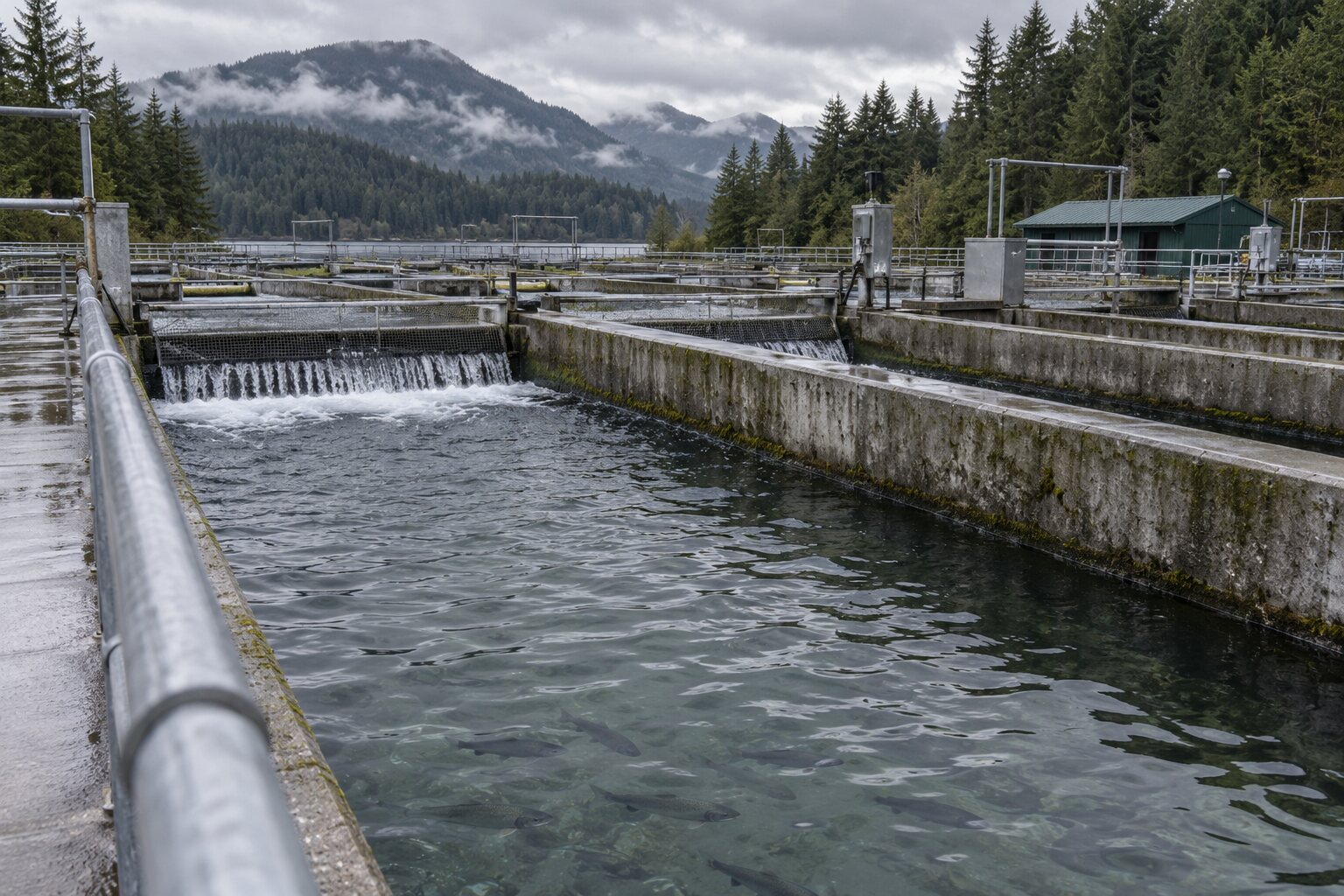
ALDER RUN, Oregon — A coastal fish hatchery has delayed release of 18,000 juvenile coho after workers found five marked fish from the same cohort in an upstream return channel. The fish were scheduled to enter the river next month. Hatchery managers are holding the group in its raceway while they inspect screens and confirm the marks.
The five juveniles were collected Monday from a shallow box where adult salmon are diverted during the fall return. Each carried a small coded-wire tag in its snout and a clipped adipose fin, identifying it as hatchery stock. A handheld detector assigned all five tags to the cohort still being raised in raceway four, manager Cora Dey said.
Coded-wire tags are inserted before release so agencies can estimate where hatchery fish travel and how many return as adults. They do not transmit a location. The code can be read only after a fish is recovered and the tag removed. Dey said the five fish were alive, undersized and showed no signs of having spent a season at sea.
Workers first considered whether the fish had escaped through a drain during cleaning. Raceway four empties through a screened pipe into a settling pond below the hatchery. The adult return channel is uphill and receives river water through a separate gate. Facilities staff added dye to both systems Tuesday and found no visible connection.
The hatchery's inventory is an estimate based on feed use and sample counts, so five missing fish would not ordinarily be detected. A contractor could also have mixed tagged juveniles between facilities before delivery. Dey said the code links the fish to this site and year, but does not prove they were ever placed in raceway four. She requested packing records from the tagging crew.
Biologist Evan Pell examined scales from two of the fish. The growth rings are consistent with juveniles raised in cool fresh water, he said, and do not show the broad summer growth expected after migration. Their stomachs contained the same compressed feed used at the hatchery, along with fragments of alder leaf from the return channel.
The delay affects a school release day and a tribal education program planned for early October. Both groups were notified that the event may move later in the month. Dey said the fish can remain in the raceway without harm for several weeks, although feed and water-temperature plans will need adjustment if the hold continues.
At the hatchery Tuesday, the five recovered fish circled in a covered examination tank. The larger cohort remained in raceway four below. When an employee scattered feed, the recovered fish struck at the surface at nearly the same moment as the fish in the raceway, though the tanks cannot be seen from one another. Pell said synchronized feeding behavior is common under a shared routine.
Staff checked the intake channel again Wednesday morning and found no additional juveniles. A motion camera will remain over the adult box, and the hatchery has placed finer screens over the raceway drains. Managers have not decided whether the five recovered fish will be released with the cohort or retained for examination.
Before the fish were returned to the covered tank, technicians scanned their tags a second time. Four produced the same cohort code. The fifth produced no reading until it was placed beside the wall of raceway four, where the detector registered through the concrete. Dey marked the fish with a temporary colored band and moved the detector away. The signal continued from the empty section of wall after the fish was carried back inside.