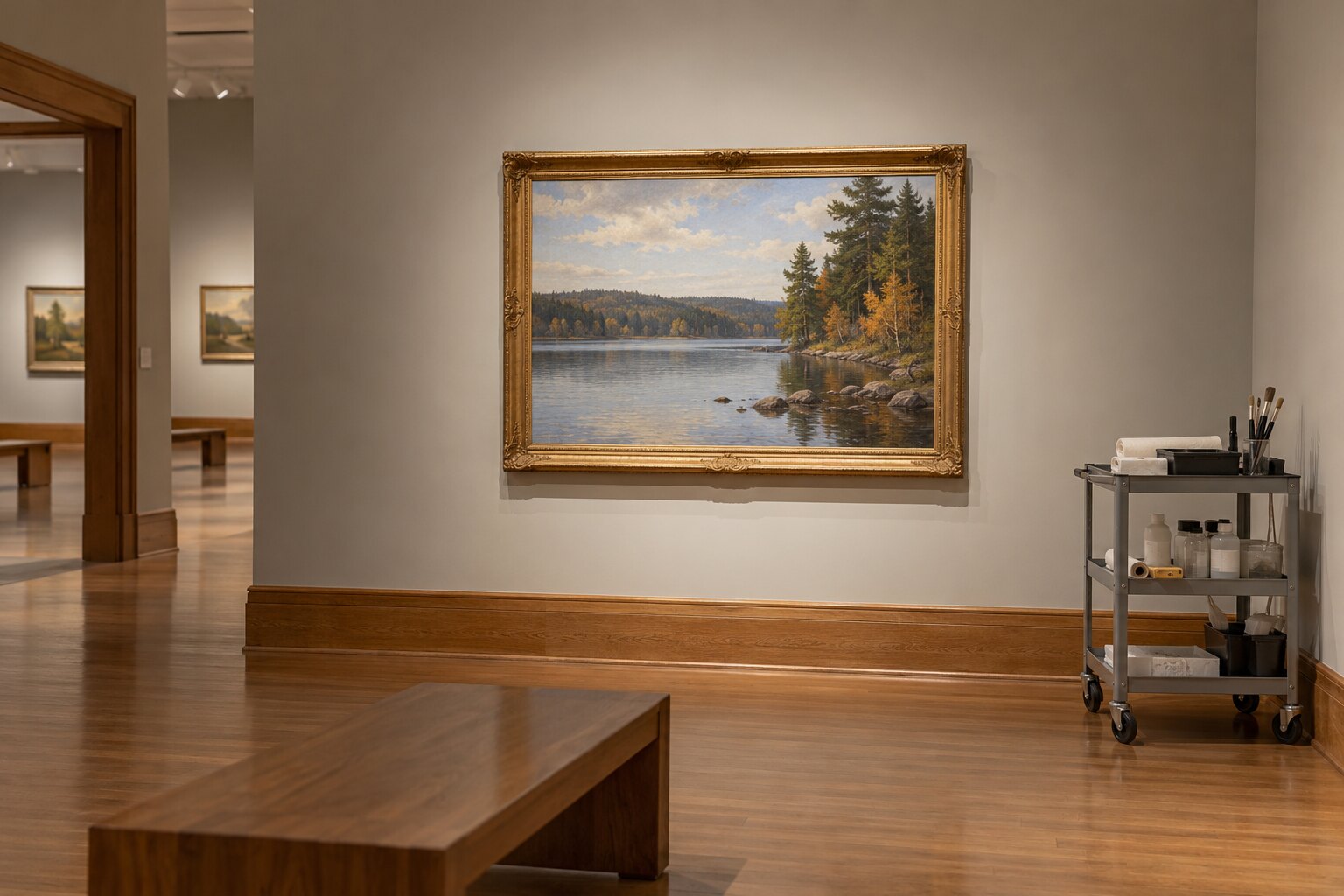
ALDERS, Minnesota — The Alders Regional Museum has removed a 1931 lake landscape from public view after visitors and employees reported changes in the weather shown on its canvas. The painting will remain in climate-controlled storage while a conservator examines its surface and frame. The rest of the north gallery is open during regular hours.
The unsigned oil painting, titled "October Shore," shows a narrow lake, a stand of spruce and a low cabin on the far bank. It has belonged to the museum since a farm estate donated it in 1978. Catalog photographs taken at acquisition show still water beneath a pale afternoon sky, with no figures or boats.
Gallery attendant Marcus Yen noticed rain in the image during a school visit September 17. Thin diagonal marks crossed the lake, and the far shore appeared partly hidden by mist. Yen moved the class to another work because he thought moisture had entered the varnish. When collections manager Ruth Baird arrived 20 minutes later, the sky in the painting was clear.
Baird said glare from track lighting can make old varnish appear clouded or streaked. She adjusted the lights and placed a barrier farther from the wall. Reports continued. Some visitors saw fog, others low sunlight or snow. Two people standing beside one another occasionally described different conditions without disagreeing about the trees, cabin or frame.
The museum began offering cards on which visitors could record what they saw before reading other accounts. Of 63 cards collected over four days, 21 described rain, 14 clear weather, nine snow and six a dark sky with lights in the cabin. The remaining cards mentioned wind, haze or no change. The exercise was ended when repeat visitors began treating it as a test.
Paintings can shift with viewing angle, illumination and the aging of translucent layers, said conservator Leona Pratt, who is advising the museum. Darkened varnish may conceal details that become visible under certain lamps. Pratt said those effects do not cause painted snow to cover and uncover the same branch, but she has not completed microscopy or imaging of the work.
The reports have increased attendance by about 18 percent and created a line in a gallery not designed for crowds. Director Helen Orr said the removal is intended to protect the painting and preserve normal access to neighboring works, not to authenticate the observations. The museum has refunded two guided-tour fees and will not sell reproductions while the review is underway.
Staff photographed the painting at the start and end of each day using the same camera, tripod marks and color card. The digital files agree on the frame and major features but not on the sky. Monday's opening photograph shows high clouds; the closing image shows a narrow band of rain over the western shore. Camera tests made on a printed reproduction did not produce the difference.
Pratt removed the painting Tuesday morning with Baird and Orr present. The reverse carries an old stretcher, patched canvas and one faded freight label. There is no secondary panel, electrical component or opening in the wall behind it. The gallery humidity remained within the museum's normal range throughout the reports.
The painting was wrapped in unbleached paper and placed upright in a locked storage rack. Baird will make a condition map before Pratt takes samples from the varnish. Orr said the work may return with a short label describing the conservation findings, but the museum will not ask visitors to report weather when it is rehung.
Before the paper was closed, Baird recorded the scene as clear with late-afternoon light. Pratt, standing beside her, recorded light snow. Both marked their observations independently. In the accession photograph taken after wrapping, the painting is hidden, but the glass over an empty frame across the storage aisle reflects a white shoreline and falling snow.