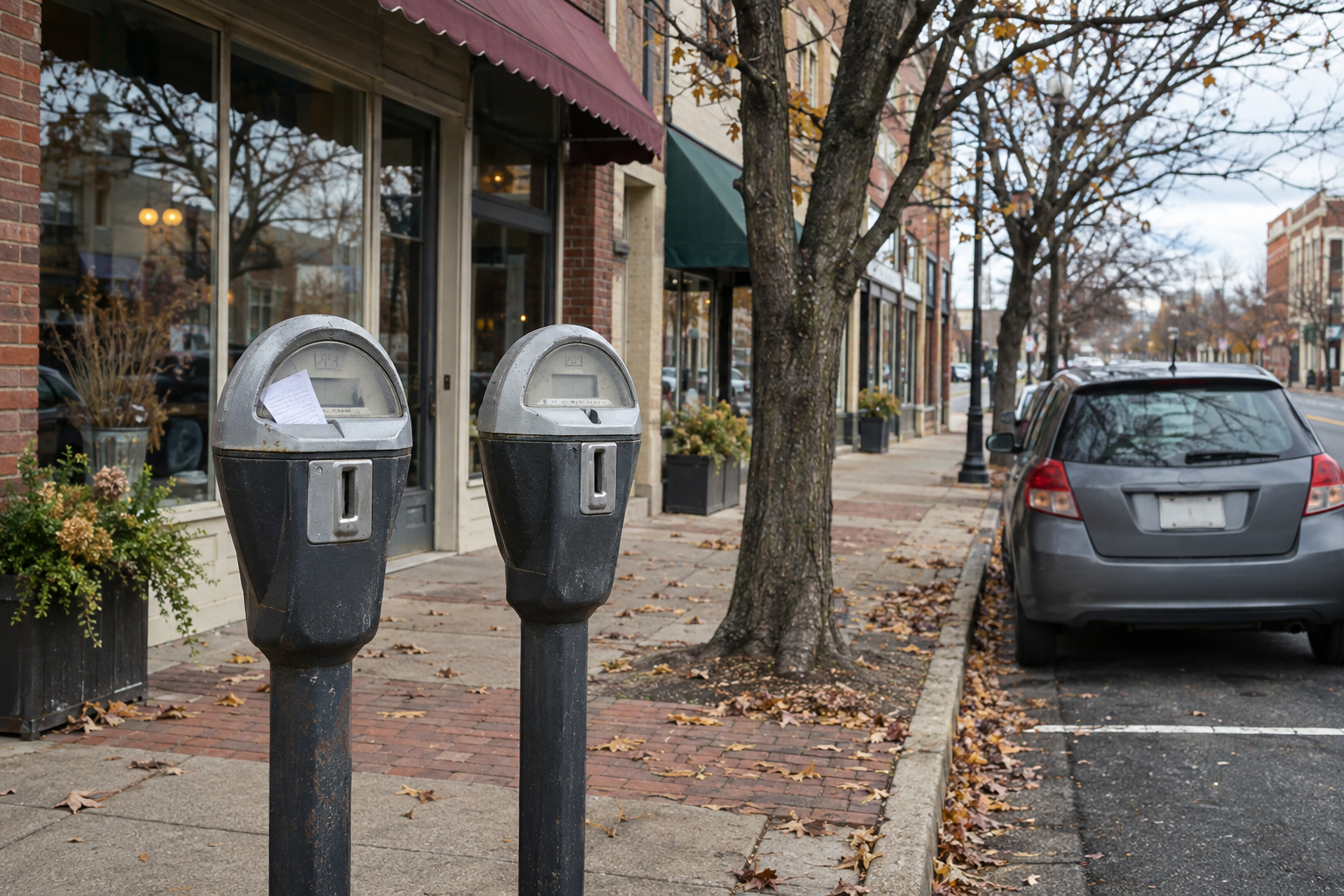
ARDELL, Ohio — The city has covered two downtown parking meters after they began adding time when people said goodbye beside the curb, though no coins, cards or mobile payments were recorded. The added minutes have not produced citations or refunds, and parking remains available elsewhere on the block.
Meters 42 and 43 stand outside a pharmacy and a diner on Clay Street. Pharmacy employee Tessa Orr noticed the first credit Tuesday when she walked a customer to a waiting car after fitting a wrist brace. The meter beside them showed four minutes remaining. As the customer thanked Orr and closed the passenger door, the display increased to 28 minutes.
Orr assumed the driver had paid by phone. The city's transaction log showed no purchase, and the meter's coin box was empty after its Monday collection. During the next two hours, meter 42 added time on three occasions. In each instance, people beside the space were parting: a delivery driver ending a conversation, two students leaving in separate cars and a diner patron sending her sister home with leftovers.
The amounts varied from seven to 53 minutes. They did not correspond to spoken words, the length of a conversation or the time already displayed. The clock sometimes advanced while a vehicle was present and once after both people had stepped onto the sidewalk. Ordinary arrivals, payments and greetings produced no change beyond purchased time.
Parking supervisor Mina Cole disabled enforcement at both spaces and placed paper covers over the payment slots. The city did not ask residents to repeat private conversations for testing. Cole said the purpose of the review is to prevent uneven enforcement, not determine whether a particular farewell was sincere enough to move a clock.
Electronic meters may retain delayed transactions when a wireless connection is weak, said Leon Marr, a technician who examined the units Thursday. A stuck button or moisture behind a display can also make numbers appear to change. Marr replaced both batteries, checked the cellular records and found the internal clock within one second of the city server. Delayed payments would still create transaction entries, he said.
The unexplained credits have had small public effects. A home-health worker found 41 free minutes after helping a patient into a family member's car and used the time to complete notes in private. A courier left early rather than accept time he had not purchased. Two motorists moved their vehicles after onlookers gathered, and the diner asked customers not to wait at the curb for a display change.
A city employee watched the meters for a two-hour period Thursday while the covers remained in place. Meter 42 stayed at zero through deliveries, lunch traffic and a couple's argument beside a parked truck. It added 18 minutes when the truck passenger returned to say she had left her gloves, then stood with the driver until both stopped speaking.
The couple did not leave. They went back into the diner together, and the credited time drained normally while the truck remained. Meter 43 then added nine minutes beside an empty space when an older man across the street waved to a departing bus. The man said he did not know anyone aboard and had raised his hand because a child waved first.
Cole removed both meter heads Friday morning and stored them on separate shelves in the municipal garage. Their curbside posts remain covered. On the workbench, meter 42 displayed zero while meter 43 continued counting down the last nine minutes, although its battery had been disconnected and its screen should have been blank.
When the countdown ended, the two dark displays lit together for one second. Meter 42 showed 00:01 and meter 43 showed 00:00. The first minute has remained on meter 42 through two battery removals. Its transaction printer produced a blank receipt with a clean fold down the middle, as if it had been kept for someone leaving in two directions.