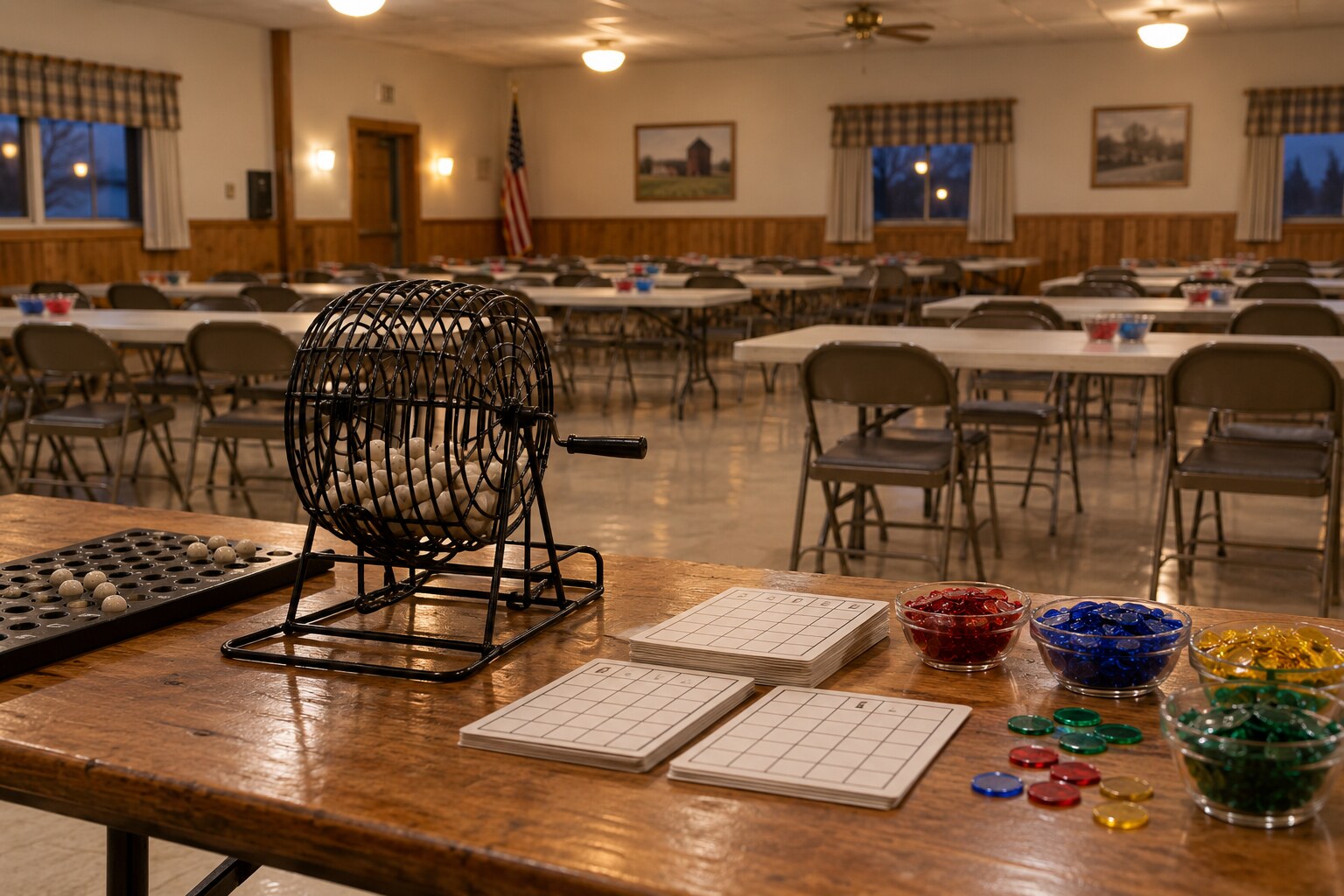
ASHBY GROVE, North Dakota — The Ashby Grove Community Hall has paused its monthly bingo game after players repeatedly announced numbers before balls were removed from the manual cage. Organizers refunded Friday's $10 admission and postponed a $480 jackpot until the equipment and game procedure can be reviewed.
The game raises money for roof repairs and the hall's winter heating bill. Seventy-five numbered balls are loaded into a wire cage that is turned by hand. Caller Marlene Doss opens a small gate, reads the ball that drops into a tray and places it on a numbered board visible to the room.
The first early call occurred during the third game, when Richard Pelham said 'B-14' as Doss reached for the crank. That number fell into the tray several seconds later. Players laughed, and Pelham said he had guessed because B numbers had not appeared recently. He received no advantage because B-14 was not on his card.
Four balls later, three players called G-52 together before Doss touched the cage. By the next game, early calls came from different tables and sometimes from more than a dozen people. They were not always loud or confident. Several players said the number under their breath and appeared surprised when others spoke with them.
Hall treasurer Annika Rowe stopped the game after 17 correct early calls. Two incorrect predictions had also been made. She asked players to leave their cards on the tables while volunteers counted cash and inspected the equipment. No winner had claimed a prize during the disputed sequence.
The cage, balls and board were purchased from a church group in 2019 and have been used at 36 games. Volunteers found no magnet, marking or duplicate ball. The cage was moved to a rear table, covered with a dish towel and turned by a different caller while players faced the opposite wall.
During that test, eight people called O-68 before the ball was shown. They included Pelham, two teenagers selling refreshments and a visitor who said she did not know bingo notation. Each described the number as briefly obvious rather than heard or seen. None could say what the following ball would be once the cage stopped turning.
Chance and expectation can produce striking clusters in a room where everyone is choosing from the same limited set, said North Plains College mathematics instructor Harlan Seo. Players may also react to a caller's posture, the sound of balls or one another's first syllables. Seo said he could not estimate the sequence without a recording and the complete order of draws.
The interruption ended the evening about 40 minutes early. Volunteers returned admission at the door and allowed the food table to continue. Rowe said the postponed jackpot will be honored at a later game, but organizers may use sealed paper draws or a digital caller if the hall board agrees. The roof fund remains about $1,700 short of its goal.
Most players left without complaint, though several asked volunteers to keep the original ball order intact. Rowe declined because the game had not been conducted under a planned test. She placed all balls back in the cage, locked its gate with a small clip and stored it in the hall office pending Monday's board meeting.
Through the cage wire, the balls settled at the bottom after it was set on the shelf. One remained held against the upper gate without touching the others. It was N-31, the number several players had begun to call when Rowe stopped the final test. The ball had not entered the tray and was not recorded on any game sheet.