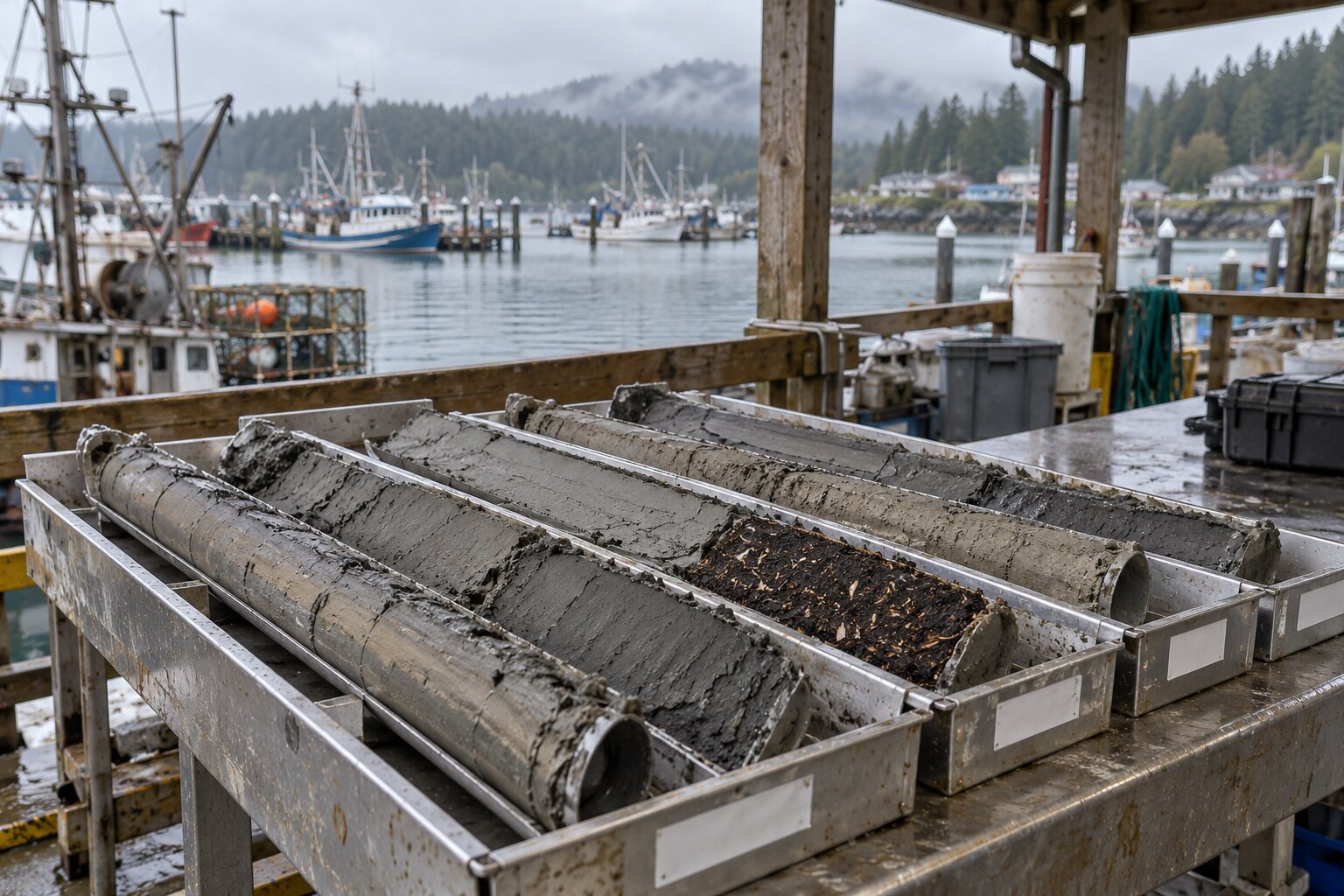
BRACKEN INLET, Oregon — The Bracken Inlet Port has paused maintenance dredging at its west berth after three sediment cores taken from the harbor floor contained fresh forest soil, living earthworms and intact seeds beneath several feet of ordinary marine mud. The finding has delayed one fishing vessel's return to the berth but has not closed the harbor.
The port removes accumulated sand and silt from the berth every four to six years so vessels can remain afloat at low tide. Contractor Northbar Dredging began preliminary sampling Friday at locations approved in the port's permit. The upper sections contained gray silt, shell fragments and the expected odor of low-oxygen sediment.
At depths between 11 and 14 feet below the harbor floor, each aluminum core barrel passed through a band of dark, loose soil. Port engineer Sela Wirth said the material looked newly turned rather than compressed. Fine roots crossed the cores without flattening, and several pink earthworms moved when technicians opened the liners on deck.
The worms remained active in a covered tray for more than a day. Botanist Kerin Cho identified the soil's visible seeds as alder, sorrel and one type of violet found in damp inland clearings. None showed salt damage. Tiny green leaves attached to two root fragments had not wilted, though the sample site lies under about 18 feet of brackish water at high tide.
Contamination can occur if a core barrel passes through material on deck or if fill from shore was placed during past construction, state geologist Mara Noll said after reviewing photographs and chain-of-custody notes. The living layer was sealed between undisturbed bands containing clam shells and marine worms, she said. Port records document rock and sand fill at the west berth but no imported topsoil.
The affected berth serves the trawler Nita Roe and two seasonal crab boats. Harbor manager Ellis Pave moved the Nita Roe to a visitor float and waived moorage charges while sampling continues. The change leaves less room for deliveries at low tide, and a fuel truck scheduled for Wednesday will use the north apron instead.
Crews collected two additional cores Saturday from opposite sides of the berth. One struck ordinary sand and clay. The other entered the same dark layer and brought up a section containing a thumb-thick root with moist bark. Growth rings were visible where it broke. Cho said the root was alive but could not identify a nearby tree from which it might have come.
Divers inspected the seabed around the sampling holes during slack water. Their video shows level mud, eelgrass at the berth edge and no exposed timber or pipe. One diver pushed a probe into the bottom and reported resistance at the depth of the dark layer. He also reported the smell of wet leaves inside his full-face mask, which receives air from a clean surface compressor.
Samples were divided between a university laboratory and the port's environmental consultant. A salinity test of water squeezed from the forest layer measured close to fresh water, while water immediately above and below it was brackish. The port will not dispose of dredged material or resume excavation until regulators determine whether the layer requires a different handling plan.
The worms were transferred to a ventilated container of the recovered soil. They avoided the surface and gathered along one side even when the container was rotated away from the harbor. Overnight they formed straight, parallel tunnels that ended against the plastic wall. Each tunnel pointed west, toward open water rather than the nearest land.
A capped core kept in the port office developed condensation Monday despite stable room temperature. By morning, pale root tips had pressed through the rubber seal around the upper cap. Staff turned the tube upright and placed it by a window. The roots bent away from daylight and continued downward through the label identifying the sample depth.