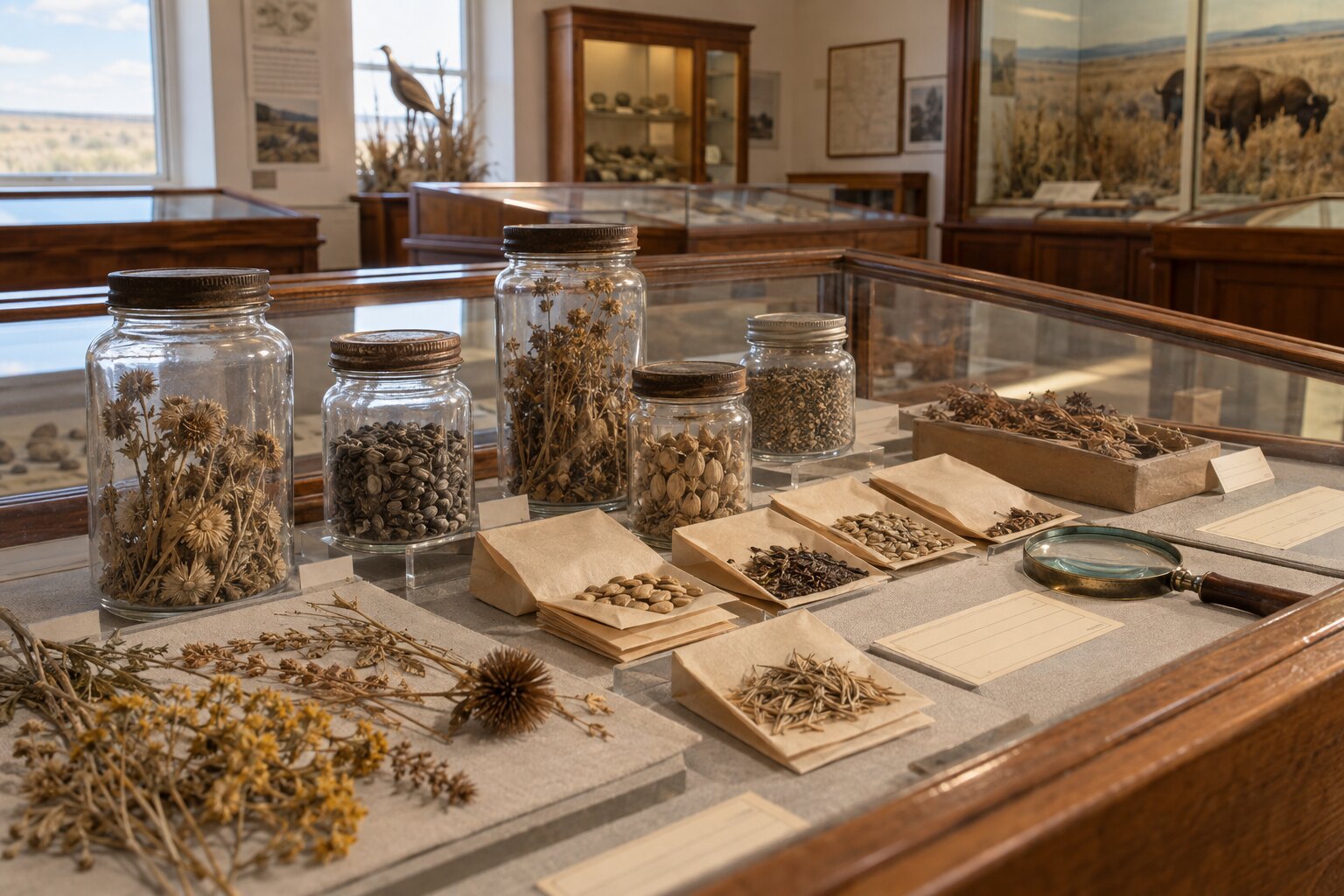
BRINDLE, North Dakota — The Prairie County Museum has closed its natural-history room while conservators examine seedlings growing inside four sealed specimen jars. The room will remain unavailable through the weekend. No other galleries are affected, and the museum's harvest lecture will move to the community hall.
The jars belong to a collection assembled between 1906 and 1913 by farm families who supplied seed samples for county fairs. Each contains dry grain, grass or garden seed and is closed with a waxed metal lid. Museum director Ruth Halden said the jars were last opened during a cataloging project in 1984 and have been displayed in the same glass case since 2009.
A volunteer noticed a pale shoot inside a jar of flax on Saturday. By Monday, shoots had appeared among wheat, sweet pea and an unidentified grass. The plants are small, with stems between one and three inches. Condensation is visible inside two jars even though temperature records show no leak or extended rise in humidity.
Halden asked the public not to treat the display as a source of viable heritage seed. Old collections can carry mold, insects or chemical preservatives, and opening a jar could damage both the contents and its paper label. The museum has contacted a conservator in Bismarck and a plant physiologist at a state university; neither had visited as of Wednesday.
Photographs taken through the case show the wax seals intact. Building custodian Mark Tolle found no water above the display and no gap around the case. A sprinkler line passes through the adjoining room but has not discharged. The museum's humidity monitor recorded 42 to 47 percent during the week, within its normal range.
The apparent growth has drawn particular attention from descendants of the donors. The sweet pea jar bears the name of Etta Solberg, who kept a large kitchen garden east of Brindle before her family left during the drought years. Her granddaughter, Alice Mork, said the emerging leaves resemble the vines her mother continued to grow from saved seed, though she acknowledged that young pea plants generally look alike.
Mork visited before the room closed and stood near the case for several minutes. She said she could smell the flowers her family called evening peas, despite there being no open bloom in the jar. Halden and two volunteers reported no odor. Mork did not ask for the specimen to be opened and said she preferred that the museum keep it whole.
The grass sample has no donor name. Its accession card identifies it only as 'low pasture, north quarter.' County agricultural agent Peter Orr said the first leaves are too immature for identification. He noted that seeds can remain dormant for decades under exceptional conditions, but germination requires moisture and usually leaves visible swelling or split hulls. Several unsprouted seeds in the jar remain loose and dry.
On Tuesday, staff darkened the case and placed a camera outside it to document change without moving the jars. The flax shoot added nearly half an inch overnight. The wheat produced a second leaf. Time-lapse images show the stems lowering at intervals when the room is empty, then returning upright before the motion light at the doorway activates.
The museum board authorized up to $1,600 for transport and examination. Conservators will first build padded carriers and photograph each seal. If mold appears, the jars may be isolated rather than opened. Halden said the goal is to preserve the collection and its labels, even if that means allowing the growth to exhaust whatever remains inside.
Staff moved the four jars to a locked workroom Wednesday afternoon. The empty display case was cleaned and covered with brown paper. On Thursday morning, a row of fresh green tips was visible beneath the paper along the case's bare felt lining. Halden left the cover in place and added the case itself to the conservator's pickup list.