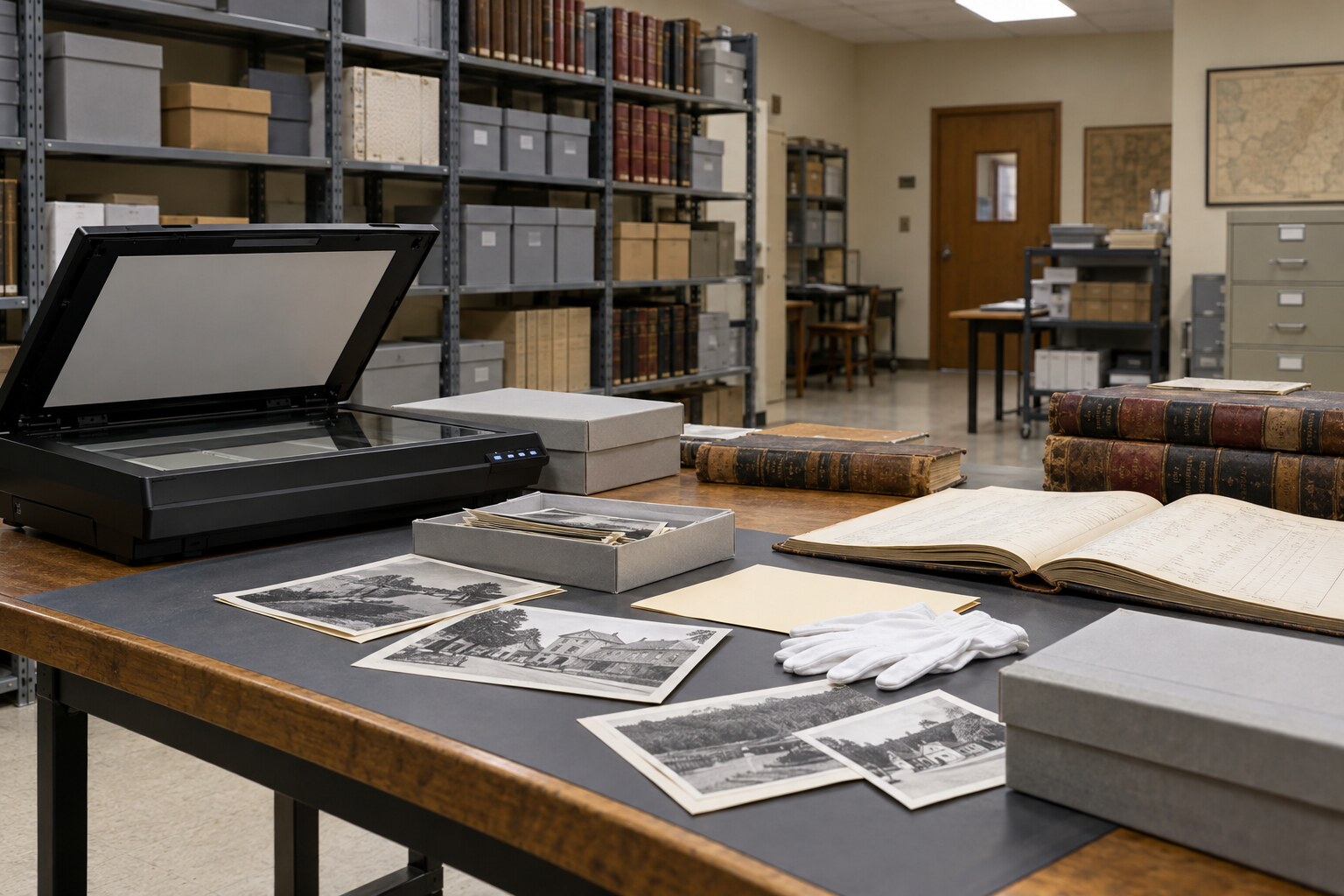
MARDEN, West Virginia — Calder County has paused a project to scan early property-assessment books after workers found loose photographs that appear to show current residents and county employees inside buildings as they looked decades ago. The images have been removed from public handling while the county develops a process for identifying the people shown.
The $38,000 project covers 47 bound ledgers dated from 1911 through 1936. Records clerk Dana Lyle said each volume was inspected page by page before scanning began in September. Staff noted tax stamps, receipts and two pressed leaves, but no photographs. The first print appeared Tuesday beneath a page listing mineral parcels in the eastern district.
That photograph shows six adults beside the courthouse's former coal room, which was converted to storage in 1954. One is county mapping technician Rhoda Penn, wearing the blue cardigan and narrow silver watch she had on Tuesday. Penn, 32, said she has never entered the sealed room. The print has rounded corners and a paper stock used by a Marden studio that closed in 1931.
Four more photographs were found as scanning continued. In one, retired school custodian Leon Hurst sits among children at a 1924 tax sale. Hurst recognized a pale scar across his left thumb and the repaired collar of a jacket he still owns. The figure appears to be about 10 years old. Hurst was born in 1958 and said neither of his parents had relatives in Calder County at the time.
The images are not tucked at consistent entries. Two were lying at the fold when a volume was opened; another rested flat between pages whose deckled edges were still joined at the top. Lyle said staff did not cut the pages. A fourth photograph slid from beneath a pasted ownership map after the book had been closed overnight in an archival cradle.
County Commission President Emmett Voss ordered the work stopped Thursday because the photographs may contain personal information unrelated to the tax records. The ledgers remain available by appointment, but readers will receive a staff copy rather than handle the originals. A state digitization grant allows a 60-day delay without penalty, Voss said.
Photograph conservator Alina Gant examined the prints without removing samples. She described them as gelatin silver photographs with ordinary abrasion, oxidation and edge wear. Their backs carry pencil numbers corresponding to ledger pages, though the writing sits beneath surface grime rather than on top of it. Gant said paper and chemical dating can establish a range, not explain the subjects.
The county contacted 11 people or families whose likenesses staff believed they recognized. Seven agreed to look at copies. Some disputed the identifications, citing period clothing and the limits of small faces. Others pointed to details that would not appear in county files, including a missing fingertip, a wedding ring worn on the right hand and a child's habit of tucking one shoelace inside her sock.
Marden resident Celia Orr identified herself in a photograph of the former courthouse kitchen, although the image depicts her at roughly her current age. A younger woman at the stove resembles Orr's mother, who died in 2009. Orr said the room's checked floor and iron sink matched a description her mother once gave but that she had never seen either the room or a photograph of it.
The clerk's office is assigning each print a temporary number and storing it apart from the ledger in which it appeared. Copies will not be placed online with the tax pages. Anyone identified will be offered a private viewing and may submit a written correction without accepting that the resemblance is accurate, Lyle said.
On Friday, staff opened an unscanned 1917 volume to verify its condition in front of the commission's attorney. No loose material was visible. When Lyle lifted the book from its cradle, a narrow contact sheet lay beneath it, holding 12 frames of the records room from above. Eleven show empty tables. In the last, Lyle is seated at the scanner with the 1917 book open and the attorney standing behind her. Both were still across the room when the sheet was found.