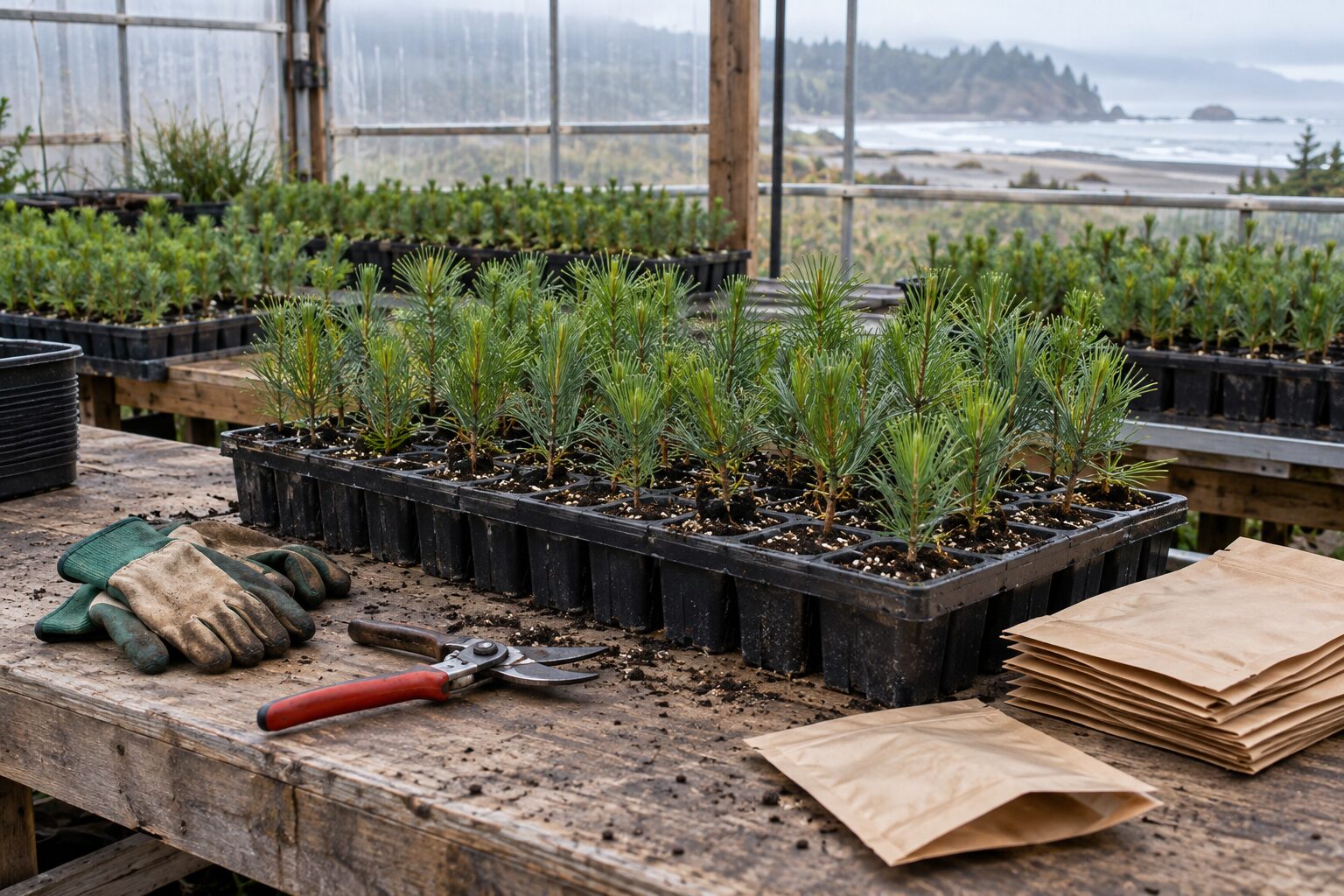
CAPE AUBURN, Oregon — A coastal restoration nursery has paused handling of 480 shore-pine seedlings after three employees developed small green growths at the sites of ordinary work splinters. The plants have been moved to a separate greenhouse bay, and next month's dune planting will use stock from another nursery, project managers said.
The Cape Auburn Native Plant Center raises trees and grasses for public and nonprofit restoration projects along the southern coast. Workers sort shore-pine plugs by root condition, remove dead needles and transfer the seedlings into larger containers. Gloves are required for potting, though short needles can enter at the cuff or through worn fabric.
Seasonal technician Rosa Ibarra reported the first injury September 21 after a needle entered the side of her left index finger. She removed it with tweezers, washed the area and covered it. Four days later, after the puncture had closed, a flexible green point appeared beneath the surface along the same angle as the splinter.
Ibarra said she initially believed a fragment remained in the wound. At a local clinic, physician Aaron Beck made a shallow incision and removed a structure slightly longer than half an inch. Beck described it as soft plant material surrounded by clear gel rather than a retained wooden splinter. Ibarra returned to work with the finger bandaged and has had no fever or loss of movement.
Two coworkers then disclosed similar growths on a thumb and forearm. Both had handled the same seedling lot, identified by the nursery as batch SP-26-14. One worker's skin contained a cluster of four pale needles joined at a single point. The other had a flat green scale under an old scratch that had not involved a known splinter.
Beck sent the removed material to Cascadia Botanical Institute, a regional laboratory used by the nursery for plant-disease screening. Preliminary microscopy found cells consistent with young conifer tissue, according to lab director Mira Shah. She said the samples lacked roots and the organized vascular connection a growing plant would need, and she could not say whether the material originated in the seedlings.
Plant-center director Nolen Price said workers had reported no unusual sap, mold or insects on the batch. The seedlings were propagated from locally collected seed and had grown at expected rates. Their roots and needles appear ordinary beside unaffected stock. Price said the hold is a workplace precaution, not a finding that the trees caused the complaints.
The center sanitized its tools, replaced work gloves and asked eight employees who handled the batch to check existing cuts without opening or probing them. No additional growths were found. The three affected workers were offered follow-up appointments, and tasks involving needles have been reassigned while the review continues.
The delay will require a shoreline association to substitute 300 shore pines from an inland supplier. The change adds about $1,900 in transport costs and may move the planting back one week. Dune grass and willow work will continue on schedule. Price said no seedlings from the held batch were sold to the public.
On Monday, nursery staff placed six trees from batch SP-26-14 in sealed sleeves and six control trees on the same bench. By Tuesday morning, fine roots from five held trees had grown upward through the soil and rested against the inside of the sleeves. The control roots remained below the surface. Moisture and temperature were the same across both groups.
Shah retained the material removed from Ibarra's finger in sterile saline for further examination. It has remained green without soil or added nutrients. Each morning, the loose needles are found pressed against the side of the vial nearest the greenhouse, though the vial is stored in a closed cabinet and is returned to the center of its rack after every inspection.