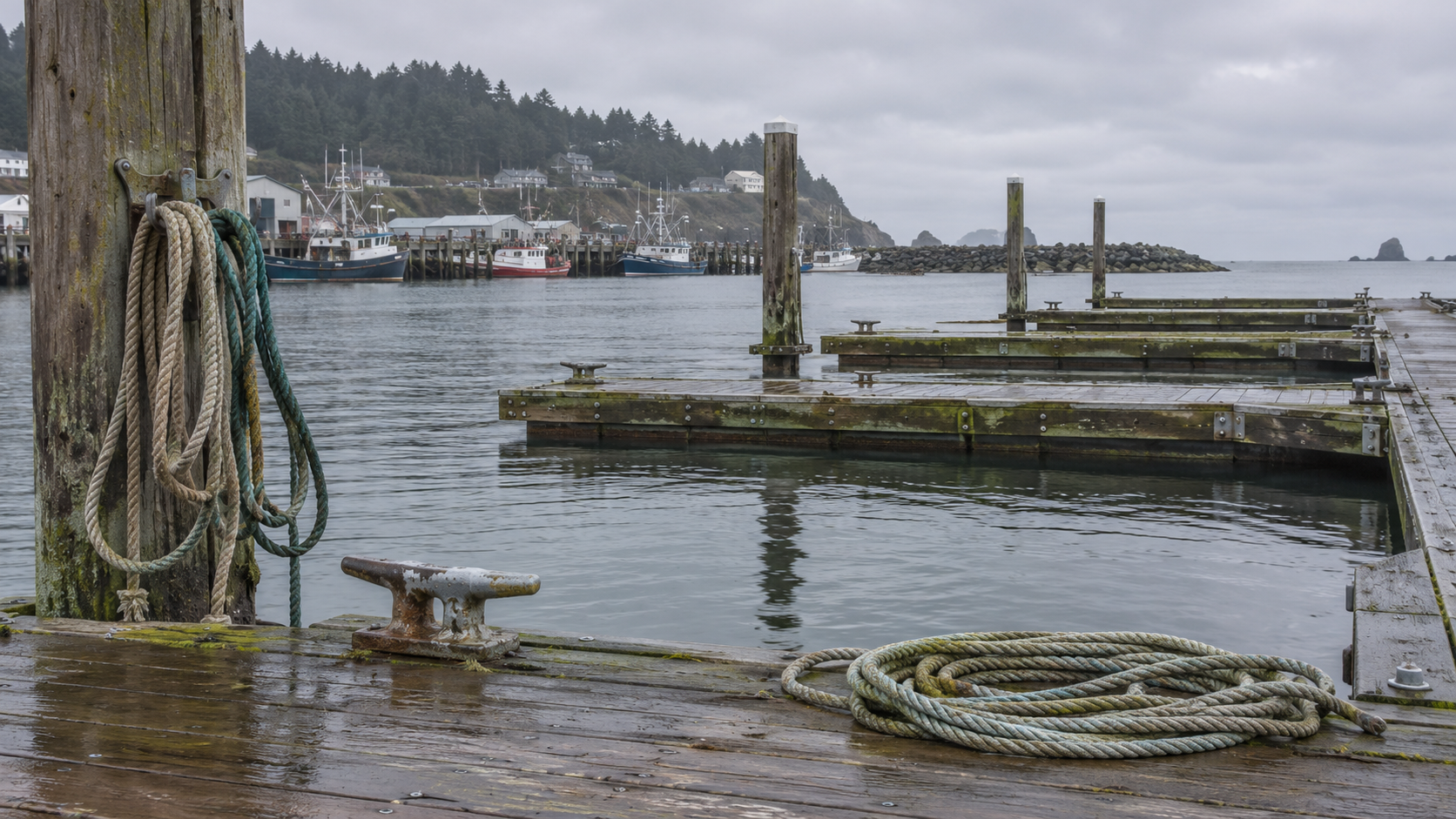
CAPE ROWAN, Oregon — The port district has assigned an overnight dock watch after mooring lines in three empty slips pulled tight against their cleats several hours before the fishing boats assigned to those berths returned. No one was struck by a line, but one cleat loosened and the district has closed that section of dock for repair.
The first line moved shortly after 2 p.m. Wednesday at slip 14, where the troller Mavis Anne had been working 11 miles offshore since dawn. Harbor attendant Len Orr said a bow line left coiled on the float unrolled, passed through the open water of the slip and drew taut toward the entrance channel. Its free end remained dry and was not attached to a boat, piling or submerged object.
Orr cleared pedestrians and cut the line after it began humming against the cleat. The section extending over the water dropped at once, although nothing surfaced beneath it. At 5:37 p.m., the Mavis Anne entered the channel. Its deckhand radioed that the vessel had lost a bow line while hauling gear that morning. The cut line on the dock was the same diameter and blue-flecked braid, but the boat's missing line was later found tangled in its own net drum.
Two more empty slips behaved similarly Thursday. Lines at slips 8 and 21 took strain in different directions, then slackened as the assigned boats rounded the breakwater. One pulled east across a neighboring berth while its vessel approached from the west. Neither line was long enough to reach the channel, and both free ends remained looped neatly on the float after the strain ended.
Port manager Nessa Cole moved incoming boats to the fuel dock and asked crews not to step between a line and its cleat. The district removed loose cordage from nine vacant slips, photographed fastening points and placed temporary barriers along the outer float. Crab deliveries continued at the main pier, though two crews waited nearly an hour for substitute berths.
Synthetic mooring line can stiffen, twist or creep after repeated loading, said Mara Pell, a marine surveyor who inspected the dock. A submerged branch or seal could pull a loose end into current, and changing tide can make an anchored float shift against its fittings. Pell said those causes would leave a wet or fouled end and would not ordinarily place sustained load on a line coiled entirely above water.
The lines did not match vessel movements exactly. A stern line at slip 21 tightened at 9:12 a.m., while the assigned seiner did not leave its grounds until noon. Its captain changed course twice for weather and arrived at 4:46. The line remained under steady tension through those changes, then went slack when the boat crossed between the harbor lights.
Crews have treated the condition as a rigging hazard rather than a forecast. Cole said captains must still radio their position and cannot rely on the dock to indicate an arrival. The district's insurer asked that affected rope be retained, but did not recommend loading it again. Each removed line has been bagged separately with its cleat number.
At Thursday's night watch, attendant Iva Marr found one bag leaning hard against the locked cabinet door. Inside, a 30-foot line had drawn itself into a straight doubled length despite being placed in a loose coil. The sealed bag was stretched smooth around it. Marr cut the bag open rather than try to push the rope back through the cabinet slot.
The line came from slip 6, assigned until last winter to the Florence Bell. Port records show the wooden vessel was dismantled after a machinery fire and its berth has not been reassigned. Its former owner, Cal Venn, said he kept no replacement boat and had not been on the water that week.
Shortly before dawn Friday, the line from slip 6 took strain across the inspection table, pulling one end against a wall hook and the other toward the closed harbor office door. Marr removed the hook before it tore free. The line then remained straight on the floor, pointing through the door and the empty slip beyond it toward the dark entrance channel. No vessel appeared before the watch ended.