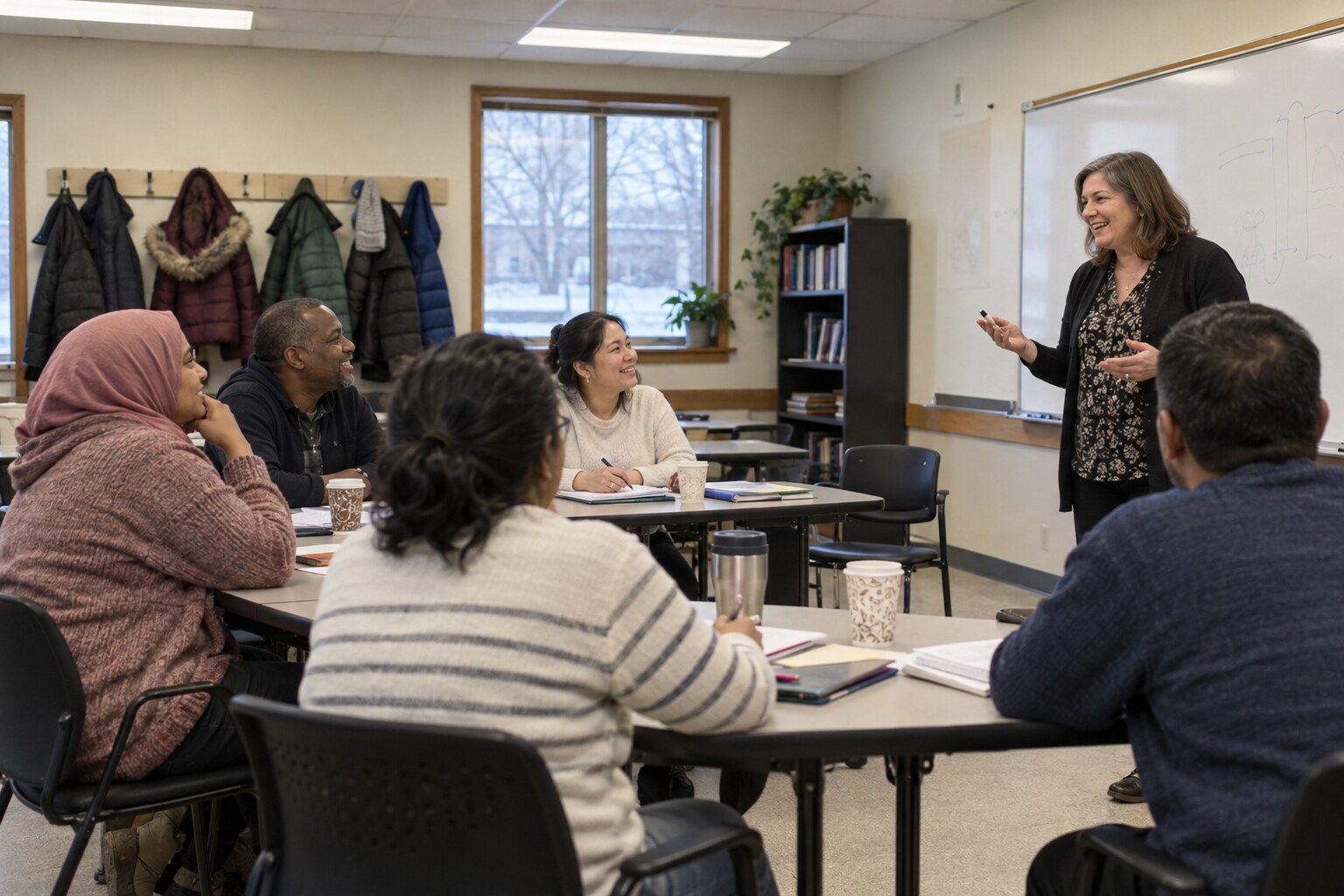
ELYARD, Minnesota — The city adult school has paused one conversation lab after learners with six different first languages began using unfamiliar words that classmates understood but classroom microphones did not capture. Regular English courses continue, and the school has moved practice groups from the basement lab to a larger classroom upstairs.
The Monday evening lab enrolled 14 adults preparing for workplace interviews, parent conferences and citizenship classes. Instructor Lena Creel asked the group to describe situations for which they did not know a concise English phrase. The exercise ordinarily produces gestures, examples and questions about idiom.
Student Mara Pell was describing the relief of finding another person awake in a house late at night when she used a short word no one could place. Classmates later wrote the sound in seven different ways, including spellings that did not share a consonant. All 13 said they understood the same meaning before Creel offered an explanation.
The group used eight additional terms during the next 20 minutes. One meant returning a borrowed object after the owner has died. Another described saving a small task because a particular person always did it better. Speakers said the words felt available but not familiar, and none associated them with a language they had studied or heard at home.
Creel ended the exercise after a term spoken by one student caused the class to close notebooks and sit quietly. Participants agreed it meant that a conversation had been completed but that leaving would be unkind. The silence lasted about two minutes. No one reported feeling ordered or unable to move.
The lab records practice sessions so students can review pronunciation. In the audio, ordinary English and the students' known languages are clear. Each disputed word is replaced by a breath, a chair movement or room tone lasting less than a second. Video shows the speakers' mouths moving, and classmates begin responding before the following English sentence.
People can infer highly specific meanings from gesture, shared context and one another's reactions, said Irena Voss, a linguistics lecturer who reviewed the recording with permission from the class. Groups also invent efficient vocabulary when existing words feel inadequate. Voss said that process would not normally make unrelated sounds feel identical in meaning or disappear selectively from two separate microphones.
School director Tomas Bell said the pause is meant to protect students from becoming a public demonstration. Staff declined requests from visitors who wanted to sit in on a session or ask learners for words about grief, marriage and work. Tuition, attendance credit and access to tutoring are unchanged.
Several participants want the lab reopened. Pell said the new terms made difficult experiences easier to discuss, but she did not want them treated as translations or assigned to anyone's culture. The class agreed not to publish phonetic lists because its members could not agree on what sounds had been made.
Creel erased the whiteboard, collected the room's two memory cards and moved the class materials upstairs. Custodian Orrin Vale cleaned the basement lab after midnight. He had not attended the session and had not heard the disputed terms, according to the school.
On Tuesday morning, Vale left a blank index card on Creel's desk with the classroom key. Three students arriving separately picked up the card, read its empty face and placed it beside the attendance sheet without asking about it. Each later said the card meant the same thing: the room is ready, but whoever was there has not gone.