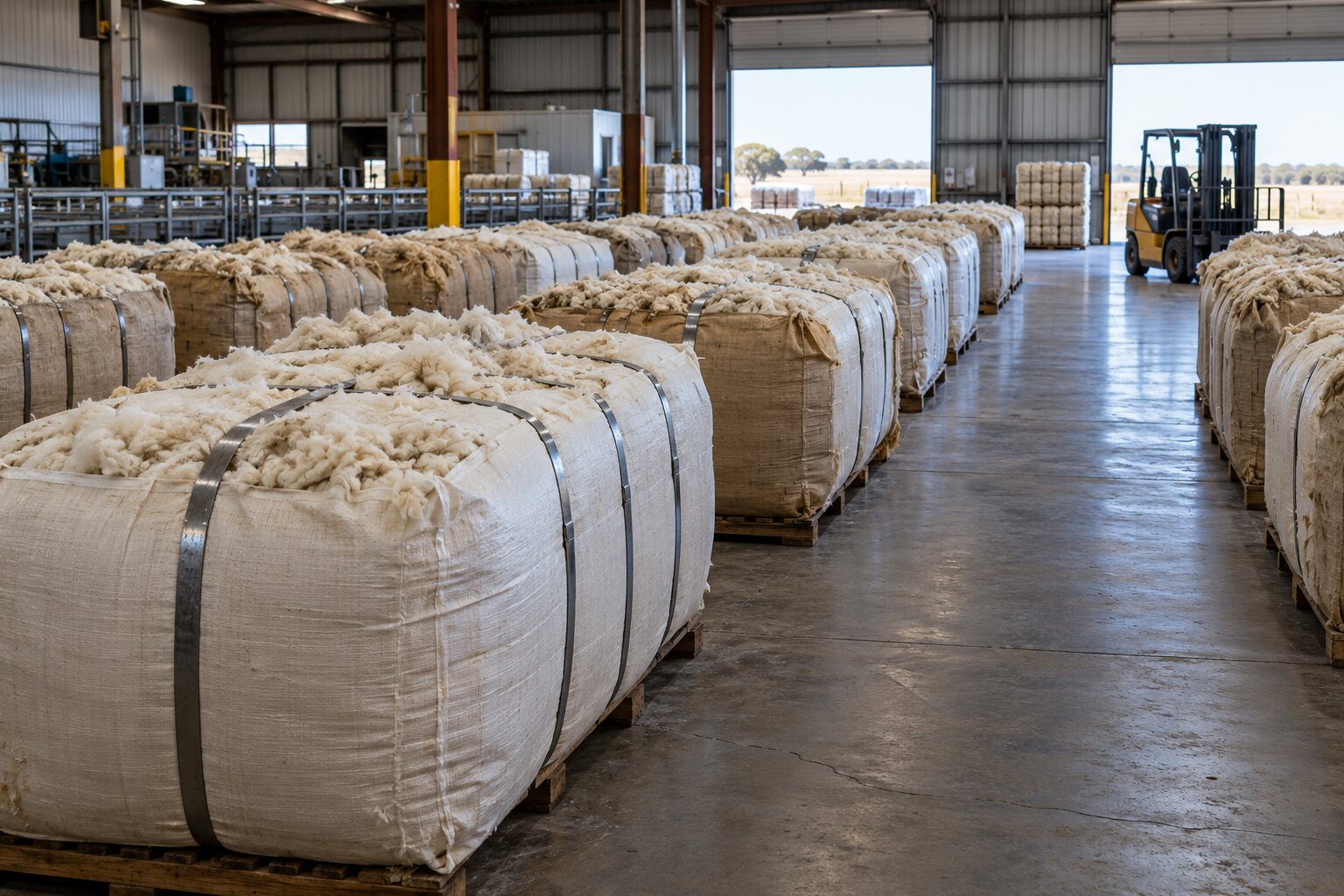
GANNET, Nebraska — A regional wool cooperative is holding 18 compressed bales after workers observed the wrapped lots expanding and contracting at regular intervals in a manner several described as breathing. Buyers have agreed to delay pickup while the warehouse checks moisture, compression and contamination.
Platte Divide Wool grades and consolidates fleeces from 27 ranches before selling them to mills. The affected bales contain about 8,400 pounds of skirted wool delivered over six days. Each was pressed to standard dimensions, bound with steel wire and wrapped in woven plastic carrying the producer and lot numbers.
Forklift operator Len Orr noticed the movement Saturday while counting rows before closing. A bale near the center aisle lifted its upper surface by about two inches, held for several seconds and settled. Neighboring bales followed at slightly different times until the stack was moving in a slow sequence from the loading door toward the rear wall.
Orr and supervisor Maris Teel cleared the aisle because shifting compressed loads can break wires or overturn a stack. They removed the first six bales with a forklift and placed them separately on the floor. The movement continued after separation. Teel counted between nine and 12 expansions a minute, with longer pauses when doors opened and cold air entered.
Wool can retain heat and moisture, especially if fleeces are baled before they are fully dry, said Corin Ames, an independent fiber grader who visited Sunday. Fermentation and trapped air may swell a package and create a fire risk. Those processes ordinarily produce sustained pressure or irregular settling, not repeated expansion followed by a return to the same dimensions, Ames said.
The cooperative shut off heaters, increased ventilation and used thermal cameras to check the lots. Internal probes showed temperatures between 58 and 64 degrees, close to the warehouse air. Oxygen and carbon monoxide readings remained normal. None of the wrappers showed scorching, liquid or unusual odor, and the steel ties stayed within their rated tension.
The hold postponed two truckloads bound for a carpet mill in Iowa. Cooperative manager Saul Venn said storage and rescheduling costs will be absorbed by the cooperative rather than deducted from ranchers' checks. Unaffected spring wool kept in another building remains available for sale, and no livestock or raw hides are stored at the site.
Workers opened one moving bale outdoors Monday under the supervision of the grader. The fleece inside was dry, clean and compacted in ordinary layers. Its movement stopped as the outer wires were cut, then resumed in smaller sections on the sorting table. Loose locks lifted together and settled without a visible draft, drawing fine dust inward along their edges.
Ames found no lung tissue, animal remains or insects in the opened wool. Samples sent to a university laboratory were identified as sheep fiber with routine plant debris and lanolin. The ranch that supplied the lot reported no missing animals or illness and said its fleeces had been stored in an open shed before delivery.
The remaining bales were moved into single rows with clearance around each lot. Employees now record the cycles at the start and end of every shift but do not remain between the stacks. Teel said the pace slows when someone places a hand on a wrapper and returns after contact ends. She has asked workers not to repeat that test.
On Tuesday morning, condensation appeared inside the clear window of one otherwise dry wrapper. It formed a round patch, faded and returned with every expansion. A fiber sample taped over the window moved outward at the same moment, although the plastic between the wool and the sample did not visibly flex.