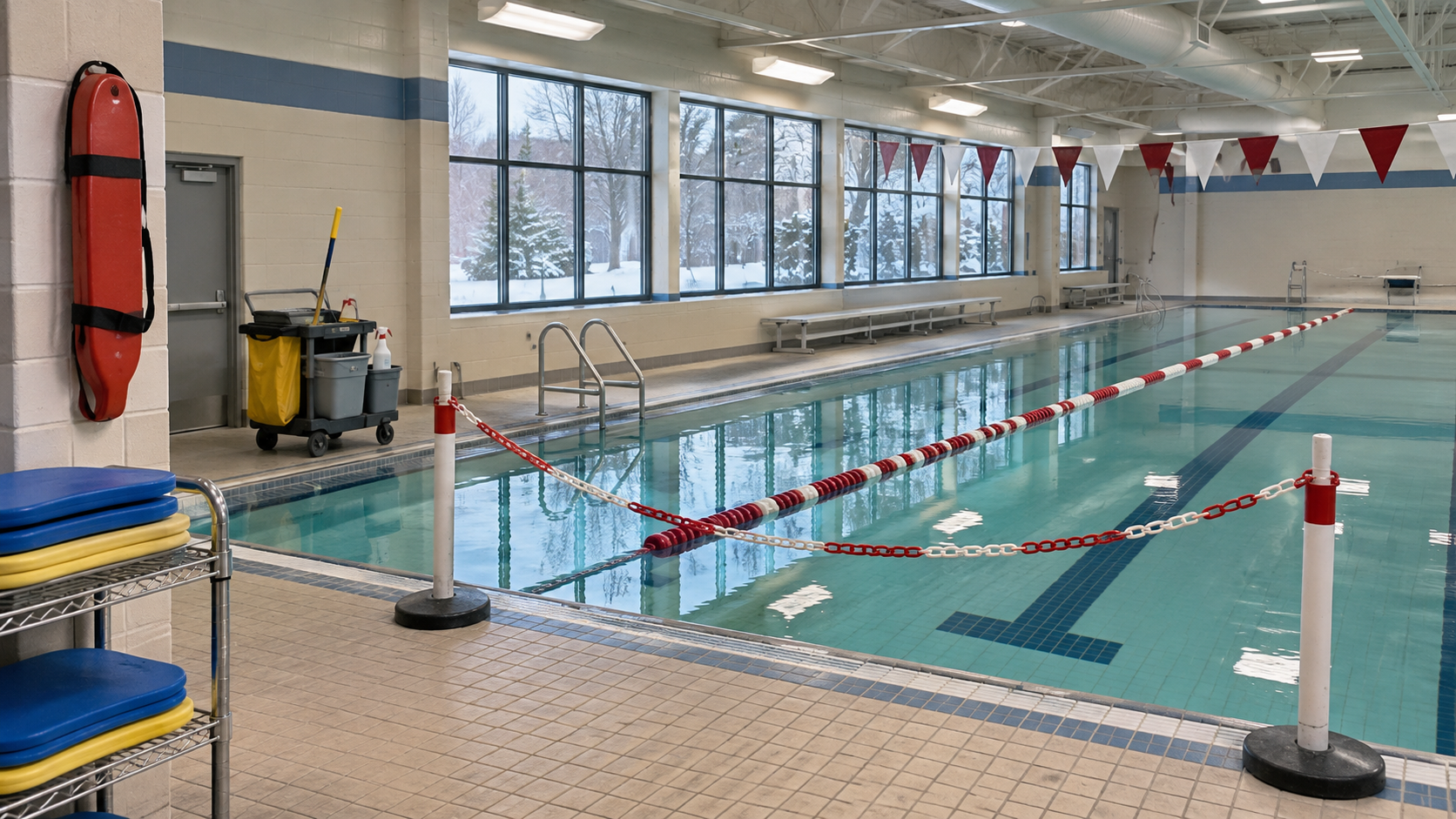
GARNET LAKE, Minnesota — The city has closed one lane at its indoor pool after swimmers leaving the water carried salt, peat and mineral traces associated with lakes, wells and coastal water they remembered from elsewhere. The remaining lanes are open for scheduled programs, and the city said routine pool samples meet health requirements.
The Garnet Lake Aquatic Center has a six-lane pool supplied by municipal water and a shared filtration system. Lifeguard Mara Pell noticed the condition Sunday when a lap swimmer climbed from lane six with fine gray sand along both ankles. The deck had been swept before opening, and no sand is used in the building.
The swimmer, Dale Rusk, said the grains smelled like the public beach where he learned to swim near Duluth. He had not visited it in 18 years. Staff rinsed his feet at the deck shower, but more sand appeared as water dried on his calves. It stopped forming after he changed clothes and left the pool room.
Six other swimmers carried different residues from the same lane. A college student tasted salt on her upper lip and identified the smell of a tidal creek near her childhood home in Georgia. An older man left a rust-colored line on a white towel and said it resembled water from his parents' farm well. Two swimmers reported only ordinary chlorine.
Aquatics supervisor Nessa Voss ended lap use in the lane and moved a beginner class to the shallow area. She asked patrons not to taste water, trade towels or enter the closed lane for personal tests. The center waived admission for affected swimmers and provided fresh towels, showers and sealed bags for clothing they did not want to wear home.
Pool water can pick up salts, soil and skin products from many users, said Cal Marr, an environmental health specialist who reviewed the center's logs. Filters distribute those materials across a system rather than preserving them around one swimmer. Marr said memory and smell can make a familiar place seem present, but several residues were visible and did not appear in samples taken directly from the lane.
The reports were not always tied to pleasant memories. One woman found black plant fibers in her hair and recognized the odor of a bog where her brother disappeared during a childhood search. She declined further questions and asked the city to discard her towel. Staff ended interviews and referred any follow-up to the city's risk office.
For another swimmer, the material belonged to a place he had never visited. Fourteen-year-old Niles Cole left the lane with red silt under his fingernails. His mother identified it from photographs as the color of a family pond in Oklahoma that was drained before he was born. Cole said he knew the pond only from her stories and had pictured the banks as pale sand.
Maintenance workers isolated the lane's return line, brushed the walls and ran the circulation system overnight. Chlorine, pH and turbidity remained within the center's operating range. On Tuesday morning, a lifeguard walked the empty deck in clean shoes and found three damp footprints beside lane six: one edged with salt crystals, one filled with gray sand and one stained red.
The prints ended at the water and had no matching approach across the dry tile. Staff covered them with absorbent pads rather than allowing them to evaporate into the room. The pads were still wet at closing, each with a different odor. The pool water beside them remained clear and smelled of chlorine.
Voss locked the lane rope in the equipment closet after the final class. Overnight, droplets formed along its dry plastic floats. Morning staff found fresh water on the first four, brackish water on the next three and dark peat water on the last one, in the same order the affected swimmers had left the lane.