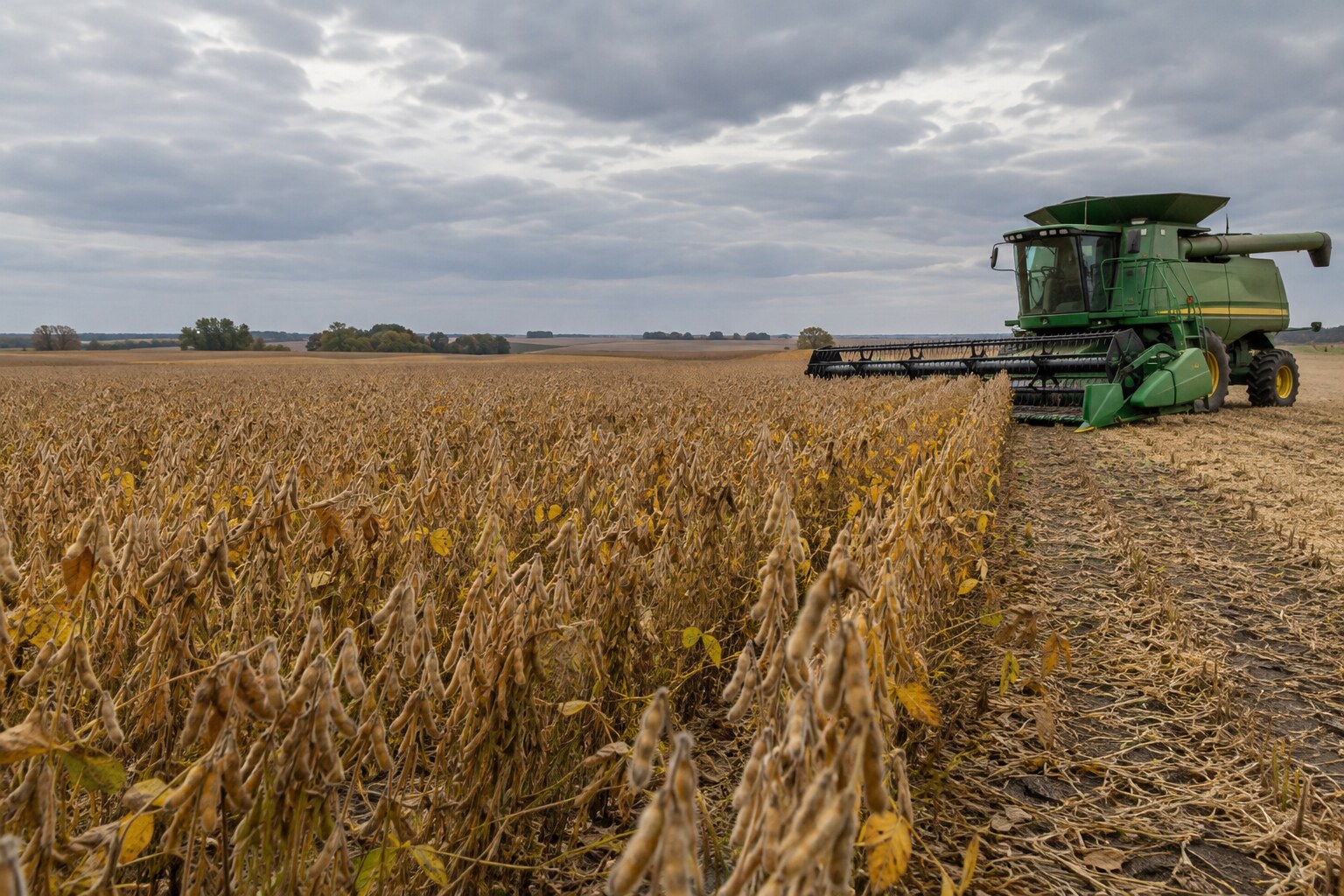
HALE CROSSING, Nebraska — A Dawson County grower has delayed harvest on 14 acres after mature soybean plants repeatedly leaned toward a seasonal equipment operator rather than with wind or field conditions. The remainder of the farm's crop is being harvested, and the county extension office has reported no sign of disease or chemical damage.
The affected ground is part of a 146-acre field planted in May with a common commercial variety. Owner Meredith Kroll expected to begin combining Monday after moisture tests reached 12.8 percent. The plants are brown, dry and between 30 and 36 inches tall, with no unusual pod loss.
Kroll first noticed the leaning Friday while operator Luis Ramey inspected the combine near the east headland. Plants within about 40 yards angled toward the machine shed, where Ramey had gone to retrieve a tool. The stems returned partly upright after he drove away and inclined toward him again when he crossed the field on foot.
Soybeans may lodge after wind, heavy rain, weak stems or damage near the roots. Lodging usually follows a common direction across a field and can slow harvest by pushing pods close to the ground. In this field, neighboring plants bent at different angles depending on their position around Ramey, forming no single downwind pattern.
Extension educator Paulina Saye visited Saturday with a soil probe and a handheld weather meter. Wind remained from the northwest while plants north, south and east of Ramey inclined toward him. When Saye stood beside him, the leaves and stems continued to orient toward Ramey rather than the larger combined outline of both people.
Ramey, 29, has worked the fall season for Kroll for three years and has not applied pesticide or fertilizer this month. He said he felt no pull, heat or vibration in the field. The movement was slow enough to watch but did not touch him unless he stood within an arm's length of a row.
The response has created a harvest problem because lodged stems feed unevenly into the combine header. Kroll completed two passes while Ramey remained at another farm. When he returned to deliver a fuel filter, plants beside the active header began leaning across the machine's path. Kroll stopped before the reel reached them and reported no equipment damage.
Saye collected whole plants from four parts of the field and placed them upright in separate buckets of field soil inside an equipment bay. The stems had partially straightened by evening. Overnight, all four leaned toward a closed metal cabinet where Ramey's jacket had been stored after he left.
Laboratory screening will check the stems for common fungal injury and growth-regulating herbicides. Saye said mature soybeans have limited capacity for rapid directional growth, and a cut plant should not reorient through its roots. She advised Kroll to treat the issue as localized lodging until the samples can be examined.
Kroll plans to harvest around the 14 acres and leave six marked rows standing through Friday. Ramey will service equipment in the yard rather than walk in front of the header. The delay may reduce yield if pods shatter, but Kroll said preserving a small area is preferable to forcing lodged plants through the machine.
On Tuesday, workers removed the four bucketed samples and swept the equipment bay. Beneath the cabinet, they found thin white root tips extending from soil left on the concrete. The roots had crossed the floor in separate lines and ended inside the heel prints of Ramey's work boots, which had been made in dust the previous afternoon.