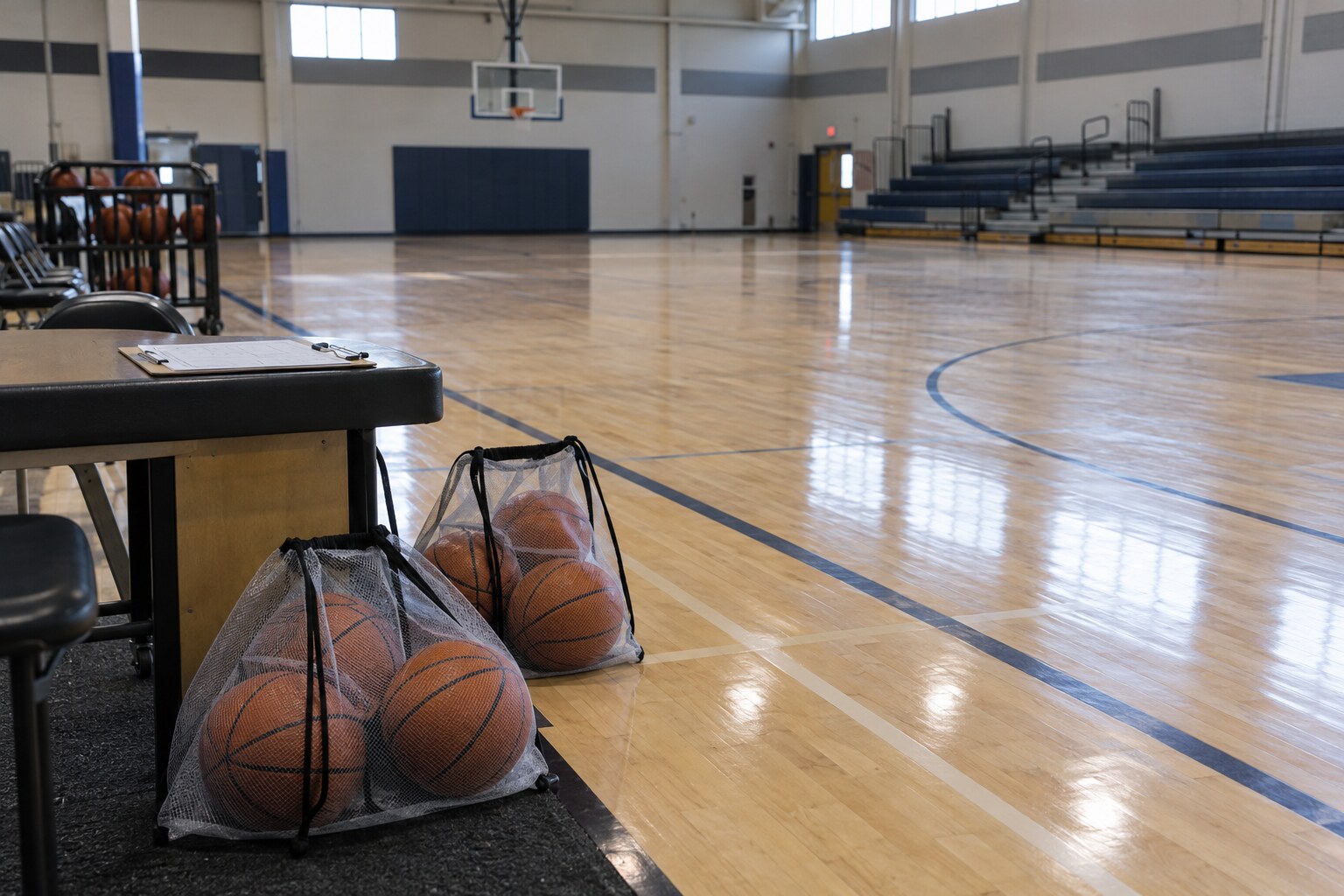
HARROW LAKE, North Dakota — The recreation district has replaced six youth-league basketballs after players and staff felt the balls expand and soften in steady pulses after Saturday's games. The gym reopened Sunday with new equipment, and the district says the affected players reported no injury or illness.
The balls were used during a seventh- and eighth-grade round robin at the Harrow Lake Community Center. Each passed a pregame pressure check and showed ordinary wear. Equipment manager Sol Pelk noticed the first change while wiping down a ball between games. The rubber shifted beneath his palm once, paused and shifted again at an interval he described as a resting heartbeat.
Pelk placed the ball on the scorer's table, where its sidewall continued moving without rolling. Five others taken from the same rack began similar motion during the next 40 minutes. Players could see the printed panels rise slightly at each pulse. Air gauges fluctuated too little to explain the movement, and none of the valves leaked under a soap test.
Coach Dena Mott asked everyone to leave the court while staff matched each ball to the game and handling log. The rates ranged from 58 to 104 movements a minute. In each case, a player who had used the ball for several possessions counted the same rate at their wrist within two beats. The correspondence shifted when another player held a ball for more than about a minute.
The effect was not limited to active players. Twelve-year-old Iva Seln had left the tournament before warmups because of a family obligation. A ball she inflated Friday continued at 72 pulses a minute in the locked equipment room. Her father counted the same rate while she sat reading at home and said the number was ordinary for her. The district did not ask families to provide medical records.
All 31 participants received a basic check from the event nurse before leaving. None reported chest pain, dizziness or shortness of breath. Recreation director Hal Rusk postponed the final game anyway, refunded admission and told families the district would not use the balls as a health monitor. He said a toy reacting to a child should not be treated as evidence about the child's body.
Temperature changes, hand pressure and a flexing bladder can make a ball seem to throb after play, said Vey Orton, a sporting-goods representative who inspected the equipment Sunday. Repeated deformation may continue briefly when rubber is warm. Orton said he had not seen separate balls maintain distinct regular rates for hours or change rate after being held without a measurable pressure increase.
Players responded with curiosity more than concern. Several wanted to keep the balls assigned to them, and one team proposed using the pulses to set the pace of free-throw practice. Rusk declined both ideas. He sealed each ball in its own mesh bag, recorded the last known handler and stored the bags in the district office pending review by the manufacturer.
Sunday's games used eight balls purchased from a school supply room in neighboring Mesa Vale. Officials checked pressure at halftime and kept the original equipment out of view. Play continued normally, though two teams stopped their usual pregame ritual of passing one ball around the circle. The postponed final will be held Tuesday without an added admission charge.
Orton deflated the six retained balls after the gym closed, removed their valve cores and confirmed that no air remained. Five lay flat by evening. The cover from Iva's ball continued drawing inward beneath its mesh at 72 paired movements a minute, tightening the numbered cord around its middle. At 9 p.m., her father said she was asleep and counted the same rhythm at her wrist without waking her.