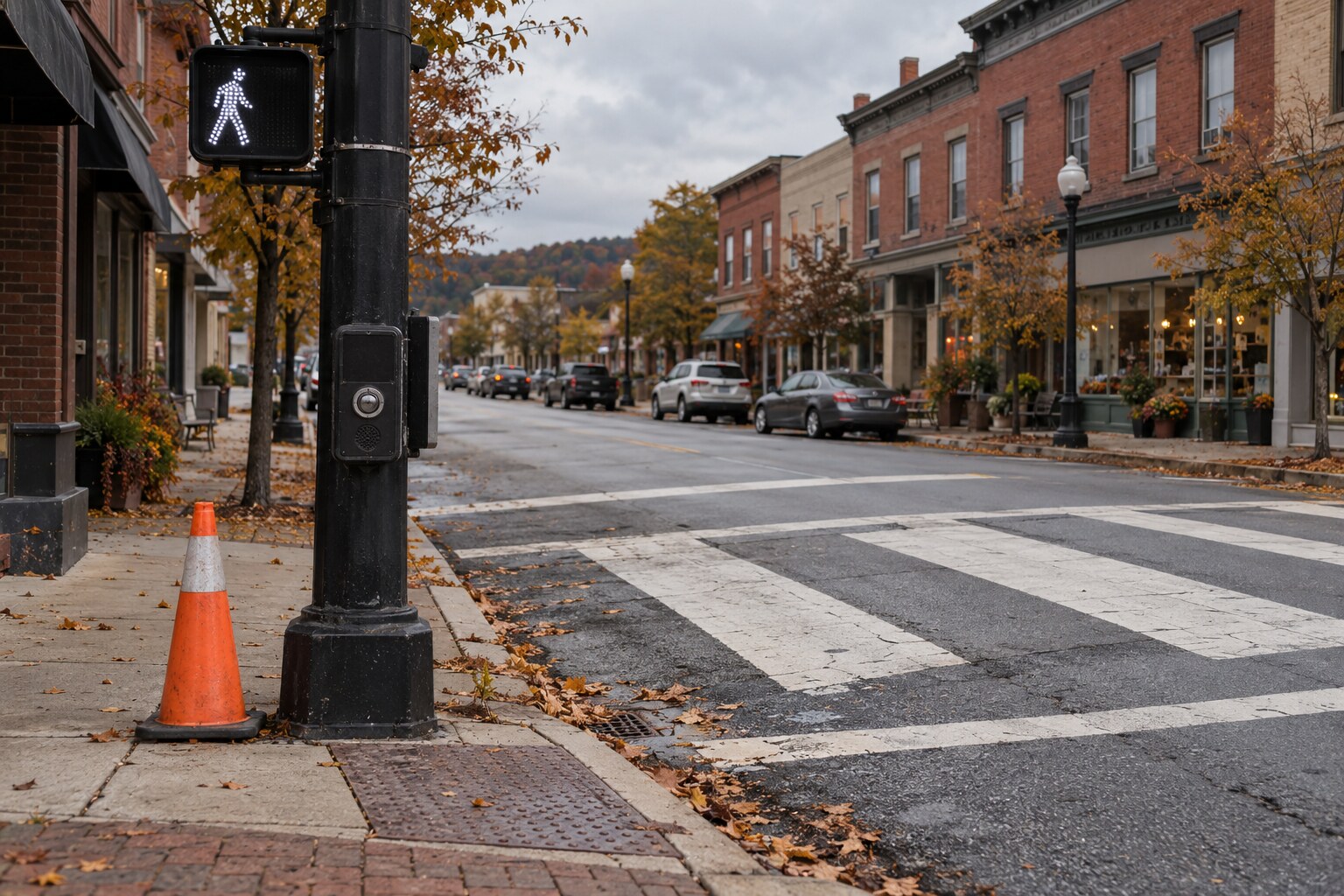
KEPLER FERRY, Pennsylvania — The borough has disabled the audible signal at Main and Alder streets after pedestrians repeatedly exchanged personal items while crossing and later said they believed the exchange was required. The intersection is operating as a temporary four-way stop while the controller and speaker are inspected.
The signal uses a standard locator tone at the push button and a rapid electronic chirp during the walk interval. It was installed in 2022 as part of a curb-ramp project. Borough manager Inez Cord said no software update, volume adjustment or timing change was made before the first report Wednesday.
Bakery clerk Janis Mott said she was carrying an umbrella when the walk signal sounded and handed it to a man approaching from the opposite curb. The man gave her a paper bag containing two library books. Neither spoke. Mott continued to work and did not question the exchange until a customer asked why she had wet books behind the counter.
Similar transfers occurred throughout the afternoon. A student traded a lunch container for a carpenter's tape measure. Two strangers exchanged house keys and returned them through police several hours later. A parent pushing a stroller gave another pedestrian one child's spare shoe and accepted a bundle of unopened mail addressed to a nearby business.
People interviewed by police said the action felt courteous rather than forced. Most remembered deciding which object to offer, but none could explain the purpose or identify a request from the other person. Several said refusing would have been rude in a way they could not define. Children who crossed without carrying anything put leaves or coins into one another's hands.
The exchanges caused no reported injury, but the key transfer temporarily locked one resident out of his apartment and the mail was delivered late. Police placed a folding table at the station for unclaimed objects and asked residents not to post photographs of identification cards or keys online. Twenty-three items had been returned by Saturday.
Social imitation can move quickly in a public space when people see others follow an unfamiliar rule, said Vera Noll, a behavioral researcher who reviewed two storefront videos at the borough's request. Noll said the first visible exchange began when both pedestrians were alone at the crossing, and later participants often could not see a previous pair.
A signal contractor tested the speaker Friday morning. Its tones matched the manufacturer's settings, and the cabinet contained no radio receiver or recorded speech. During the test, two borough employees standing on opposite corners removed their watches at the same time. Cord stopped the test before either entered the street.
Crews disconnected the speaker and covered the push buttons, then set the intersection to flashing red. The visual walk symbols are dark. Most pedestrians have used the marked crossing normally since the change, although some pause at the curb until another person arrives and then choose a different route rather than pass them.
Merchants have asked the borough to restore the signal before the weekend market, when foot traffic increases. Cord said accessibility must be preserved and the borough will install a temporary compliant device at another pole if the existing equipment cannot be cleared for use. The state transportation office is providing a replacement controller for comparison.
During a silent timing check Saturday, a boy crossing alone stopped at the center line and placed a baseball card on the pavement. He waited until the signal cycle ended, then continued without looking back. His mother said the card was not his. It showed no player or statistics, only a photograph of the same crossing taken from the center line while he was still standing there.