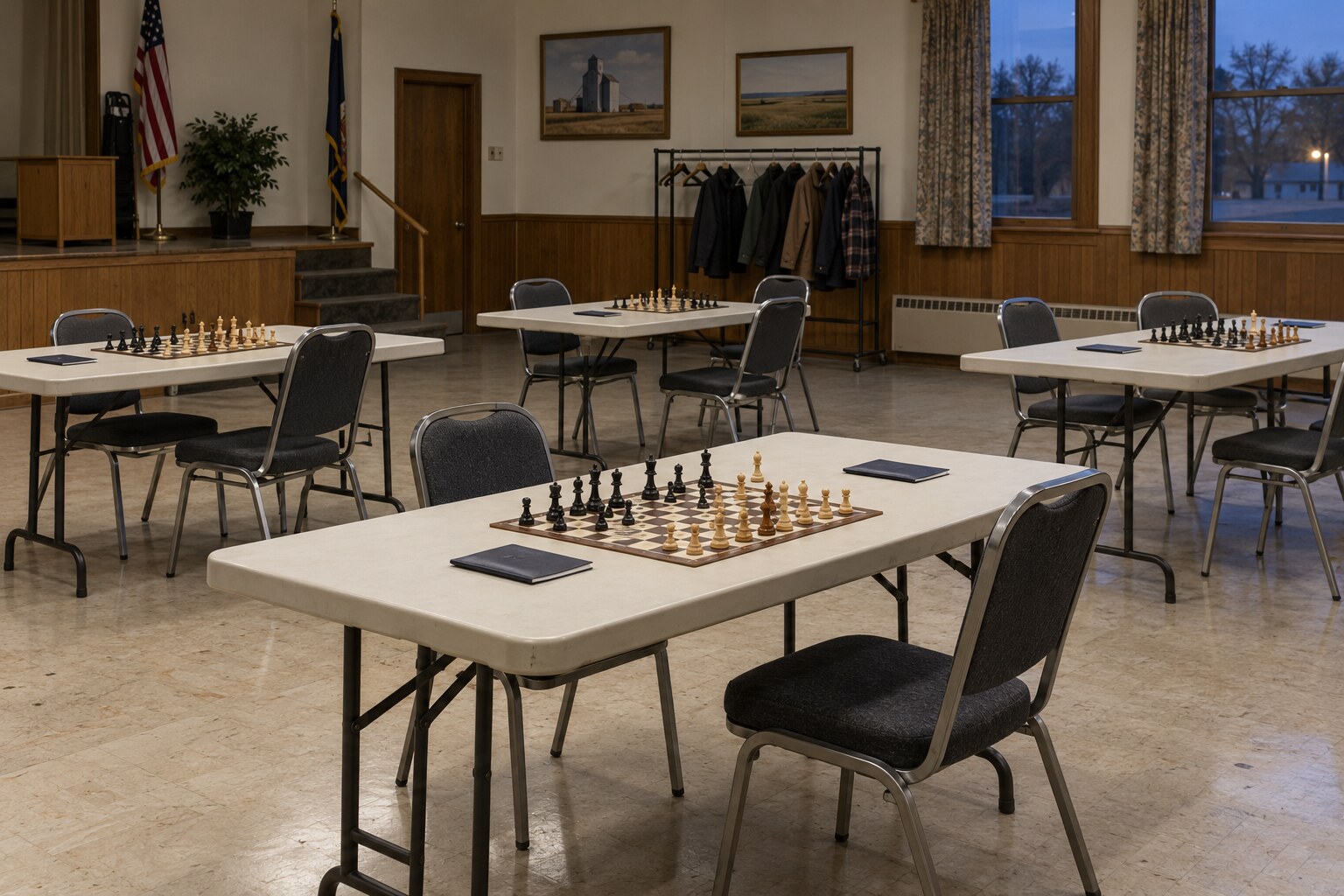
KESSEL PLAIN, North Dakota — A community chess league has postponed its fall standings after 12 games with different openings reached the same board position on move 22. Players will meet for casual games next week while organizers decide whether the affected round can be rated.
The Kessel Plain league plays Tuesday evenings in a former American Legion hall and includes 26 adults and teenagers. Its autumn round uses standard tournament rules, paired clocks and notation sheets. The repeated position first appeared last week in four games that had begun with unrelated pawn and knight moves.
In each position, White retained a king, queen, two rooks, one bishop, five pawns and an advanced knight on the edge of the board. Black had the same material arranged in a tight group near the opposite corner. Neither side was in check. League director Alma Creel said the position favored no obvious tactic and did not resemble a known opening trap.
Players initially assumed they had copied one another. The hall is quiet, and competitors can see neighboring boards when they stand. Creel moved the next week's tables farther apart, placed cardboard dividers between them and asked players to choose openings privately before the clocks began.
All eight games Tuesday reached the position after Black's 22nd move. The paths were not the same. One game traded queens on move nine and later had both queens back on the board. Two notation sheets record bishops moving from squares those pieces could not have reached under the preceding moves. Players did not recall making illegal moves, and opponents signed the sheets without objection.
Video from the hall shows hands moving pieces at ordinary speed. From several angles, captured pieces remain beside the boards until they are present again in the repeated position. No player reaches across a divider or adds a piece. Creel said reviewing the recording frame by frame did not establish when the material changed because every individual move still appeared continuous.
The league stopped the clocks and asked players to reconstruct their games on fresh boards. Each pair agreed on its opening and several memorable decisions, but disagreements began around move 14. Players who believed they had been attacking remembered defending instead when shown their own written notation. Nobody could reproduce a complete route to the final arrangement.
Chess positions can recur through transposition, when different move orders lead to the same arrangement, said university coach Ren Ivers, who reviewed diagrams supplied by the league. He said 12 identical positions with restored material and inconsistent legal histories cannot be treated as ordinary transpositions. He advised organizers not to assign wins based on a position nobody chose to enter.
That ruling matters to several members seeking regional ratings. Seventeen-year-old Nia Holt had been leading her first game against the league champion before the boards converged. She said canceling the score was fair but disliked losing the particular mistake she had spent the week preparing to correct. Other players asked to continue from the common position as a new tournament.
Creel instead boxed each set separately and photographed the tables. Next Tuesday's casual session will use donated pieces on paper boards, with no clocks or standings. The league will preserve signed notation sheets and return entry fees if the regional association declines the round. The hall remains open for its other programs.
On Thursday, custodian Orrin Bell removed the tablecloths for washing. Beneath each of the six tournament tables, 22 pale squares had appeared in the varnish, matching the occupied squares in the repeated position and not the pattern of a full chessboard. Bell stacked the tables against different walls. By Friday morning, every pale arrangement faced the hall's north window.