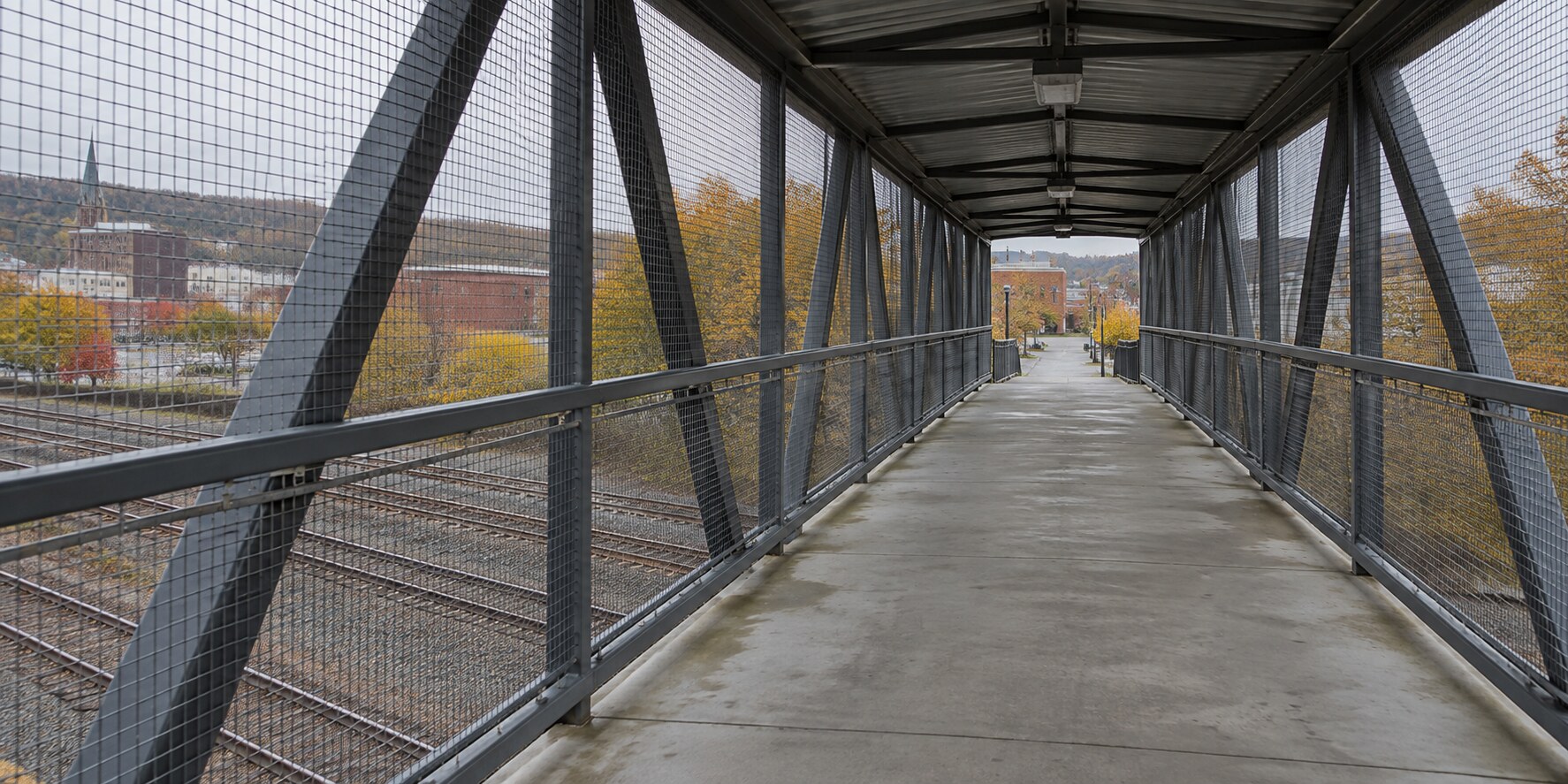
KETTER VALE, Ohio — The city has limited access to the Mill Street pedestrian bridge after workers and commuters reported the crossing flexing under what felt like a large group of walkers when no one else was visible. Structural engineers found no immediate failure but recommended monitoring before normal hours resume.
The enclosed steel bridge crosses six rail tracks between downtown and the Harlow neighborhood. About 900 people use it on weekdays, according to a count completed in September. Until further notice, it will open from 6 to 9 a.m. and 3 to 7 p.m. with a city employee at each end. A shuttle will serve the crossing during midday.
Transit cleaner Marcus Teel first noticed the movement before dawn Thursday. He was sweeping the western stair when the deck began to pulse at a walking pace. Handrails vibrated and grit shifted in small jumps toward the center span. Teel expected a group from the first inbound bus, but both stairwells and the 280-foot walkway were empty.
A railroad camera shows Teel stepping onto the bridge alone. Its microphone records overlapping footfalls for 38 seconds, followed by the rattle of the side mesh. No figures appear in the footage. The railroad confirmed that no train passed beneath the bridge during that period and that a freight movement two miles away did not register on trackside vibration monitors.
The city installed four temporary accelerometers Friday. At 7:14 a.m., while the bridge was closed for a test, they recorded a moving load traveling east at roughly three feet per second. Engineer Gwen Iles estimated the response was consistent with 60 to 80 adults walking close together. Load cells at both stair landings remained unchanged.
Inspectors checked bolts, bearings, welds and the concrete approaches. They found worn expansion-joint seals and surface corrosion already listed for spring repair, but no cracked members or displaced connections. Iles said bridges can respond strongly when many footsteps align with their natural frequency, though that explanation would ordinarily require walkers.
During escorted hours, users must keep moving and may not gather at the center windows. The city is separating groups into intervals of 15 and recording each entry and exit. Mobility devices and bicycles are permitted. Public Works Director Cora Vane said the restrictions are intended to produce cleaner measurements and avoid adding a real crowd to an unexplained load.
The detour has added 12 minutes for pedestrians who use the nearest street underpass. Harlow grocer Sam Eddis said morning sales fell after the first closure because customers from downtown did not cross for coffee and newspapers. The transit authority added the shuttle without fare, though its route cannot accommodate the narrow east-side alley used by some bridge commuters.
Several regular users described the movement as orderly rather than violent. Office clerk Neva Sol said she felt shoulders brush both sides of her coat during an event Friday evening. She heard breathing and rubber soles, but could see the far exit throughout. Her coat showed gray smudges at shoulder height; laboratory testing has not been requested.
Iles said the bridge's measured deflection remains below its design limit. Her firm will conduct a controlled walking test Monday and compare it with the unoccupied recordings. The city has also asked the original fabricator for shop drawings and will keep the bridge closed overnight until at least Wednesday.
After Saturday's final escorted group exited, counters at both ends showed 312 entries and 312 exits. The bridge remained locked for 20 minutes while sensors continued to record a steady eastbound cadence. Fresh anti-slip paint at the center span developed a line of dull impressions, each the size of a shoe heel. They stopped at the locked eastern gate, where the deck continued to settle for another six minutes.