LARKSPUR, Minnesota — Larkspur Elementary School has temporarily limited a recess game that appeared among students in several grades this month, after disagreements over its unwritten rules led to two scraped knees and repeated arguments. Students may continue playing in a marked area with an adult present. Principal Dana Rollins said no disciplinary action is planned.
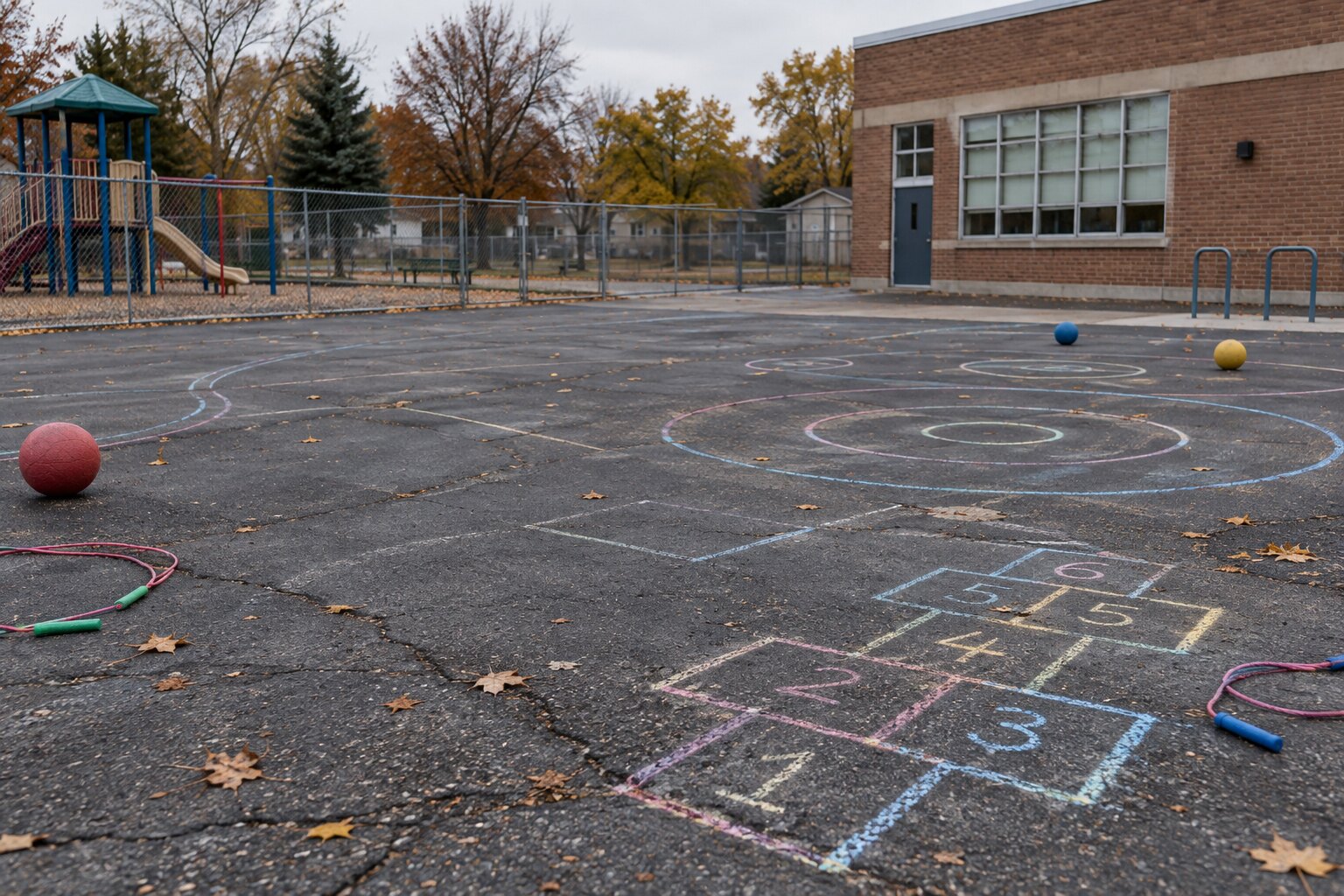
Children call the game Lantern, although it uses no lantern or other equipment. Five players stand in chalk circles while a sixth walks between them and names ordinary objects. Players change circles after certain words and remain still after others. A round ends when the walking player returns to a spot called the north door, which can be on any side of the yard.
Fourth-grade teacher Mina Cole first noticed the game September 14. She assumed older students had taught it to younger ones, but children in grades two through five each said they had learned from classmates their own age. Several kindergartners began playing a simpler version the same week. The school has not found instructions online or in its physical-education materials.
The concern is not the game's content, Rollins said, but the certainty with which children enforce rules adults cannot identify. Students agree that the words 'spoon,' 'window' and 'Thursday' require different movements, though the response changes from round to round. A player who asks what a word means within the game loses a turn. Children who are new to the school usually follow without being coached.
On Tuesday, two students collided while moving toward the same circle. Neither required medical treatment. Later that day, a group stopped speaking to a classmate whom they said had crossed the north door after it was closed. A counselor helped the children resume ordinary play, but they could not explain how the door had been closed or who made that decision.
School social worker Brendan Yu observed three rounds Thursday. He said the activity resembles many playground games in which rules travel informally and are revised by the group. Children can coordinate complex play with little explicit discussion, he said, especially when they expect adults not to understand it. He found no threatening language, exclusion based on identity or reference to self-harm.
Parents received a notice Friday asking them to discuss fair play and report any version of Lantern played away from school. Responses were divided. Some said the restriction gave ordinary make-believe too much importance. Others said their children had arranged shoes or dinner plates in circles at home and would not step through doorways until a family member named an object.
Rollins washed away the chalk markings and designated a supervised section beside the basketball court. During Friday recess, students drew five new circles there without discussion. When Cole moved one circle to create more space, every group treated the new location as the north door. Children continued playing and accepted the adult placement as part of the game.
The school will review the policy next week and may ask physical-education staff to turn the activity into a conventional game with posted rules. Yu cautioned that banning a harmless pastime can make it more attractive. Rollins said the immediate goal is to prevent collisions and keep children from carrying playground disputes into class.
At the end of recess Friday, Cole blew the first whistle and told students to line up. She then heard herself call, 'Lantern stays,' a phrase she said she had not heard the children use. Every student inside a chalk circle remained motionless while the others entered the building. Cole gave a second whistle and said, 'Door open.' The children followed without comment. She has written both phrases in her supervision log and will not use them Monday.