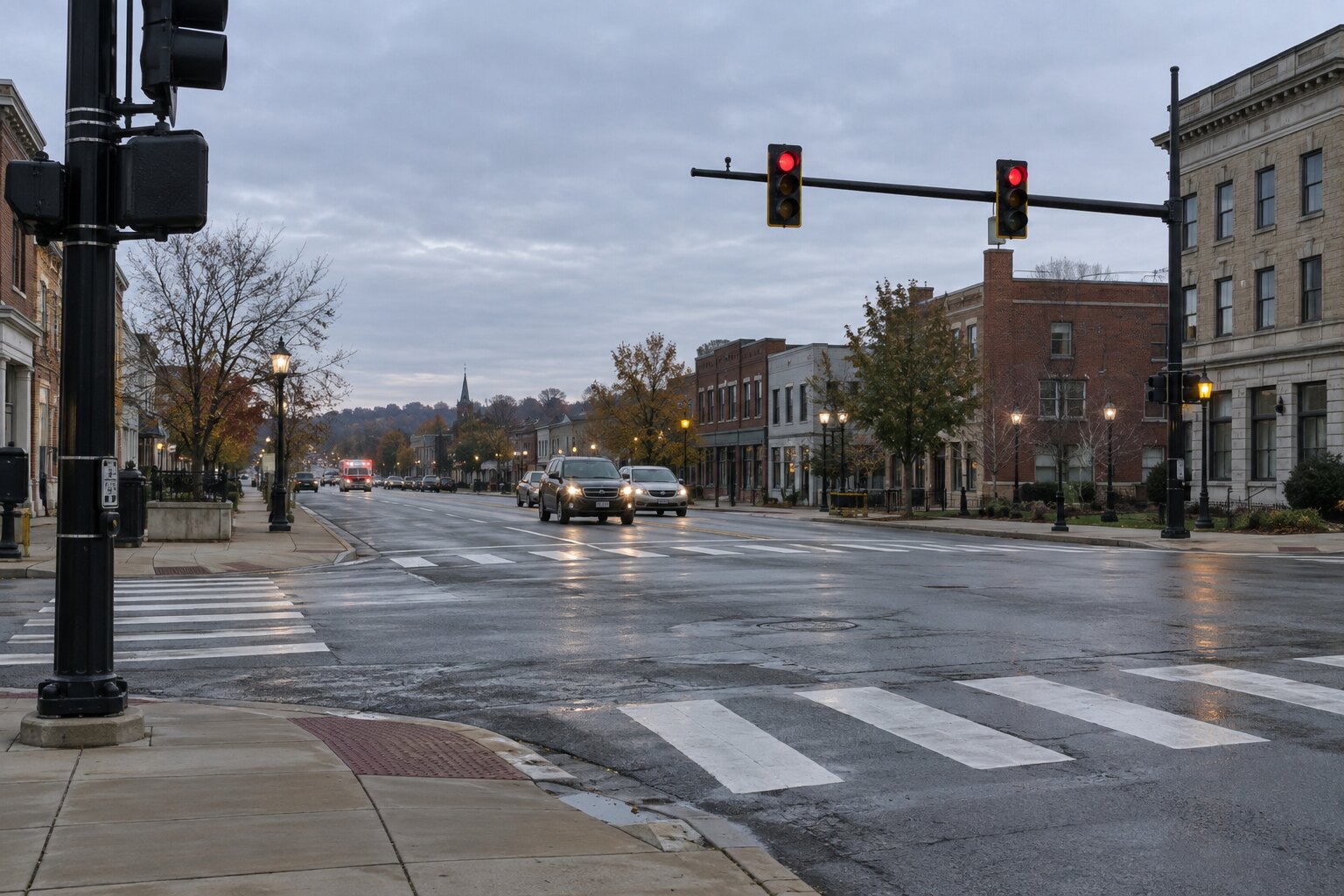
LINDEN CROSS, Ohio — Linden Cross has begun an audit of seven traffic signals after they repeatedly cleared an eastbound route before ambulances were assigned to use it. The signals continue operating for ordinary traffic, but their emergency preemption receivers have been disabled while engineers examine the timing records. Ambulance response has not been delayed, city officials said.
Emergency preemption normally changes a signal when a transmitter on an approaching vehicle sends a coded pulse. The sequence gives the vehicle a green light and stops crossing traffic. Fire Chief Rina Holt said the Broad Street lights began entering that sequence two to four minutes before an ambulance left Station 2, rather than as the vehicle approached.
The first early sequence occurred September 18 before a medical call on Heron Avenue. A dispatcher noticed the corridor cameras changing in order while she was still confirming the address. When the ambulance departed three minutes later, every light to the hospital was green. The crew attributed the timing to another emergency vehicle that could not be seen on camera.
Five similar sequences were identified during a review last week. Each began before dispatch assigned a unit, and each followed the route the driver later selected. Three calls involved Broad Street; two turned north at the courthouse; one continued to the river bridge. The intervals varied enough that traffic engineer Paul Neris ruled out a simple repeating schedule.
Neris said the signal cabinets have no connection to the city's emergency call system. Receivers respond only to nearby vehicle transmitters, which record their own activations. The city's logs show the green phases but no valid transmitter code. A defective receiver can trigger a single intersection, he said, but would not ordinarily select a continuous route through seven independent controllers.
The early clearances have helped rather than obstructed ambulance crews. Holt estimated that an open corridor can save 40 to 70 seconds during busy periods. She nevertheless asked the city to disable the feature because drivers entering unexpectedly long red phases may attempt unsafe turns, and crews should not rely on a route being prepared before they choose it.
Residents near Broad Street reported noticing the empty green periods before the audit was announced. Cafe owner Luis Valez said traffic would stop on both cross streets while no eastbound vehicle passed. He began using the intervals to carry trash to the curb, then stopped after realizing an ambulance usually appeared several minutes later.
A contractor inspected the first three cabinets Saturday and found dry housings, current software and no unauthorized radio equipment. The receivers were removed and placed in separate bags. On Sunday morning, the Broad Street sequence occurred again using ordinary programmed phases, beginning at the station and advancing east at the posted speed limit.
Neris compared the traffic record with routine ambulance movements, including training trips and returns from the hospital. The lights did not clear for those vehicles. They also did not respond to police cruisers or fire apparatus. All six recorded sequences preceded medical calls that resulted in transport, although the destination hospital was not chosen until crews evaluated each patient.
The city will replace the controllers one at a time and station an engineer on the corridor during peak hours. Holt said dispatch procedures will not change, and residents should yield to emergency vehicles only when they see lights or hear a siren. The audit is expected to cost less than $9,000 if no underground cable work is required.
At 6:08 Monday morning, while the preemption receivers remained locked in the public works garage, the signals cleared from Station 2 toward the river bridge. No call was pending. The lights returned to their ordinary cycle after four minutes. At 6:19, a woman walked into the station and asked for an ambulance for her husband; before giving their address, she said the crew should take Broad Street because the lights were already waiting.