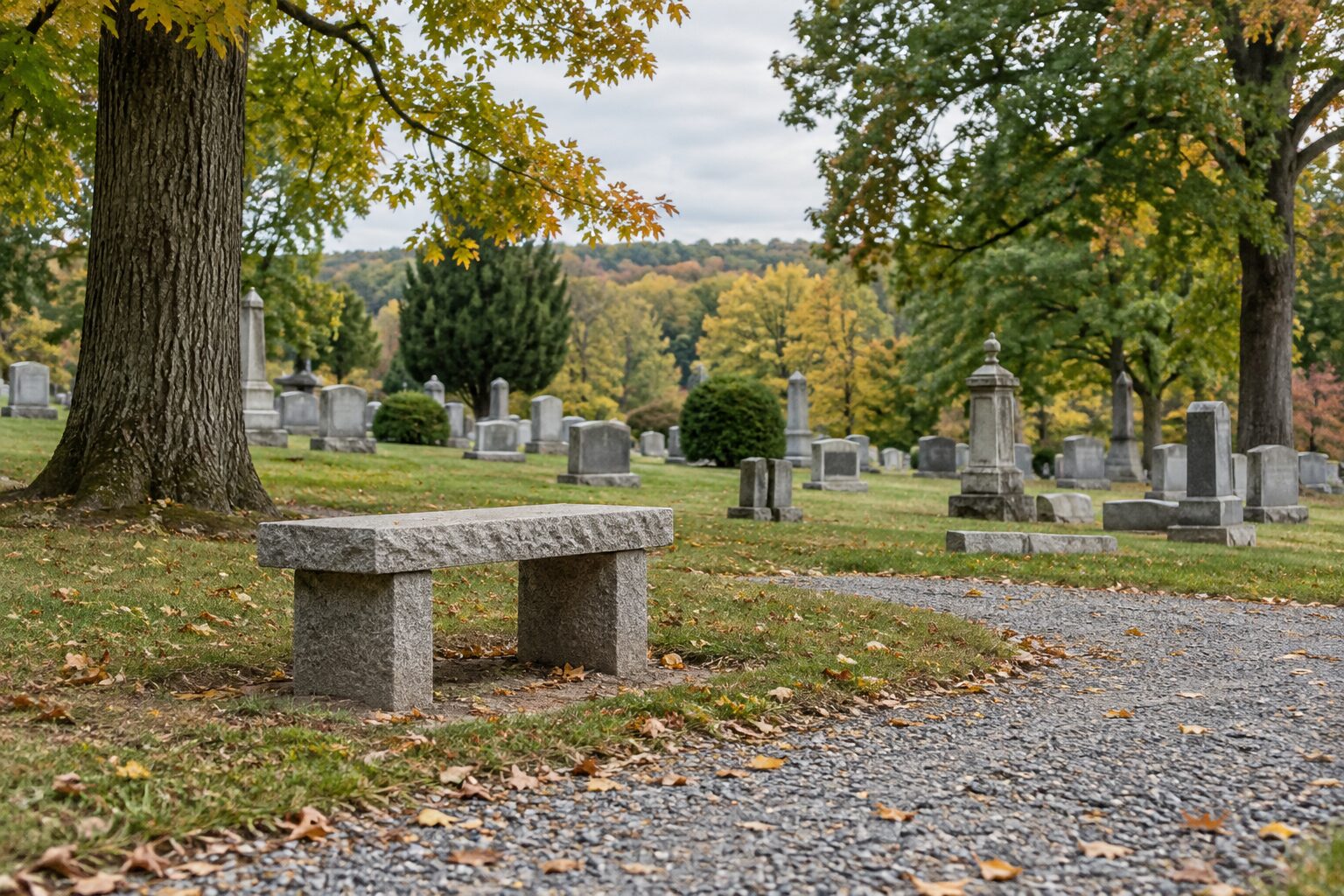
MERCY HILL, Pennsylvania — The Mercy Hill Cemetery Association has removed a recently donated stone bench after visitors said sitting on it left them with detailed memories of deceased relatives in a kitchen they had never seen. The bench is being stored in a maintenance shed while the association reviews its placement and speaks with the donor family.
The gray granite bench was installed September 12 beside the east walking path in memory of local teacher Miriam Saye. It faces a stand of maple trees rather than a particular grave. The Saye family chose the location because Miriam walked that path and often stopped nearby to speak with grounds employees, association president Judith Crane said.
Visitor Anne Laird reported the first experience five days later. While resting after visiting her father's grave, she remembered him washing a yellow mixing bowl in a narrow kitchen. Sunlight crossed a checked floor, and a radio played in another room. Laird said the scene arrived with the familiarity of a childhood memory, though the house where she grew up had a larger kitchen and no checked floor.
Laird mentioned the memory to caretaker Stephen Mora without asking the bench to be removed. Mora had heard a similar account from a man who visited his late sister. The man remembered peeling apples beside her in a narrow kitchen with yellow cabinets. He was certain the event occurred, then called the association to say his sister had never lived in a house with that room.
Nine visitors have since provided accounts. Each involved an ordinary domestic task shared with someone buried at Mercy Hill: drying dishes, sorting mail, cutting bread or putting groceries away. The remembered person differed, but the room usually had a checked floor, a yellow bowl and a radio playing beyond an open door. No visitor described seeing the cemetery or the bench within the memory.
The experiences were not uniformly unwelcome. Two families asked the association to leave the bench in place because the scenes felt peaceful and included relatives whose final years had been difficult. Others objected to receiving what they considered a false memory. One woman said it had begun competing with her last clear recollection of her mother.
Memory can be assembled from familiar details without corresponding to one event, said psychologist Elaine Porter, who is not treating the visitors. A shared description may also influence later accounts, especially in a setting where people expect reflection. Crane said the association collected initial statements separately and has not posted the kitchen details at the cemetery.
The bench came from a regional monument supplier and was cut from standard Pennsylvania granite, according to its invoice. The supplier uses the same model at parks and cemeteries across the state and has received no similar complaint. The stone carries only Miriam Saye's name, dates and a short line selected by her family.
Before removal, Crane sat on the bench for 20 minutes with Mora nearby. She remembered a woman folding tea towels at a kitchen table while a radio announcer read snowfall totals. Crane recognized the woman as her aunt, who died when Crane was 4. Her family later confirmed that the aunt's kitchen had blue cabinets and plain linoleum.
Grounds employees moved the bench Tuesday using a padded lift and found no object beneath it except gravel and two earthworms. The association will meet October 8 to decide whether to return it, relocate it to the Saye plot or offer it back to the family. Crane said visitors may submit comments without describing their memories publicly.
Miriam Saye's daughter, Ruth, has asked the board to keep the bench under cover until the meeting. She sat on it once before it was moved and remembers her mother drying a yellow bowl while Ruth put away silverware. Their actual kitchen was red and the family owned no radio. Ruth said the memory is not true, but it is the only one she has in which her mother is young, unhurried and not yet ill. She has not decided whether she wants to lose it.