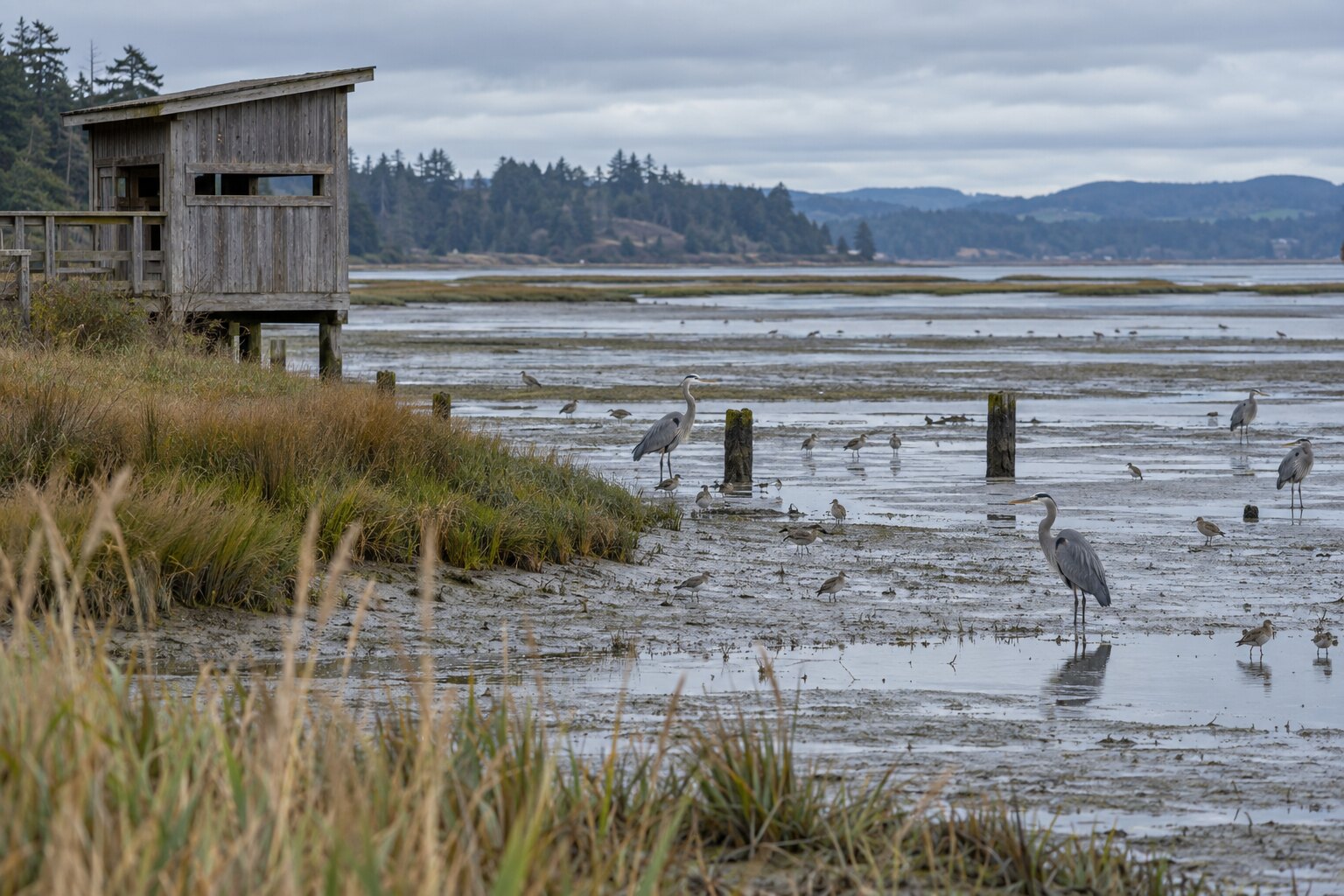
MORROW SPIT, Oregon — Morrow Spit Wildlife Refuge will close its west viewing blind at 5 p.m. through next weekend after several species of wading birds began gathering around the same empty patch of mudflat each evening. The refuge remains open during daylight hours, and its north trail and boat launch are unaffected.
Staff first noted the behavior Monday near the low point of the tide. Four great blue herons stood about 30 feet apart while smaller sandpipers and plovers settled between them. Together they formed a loose ring roughly 70 feet across. All faced inward toward bare mud, according to refuge manager Celia Ward.
The congregation lasted 22 minutes and dispersed before the incoming tide reached it. Similar gatherings occurred Tuesday through Thursday, beginning between 5:18 and 5:31 p.m. The species and number of birds changed, but the open center remained in the same place, about 90 yards southeast of the blind.
Herons are usually solitary feeders and may defend space from one another. Shorebirds commonly flock, especially during migration, but their groups shift with food and water depth. Refuge biologist Evan Reeve said mixed species can respond to a shared threat or concentrated prey. Staff found neither at the site.
The mudflat was inspected Friday morning after the tide receded. Workers found worm casts, shell fragments and ordinary bird tracks. There was no carcass, fishing line, oil sheen or object beneath the surface. A probe met the same sand and silt found elsewhere on the flat, Reeve said. The refuge did not excavate because the area is protected habitat.
Word of the gatherings brought more than 40 visitors to the blind Thursday evening. Some used camera flashes, and two people left the boardwalk to approach the birds. Ward said the early closure is intended to prevent harassment and keep visitors out of soft mud after dusk, not to conceal the behavior.
Several observers described the birds as attentive rather than feeding. Photographer Len Graves said the larger birds occasionally lowered their heads in sequence, moving clockwise around the ring. His photographs show those postures but do not establish an order. A continuous video taken from the blind contains wind noise and quiet calls typical of the refuge.
Graves and refuge staff produced a contact sheet from 36 still photographs for the daily record. The visible center appears as flat gray mud in each supplied frame. A white feather lies near its eastern edge in later images; Reeve identified it as a gull feather and said gulls were present outside the formation.
The closure will cancel one guided sunset walk and may reduce donations at the visitor kiosk. Morning bird counts will continue, and staff will mount a fixed camera on the blind. Ward asked visitors not to leave food, markers or recording equipment on the mudflat. No animal has been captured or removed for the observation.
On Friday evening, staff locked the west blind before 5 p.m. and watched from a maintenance road farther inland. The birds did not gather at the former patch. At 5:24, three herons landed beside the blind and shorebirds settled along its perimeter, leaving the original mudflat empty.
When employees returned after sunrise, the birds had gone. Tracks formed a broad band around the blind's pilings and access ramp. None crossed beneath the structure. On the interior floor, which had been swept before closing, staff found one set of wet boot prints facing the observation window. Ward said no employee had entered after the door was locked.