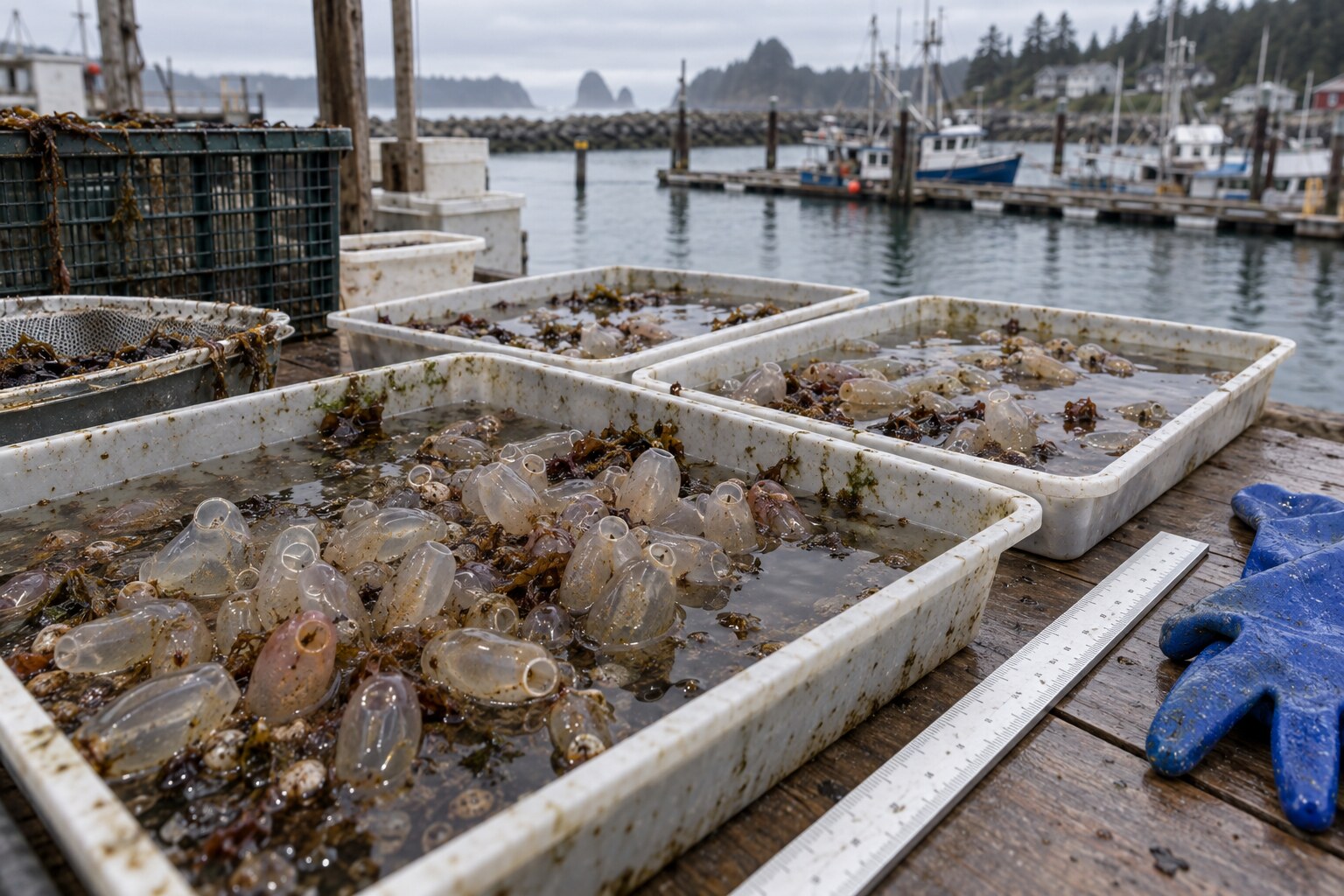
NEEDLE COVE, Oregon — A nonprofit shellfish nursery has suspended transfers from one work dock after colonies of common sea squirts developed raised surface patterns matching the fingerprints of employees who handled them. The animals are not sold for food, and state officials said the nursery's juvenile oysters remain under routine monitoring.
Needle Cove Estuary Works grows oyster seed for habitat projects in three coastal bays. Sea squirts, or tunicates, commonly attach to cages, lines and trays used by the nursery. Crews scrape the soft-bodied animals away during weekly maintenance and return them to the water with other fouling organisms.
Technician Rowan Iles noticed narrow loops on several tunicates Thursday while clearing an upweller tray. The pale ridges appeared on the outer tunic, a firm translucent layer that protects the animal's filtering organs. Iles said one pattern resembled the whorl on his gloved right thumb, including a short scar where the glove fabric had split earlier that morning.
Supervisor Tess Farrow moved the tray indoors and asked five employees to use new gloves. Each pressed one finger gently against a different animal for three seconds while another worker recorded the contact. The surfaces looked unchanged at first. Within 20 minutes, four developed ridges corresponding to the glove prints; the fifth produced the employee's bare fingerprint rather than the smooth nitrile surface that touched it.
Tunicates can heal injuries, change the firmness of their outer covering and form colonies from connected individuals, marine biologist Orla Men said. Their tunics can preserve scratches or pressure marks, particularly after removal from water. Men said she knew of no mechanism by which tissue could reproduce ridge detail blocked by an intact glove.
The nursery separated 31 affected animals in aerated trays and disinfected knives, baskets and tables under its ordinary biosecurity plan. Staff photographed the patterns but did not apply ink or powder. Farrow said the marks are part of the tissue rather than residue and remain visible when the specimens contract or rotate in the water.
Several older patterns matched employees who had worked on the dock during the previous month. One belonged to a seasonal deckhand who had left Oregon before the tray was installed. Twelve animals carried the same unidentified print, a narrow arch with two broken ridges. The nursery has not submitted the print to a law-enforcement database and does not plan to collect fingerprints from volunteers.
State aquaculture inspector Damon Sill found no unusual mortality, discoloration or odor during a Friday visit. Water temperature, salinity and dissolved oxygen remained within the site's expected range. Sill asked the nursery to retain the marked animals and avoid moving cages from the dock until a pathology laboratory can examine tissue samples.
The hold will delay delivery of about 180,000 juvenile oysters to a restoration site but is not expected to harm them, Farrow said. Staff moved the seed to clean tanks supplied by a separate intake. Volunteers may continue shoreline planting elsewhere, and public access to the harbor has not been restricted.
Iles placed one marked tunicate in a clear container without handling it again. During observation, the ridges slowly narrowed and deepened until they opened into rows of pin-sized siphons. Each opening drew water in sequence from the center of the print outward, then closed in the reverse order. The animal's two natural siphons continued filtering normally.
A laboratory technician fixed a small tissue sample in preservative Saturday and cut it into thin sections. The ridge pattern did not end at the surface. It repeated through each layer, decreasing in size toward the animal's center. In the final section, the lines formed the same unidentified arch, complete except for two breaks occupied by living, beating cilia.