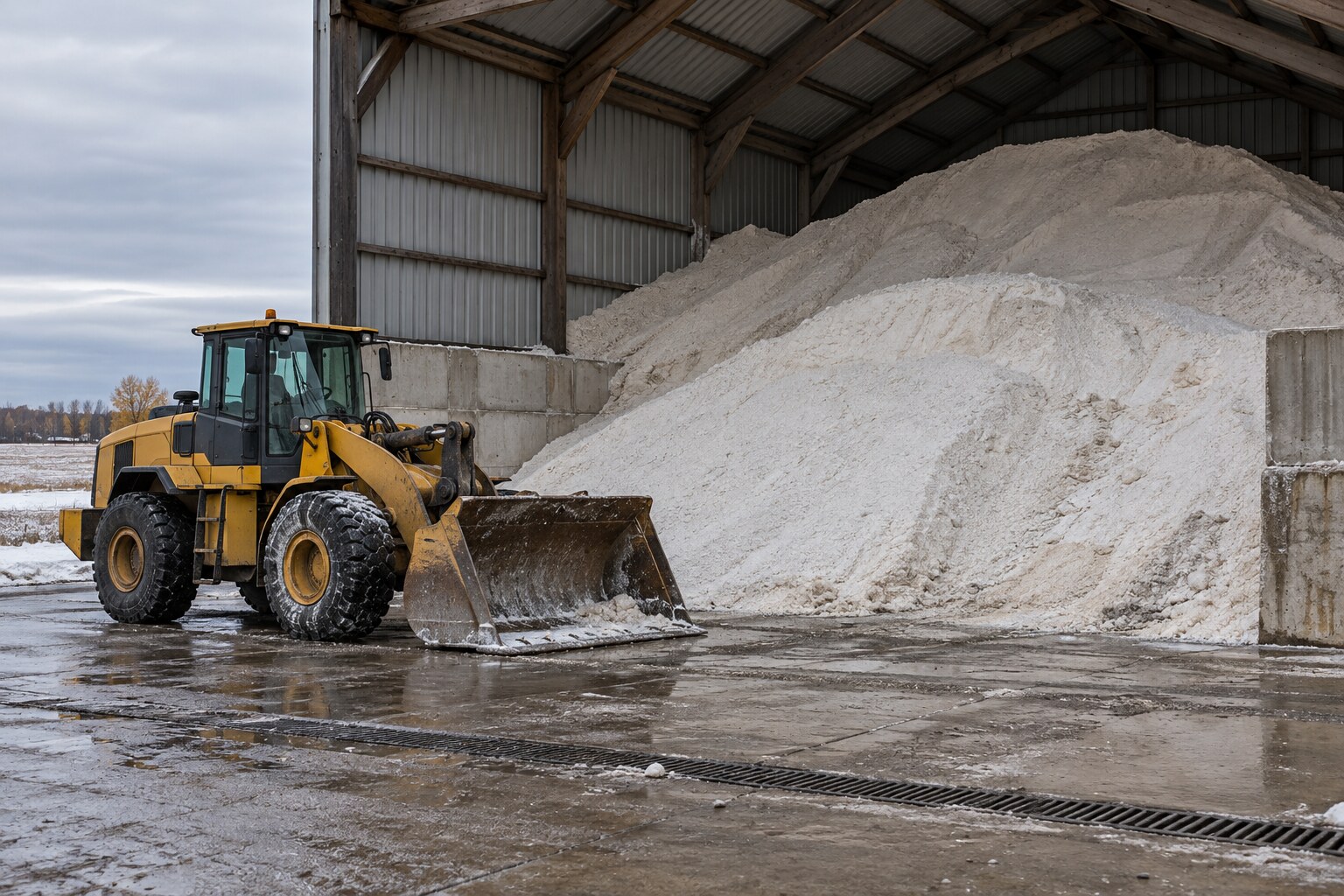
NORLAND, North Dakota — The city has moved about 180 tons of road salt into temporary covered bins after branching channels formed through its main storage pile and carried brine toward parked equipment. Norland has enough treated sand and bagged salt for early storms, and officials said the move will not change winter street priorities.
The salt shed stands behind the public works garage and holds deliveries for city streets and two county-road contracts. Its concrete floor slopes to a collection trench intended to catch ordinary runoff. Foreman Cal Rusk noticed the first channels Monday while inspecting a loader parked six feet from the pile after a dry weekend.
Narrow grooves ran from the base of the salt toward each tire, dividing and rejoining around floor cracks. Their edges were raised with clean crystals, and a clear brine moved inside them despite the shed's 32 percent humidity. No track reached the drain. Rusk moved the loader outside and spread absorbent pads over the wet concrete.
By afternoon, four new channels had crossed the pads without soaking them. The liquid ran beneath the absorbent fibers and emerged on the far side, leaving the pads dry and stiff with salt only along their edges. Smaller branches ended below a wall-mounted shovel, an unopened pallet of deicer and the steel legs of a workbench.
Employees cut a trench between the pile and equipment with the loader bucket, exposing dry salt to the floor. Within 20 minutes, crystals along the cut face loosened and assembled into thin ridges that reached across the empty gap. The ridges collapsed when struck but resumed from nearby points. Workers stopped disturbing the pile and disconnected power to the shed.
Salt readily takes up moisture from air and can form brine that follows floor slope, said Rena Wold, a materials engineer retained by the city. Repeated wetting may also create crusts, cavities and branching drainage paths inside a stockpile. Wold said the shed was dry enough to limit that process and that several channels traveled uphill or ended beneath objects with no visible moisture source.
The relocation required six dump trucks and closed the public drop-off for sand barrels on Wednesday morning. Residents may collect small amounts from bags outside the garage until the bins are inspected. Public works director Elsie Noll said the city is treating the salt as usable material, not contamination, but will not load it into spreaders while its flow cannot be predicted.
Crews found no plumbing leak, roof opening or groundwater rise beneath the slab. Samples contained ordinary sodium chloride, anti-caking agent and trace minerals consistent with the city's September purchase. The brine held fine yellow paint from the loader and a few steel particles from the workbench, although neither object showed a fresh scrape below the channels' endpoints.
Most of the pile moved normally. The last 20 tons had compacted into a low shell around an empty center, large enough to hold the loader bucket without contact. Staff broke the shell from outside and found its inner wall lined with parallel grooves about the width of shoelaces. The grooves descended to the concrete and continued beneath the remaining salt.
After the shed was swept, Rusk parked no equipment inside and locked the doors. At Thursday's opening, the floor was dry except for a branching white line that began at the empty center and divided toward six bare patches where machines and tools had stood. The longest branch passed under the closed door and ended beneath the front axle of the loader outside, coating its tire valve with a new collar of clear crystals.