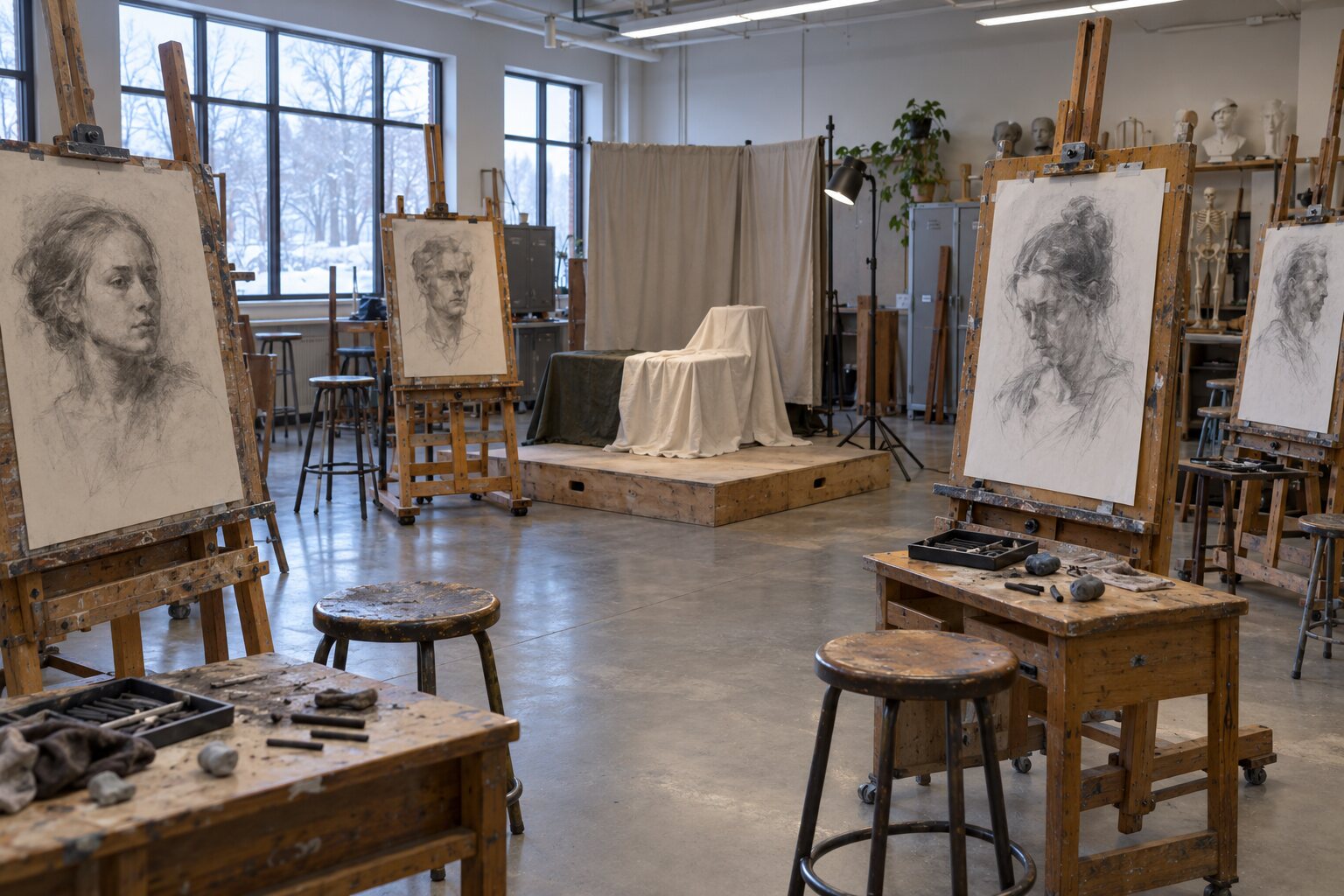
PELICAN WARD, Minnesota — Pelican Ward Community College has paused an evening portrait course after charcoal drawings appeared progressively older each time students erased and redrew them. The three volunteer models showed no corresponding physical change, and the college said regular art classes will continue in other rooms.
The noncredit course meets Mondays for adults practicing figure and portrait work. Instructor Calla Mertz said the class used ordinary vine charcoal, compressed sticks and white drawing paper supplied through the campus bookstore. Students began with 10-minute studies before moving to a seated pose by retired mail carrier Doreen Voss.
Mertz asked the class to soften Voss's jaw line and reposition one eye. After students used kneaded erasers, the revised portraits showed deeper folds around the mouth and a lower left eyelid. Voss is 68. Several drawings appeared to depict her at a considerably later age, though the changes differed according to how much each student had erased.
The class first treated the effect as a problem in observation. Mertz changed the lighting and asked students to start new sheets. Fresh drawings resembled Voss as she sat. When one student corrected the outline of her hand, the charcoal version developed prominent joints, loose skin and a wedding ring Voss had not worn since her husband died.
Voss reviewed the drawings before agreeing to continue. She said one looked like her mother near the end of her life but did not ask that it be destroyed. A second model, 24-year-old student Devin Al, sat for the final half hour. Erased areas on his portraits produced gray hair, a healed line across the scalp and the outline of heavy glasses.
No student reported seeing the older features on the models themselves. Photographs taken during the poses show their current appearances. When photographed alone, however, the drawings retained the added details. The campus print lab made copies for the college's incident file, and the copies aged only where a technician cropped or adjusted their contrast.
Repeated erasure can spread charcoal into skin folds and make a face seem older, said Nadine Frey, a conservator who examined five works Tuesday. Corrections also tend to harden contours and darken eyes. Frey said those effects do not explain features appearing in untouched sections or the consistency of details across students who could not see one another's easels.
The college closed the studio so facilities staff could check ventilation and chemical storage. Carbon monoxide and solvent readings were normal, and no student reported dizziness or confusion. The course fee will be refunded if another room and materials cannot be arranged before next Monday.
Mertz collected 22 drawings with permission from the students and models. Voss asked to keep one unfinished portrait showing only her hands. By the time she reached home, the paper depicted one hand resting on the other and a third, smaller hand underneath them. She returned it to the college without attempting another correction.
Students met online Tuesday to decide whether the works should be retained, covered or returned. Most favored preservation if the models approved. Al requested that images of his drawings not be shared publicly because several showed the same scar and eyeglass frames, details he said could be mistaken for medical or identifying information.
The drawings are stored flat with tissue between them. Mertz checked the stack Wednesday without lifting the sheets and found a faint charcoal line across the top tissue. It slowly lengthened while she watched, then stopped at the dimensions of the model platform. She left the tissue in place and recorded the time in the course file.