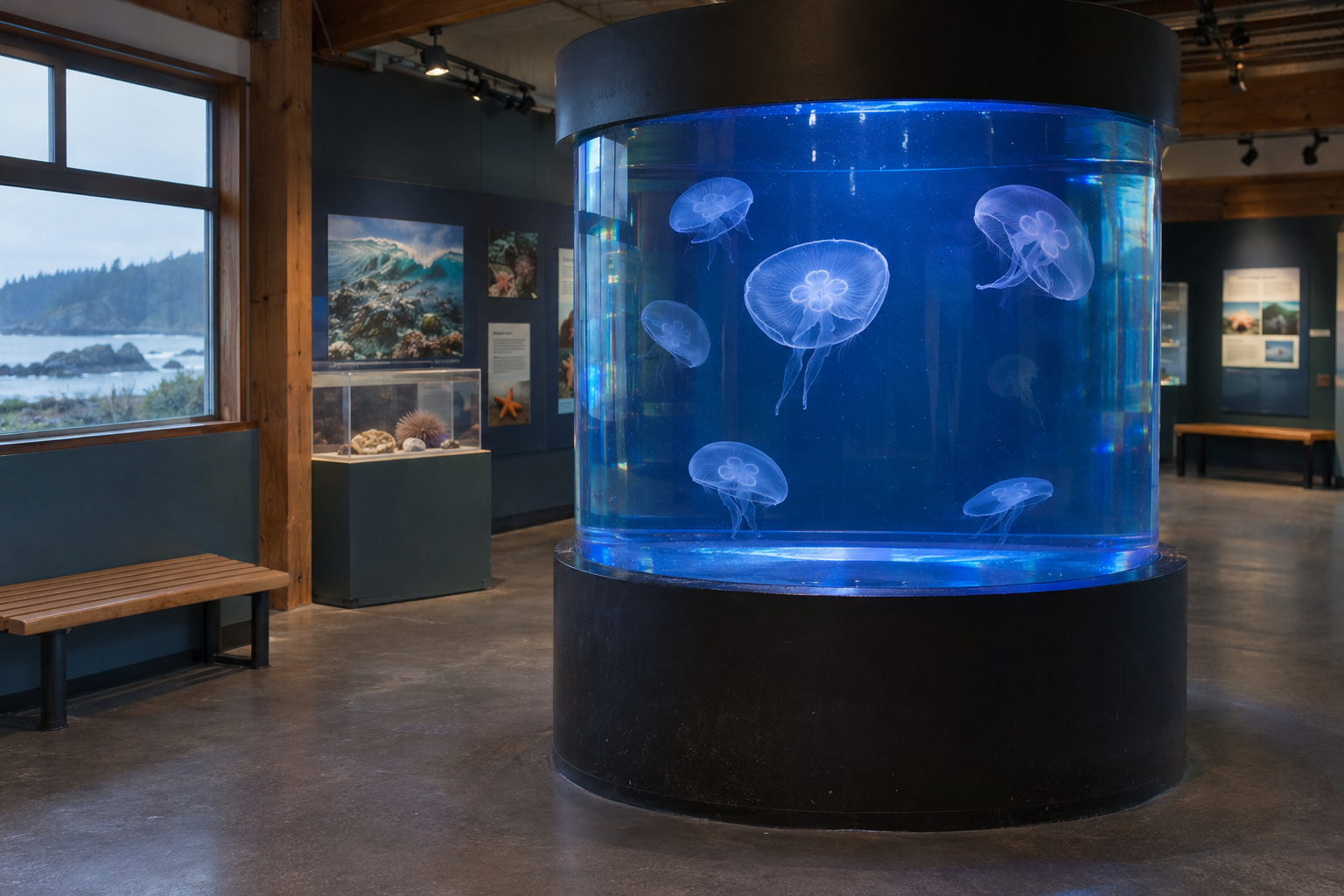
PORT CALE, Oregon — Port Cale Marine Center has closed its moon-jelly gallery after animals in a cylindrical exhibit changed their bell contractions to match the pulse rates of visitors standing nearest the glass. The center remains open at reduced admission, and aquarists said the 34 jellyfish are feeding and moving normally when the gallery is empty.
The exhibit uses a slow circular current to keep moon jellies away from drains and tank walls. Soft blue lights run on a fixed daytime program. Aquarist Nessa Marr noticed the change Saturday when a school volunteer counted 92 contractions per minute in several animals while a child beside the tank wore a fitness watch showing the same rate.
Marr first treated the match as coincidence. Moon jellies contract irregularly as they swim, and several may pulse together when they encounter the same current. She moved the child to another exhibit and asked an adult with a resting rate of 61 to stand in the same place. Within two minutes, 11 jellies nearest the glass slowed to between 60 and 62 contractions.
The response moved with the person rather than a fixed part of the tank. Visitors standing at opposite sides produced two groups with different rhythms, separated by a drifting band of animals that kept their ordinary pace. When the groups crossed, individual jellies changed rates without colliding or turning toward the visitors.
Director Mara Cole closed the room after guests began comparing medical devices and trying to raise their heart rates on the stairs. One visitor asked whether the exhibit could identify an irregular rhythm; another stood at the glass during a panic episode and became more distressed when the animals accelerated. Staff cleared the gallery, dimmed the lights and posted refunds at the admission desk.
Jellyfish respond to light, water movement and dissolved chemicals but do not have a centralized brain or a known ability to detect a person's heartbeat through acrylic, said Len Voss, an invertebrate biologist who inspected the system. Vibration from footsteps could alter their swimming. Voss said the tank wall and concrete floor were isolated enough that a fingertip pulse could not be measured at the exhibit pump.
The closure has canceled two guided programs and moved a preschool visit to the touch-pool room. Aquarists are taking manual counts rather than using visitors as test subjects. Cole said the center will not advertise pulse matching or allow private sessions, and any health concern belongs with a clinician rather than an animal exhibit.
On Sunday, staff tested the tank with the public doors locked. A metronome, recorded heartbeat and mechanical pump placed against the outer rail produced no consistent change. The jellies also ignored two aquarists standing behind an opaque service curtain, though their pulse monitors were visible to a colleague in the gallery.
Marr then entered alone without a watch and sat on the visitor bench. The nearest animals slowed together, paused through what she described as a familiar skipped beat, and resumed. Marr has a documented benign rhythm variation, but she said the pause occurred before she noticed it in her own chest and would not use the exhibit to evaluate it.
After closing, cameras showed the animals dividing into three steady pulse groups while the room was empty. The rates were 58, 73 and 101 contractions per minute. Those figures matched the last readings written on the day's aquarist board, including the rate of a volunteer who had gone home four hours earlier. Staff erased the board Monday morning. The three groups continued at the same rates until the gallery lights came on.