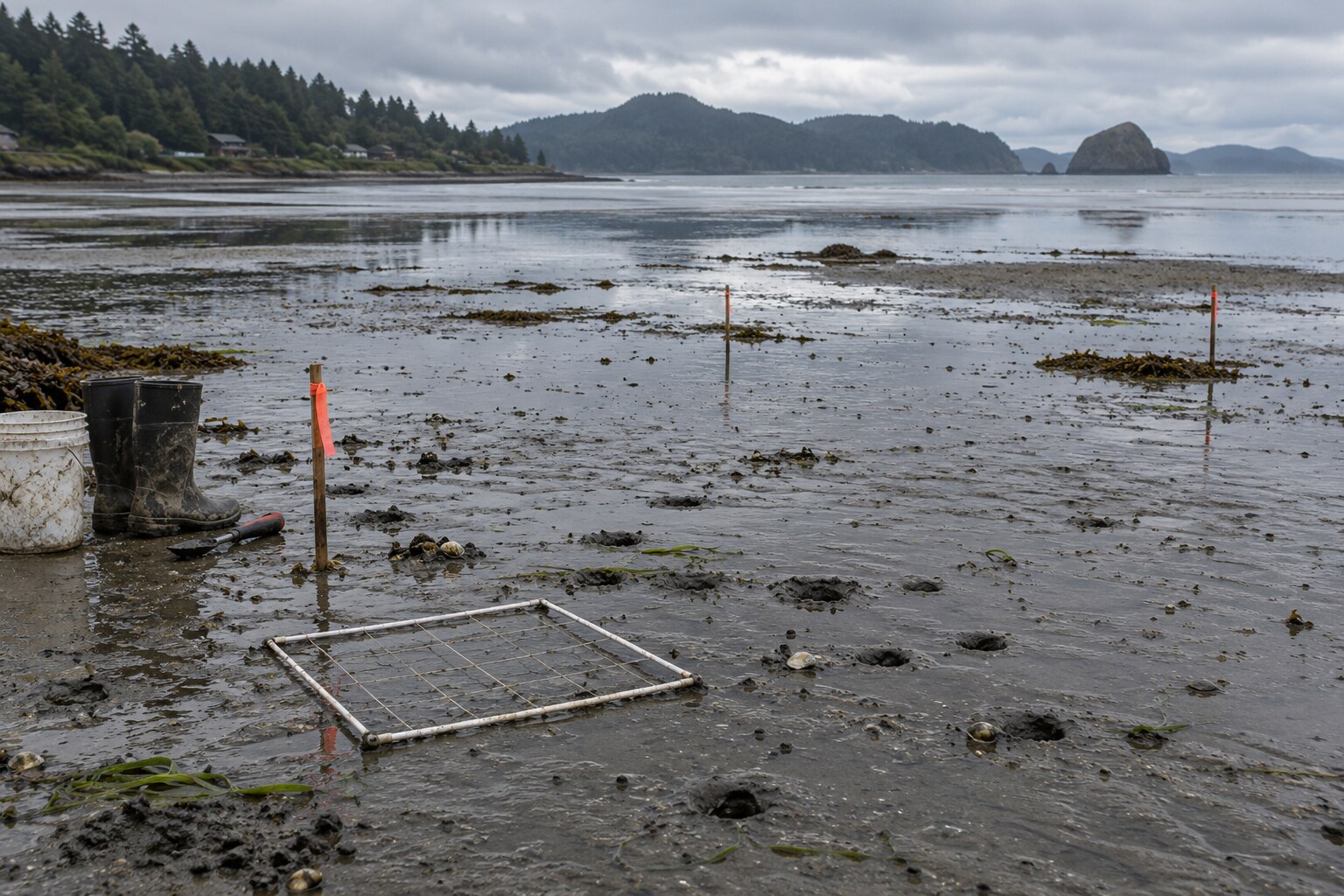
PORT DANNER, Oregon — The county has paused a fall clam survey after burrow openings closed in the shape of approaching footsteps before volunteers crossed a marked tidal flat. Recreational digging remains open outside the survey tract, but biologists will not use Saturday's counts to set next spring's sampling schedule.
The annual survey covers six transects along Harrow Inlet at low tide. Teams place square frames on the mud, count visible siphon holes and dig a small number of test plots to estimate butter and littleneck clam density. Twenty-two volunteers had completed two transects when coordinator Nessa Cole noticed an undisturbed strip forming ahead of the third team.
Clam holes normally close when the ground vibrates. On this strip, they disappeared in pairs shaped like boot soles, beginning about four feet ahead of volunteer Mara Voss and advancing at her walking pace. Each pair matched the angle of her next step. When she stopped with one foot raised, the closing stopped beneath the place where that boot would have landed.
Voss stepped sideways instead. A second line of paired patches opened across the mud before her foot came down, while the first line slowly filled with water and showed siphons again. Other volunteers tried ordinary, shortened and backward steps. The burrows receded before each choice, including two changes made after a team member called a direction from behind.
Cole ended the count because the response made surface holes unreliable and because volunteers were beginning to test the flat rather than survey it. The county collected its frames and flags, filled the test plots already dug and returned participation fees. A nearby shellfish stand extended breakfast service for volunteers who had expected to remain through noon.
Clams sense pressure changes and retreat rapidly through soft sediment, said Len Marr, a marine ecologist who visited after the tide returned. A person shifting weight can transmit vibrations before a visible step. Marr said that could account for an early response, but not for separate patches taking the size and direction of a foot that remained off the ground.
The reaction was limited to living movement. A volunteer tossed an empty glove onto the marked strip, and the nearest siphons stayed open until it landed. A boot pushed on a long pole made holes close around the pole tip rather than the boot. When Cole walked with her eyes shut while another person guided her, the paired clearings continued ahead of her.
The pause affects a cooperative that uses county counts to plan seed-clam work and volunteer shifts, though no harvest limit has changed. Cooperative manager Dale Orr asked the public not to crowd the tract or repeat the walking tests. He said people can damage juvenile clams while trying to observe a response that is easiest to see where animals are most densely settled.
Staff returned at the next low tide without volunteers and watched from the gravel access. The surface appeared ordinary until Cole carried the measuring frame toward the water. Burrows closed ahead of her as before, but the paired patches stopped at the edge of the first transect and did not continue into the area that had never been marked.
Cole left the frame, bucket and her rubber boots beside the first stake and walked back in stocking feet along the gravel. For the rest of the tide, clam holes remained open around the equipment. A narrow boot-shaped clearing persisted in the mud between the empty boots, its toes pointed toward shore. Incoming water covered the tract before any siphons appeared inside it.