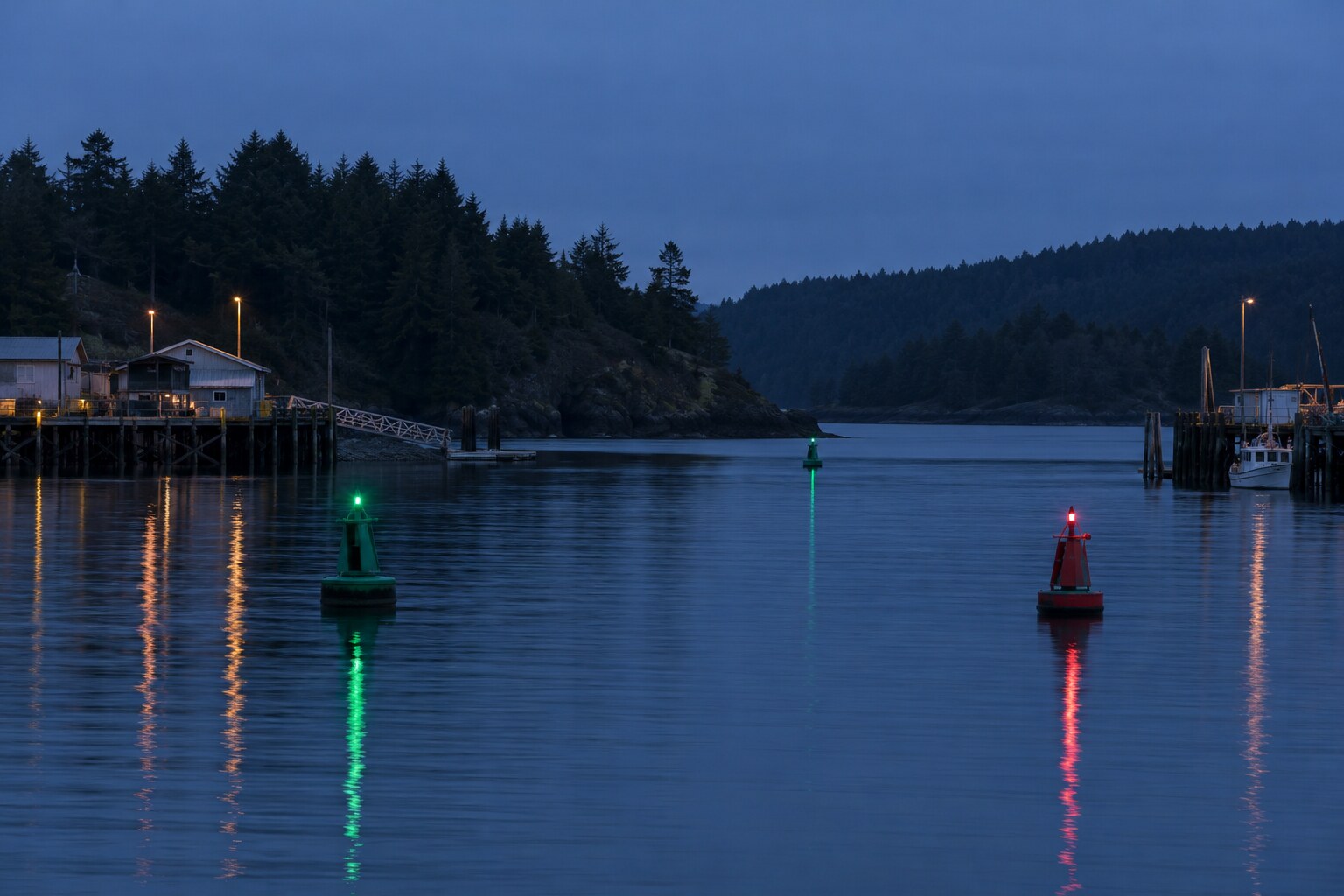
PORT MALLOW, Oregon — The Port Mallow harbor board has prohibited fishing within 100 feet of three navigation buoys after fish, crabs and plankton began gathering in columns of water that appear sunlit after dark. The channel remains open, and the Coast Guard has not changed the markers' ordinary red and green signals.
The gatherings began Saturday near buoys 4, 5 and 7 at the mouth of the inner harbor. Deckhand Lio Mercer saw what he took for pale sand beneath buoy 5, although the channel there is 38 feet deep and normally black at night. When he passed over it, he could see juvenile herring circling below his boat and the shadow of his propeller on the bottom.
From the docks, the water looks dark except for the navigation lights reflected on its surface. Viewed from a boat or with a camera lowered below the waterline, each buoy stands above a clear vertical area with the color and direction of midday light. The columns extend to the bottom without widening. Harbor staff said their edges can be crossed as distinctly as the edge of a building's shadow.
The buoy lanterns are sealed LED units powered by small batteries and solar panels. They passed their annual service in August and emit no light downward. Electrician Mara Tern disconnected buoy 4's lantern Tuesday while a port vessel stood by. The red signal went out, but the water beneath it remained bright enough for a diver to read the date on a dropped beverage can.
Life inside the columns has begun following daytime behavior. Herring school tightly, anemones remain open and kelp blades angle toward the light despite a slack tide. Marine technician Sol Ivers counted 17 Dungeness crabs on a bottom area that usually holds two or three in survey photographs. Outside the edge, animals continued their ordinary night feeding.
Ivers said artificial light can draw fish and disrupt migration, but its source is normally visible and its intensity declines with distance. A submerged meter registered a spectrum close to a clear October afternoon, including ultraviolet wavelengths not produced by the buoy lamps. Water temperature, salinity and dissolved oxygen were the same inside and outside the lit areas.
News of the concentrations brought nine small boats to the channel Monday night. Anglers caught herring and squid quickly by lowering hooks along the edge, and two boats anchored between the markers. Harbormaster Celia Marr said that created a conventional navigation hazard regardless of the cause of the light. The temporary restriction will remain until at least October 30.
The port has also asked crews not to collect animals for sale from the columns. Fish held overnight in a dark tank continued circling an empty vertical space and did not feed. Most resumed ordinary movement by morning. Three herring kept their left sides toward the tank's center until they were released, even when the tank was slowly rotated.
Commercial crabber Nessa Orr said the restriction removes one productive stretch but may prevent boats from crowding the entrance. She has moved two pots after finding them packed with undersized crabs beneath buoy 7. One pot set 40 feet away held none. Orr said she would rather lose a night's catch than carry animals that had stopped responding to bait.
Port divers found no cables, reflective material or unusual growth on the three anchor chains. At 2 a.m. Wednesday, Ivers watched diatoms rise through the illuminated water in dense sheets, then settle when wind briefly pushed buoy 5 several feet off station. The bright column did not move with the buoy; it remained centered over the place where the marker had been.
Just before sunrise, the three columns faded as natural daylight entered the harbor. The fish did not disperse. Mercer, bringing in the first workboat, saw them packed in dark water beneath the former boundaries, all facing downward. When the channel brightened enough to show the bottom, the gathered animals cast shadows toward the rising sun.