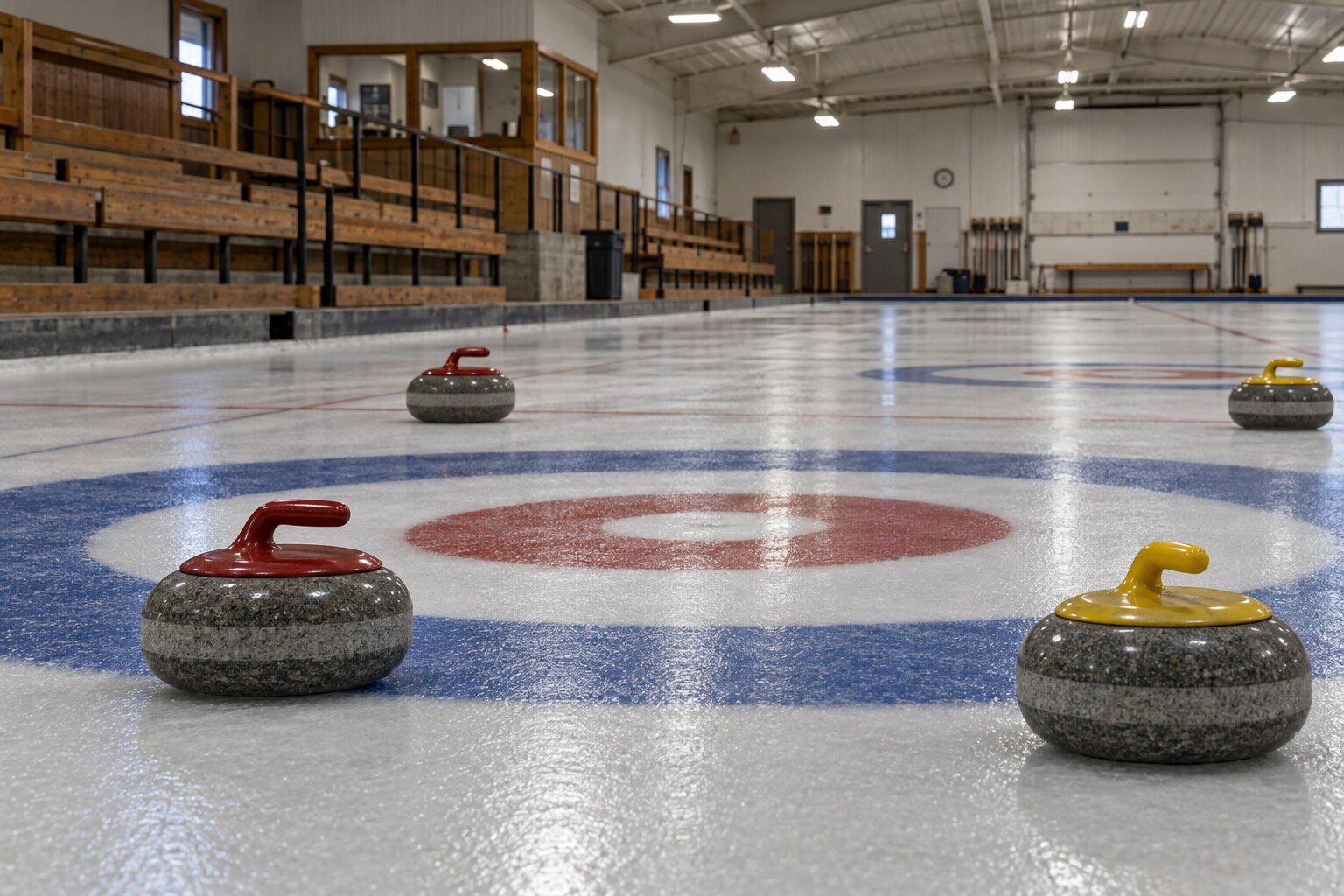
RED HORN, North Dakota — The Red Horn Curling Club has closed one sheet of ice after stones released during a beginner clinic repeatedly stopped in positions recorded during matches played by former members. League games will continue on two other sheets, and the Saturday clinic has moved to the county rink.
The club opened sheet two this month after summer repairs to its cooling lines and boards. On Tuesday, volunteer instructor Mina Lorne asked eight beginners to practice straight deliveries without sweeping. Their first four stones curled sharply toward the edge of the house despite being released on different lines.
Lorne photographed the final positions before clearing the stones. Club historian Dale Orr recognized the arrangement as the last end of a 1997 district semifinal, when Red Horn lost by one point. Two stones occupied nearly identical spots, including a guard that had stopped outside the rings after striking a rough patch near the center line.
The next practice group produced a different arrangement. Six stones gathered in a shallow arc behind the button, matching a 2008 bonspiel score sheet and photograph kept in the upstairs lounge. That end had been played by a senior team whose four members have since died. None of the beginners knew their names, and the photograph was not on display.
The stones did not move after they stopped and did not travel without being released. Their paths varied in speed and direction, but ordinary sweeping had little effect once a delivery began turning toward its eventual place. One slow stone crossed a scraped section of ice and climbed slightly over a pebble ridge before resting at the edge of the recorded arc.
Club president Elsie Wren closed the sheet rather than let members request particular matches. She said several people had already asked to replay family games or settle disputes about old scores. The club refunded clinic fees, moved equipment away from the closed surface and asked members not to throw objects onto the ice from the viewing area.
A curling stone follows its rotation, release and changing friction across pebbled ice, said Naren Bell, an ice technician who checked the sheet Wednesday. Subtle differences can produce surprising curl, especially on newly prepared lanes. Bell found the surface level and the cooling system stable; he said those conditions would not make unrelated deliveries assemble into separate historical ends.
Volunteers weighed and numbered the eight practice stones, then exchanged them with stones from sheet one. The replacement set repeated a 1986 mixed-league end after three deliveries. The original set behaved normally on sheet one. Wren concluded the condition followed the ice rather than the granite, though water and scraper logs showed no material difference between sheets.
The closure has prompted quieter responses from longtime members. Orr said the repeated positions were not famous wins, only ends people had argued over, laughed about and then forgotten. He found one score card in his father's handwriting and left it in the office rather than bring it rinkside. ‘It doesn't need us to applaud it,’ he said.
Bell shaved the top layer from sheet two Thursday and flooded it with fresh water. Before the surface fully froze, a single practice stone left beside the boards rotated a quarter turn without sliding. Its handle came to point toward the hack used by Orr's father in the 1997 match. Wren carried the stone to the rack and locked the gate; a thin curved track remained in the soft ice where no part of the stone had touched.