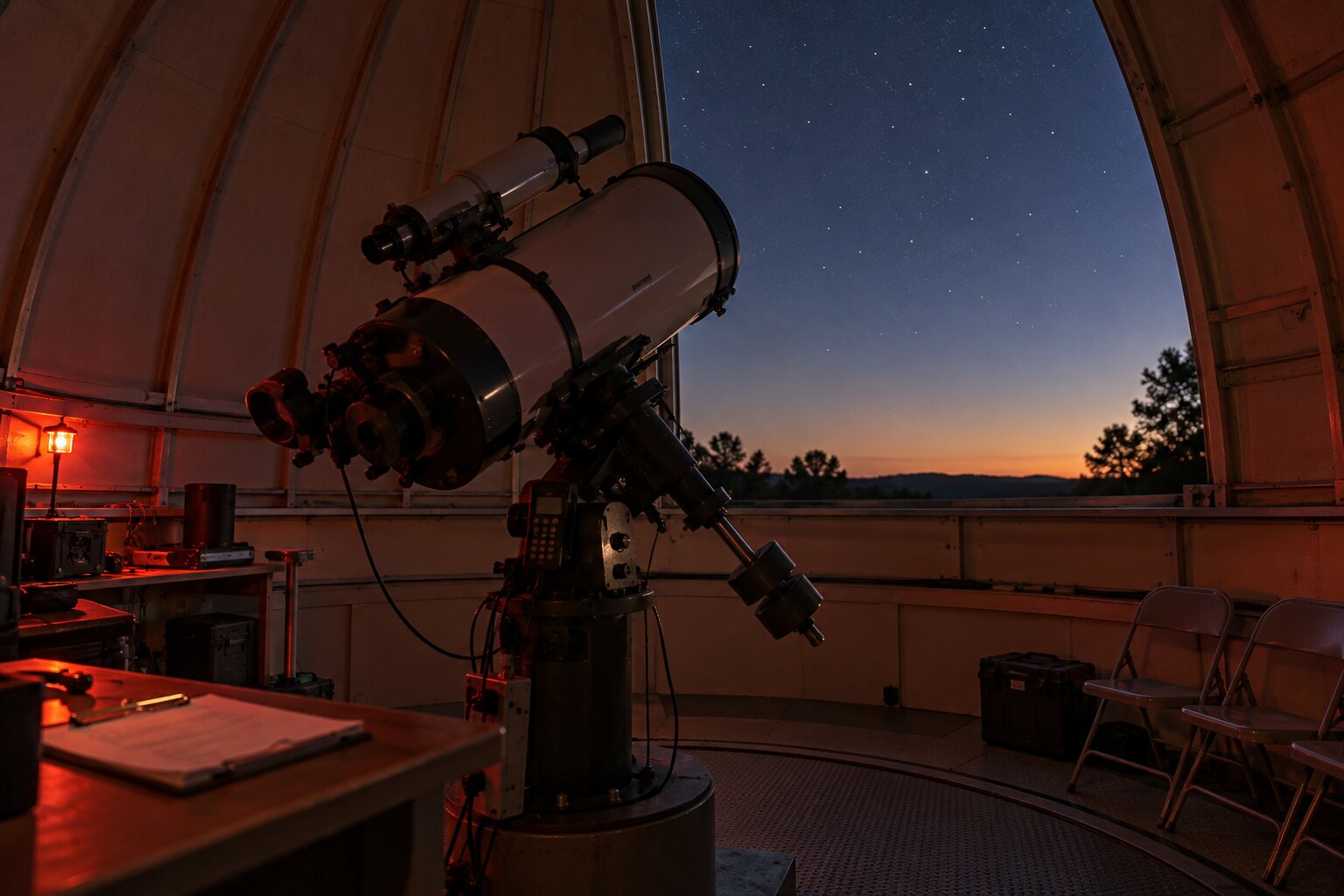
RIDGETON, Pennsylvania — The Ridgeton County Observatory has postponed its Sunday public viewing program after its largest telescope repeatedly moved away from scheduled targets and followed an uncataloged point above the eastern ridge. The building will remain closed while a contractor examines the mount and control system. No research observations or emergency services depend on the facility.
The tracking began Thursday while volunteer operator Ruth Parry was aligning the 16-inch reflector on Saturn. Before she completed the alignment, the instrument turned about 14 degrees east and slightly downward. Parry stopped the drive, returned it to Saturn and saw it make the same movement six minutes later. The telescope then continued at a steady rate too slow to notice without reference marks on the dome.
Automated mounts ordinarily compensate for the Earth's rotation, allowing a telescope to remain pointed at a star or planet. The observatory's system also includes preset positions for public programs. Director Soren Bell said the disputed movement did not correspond to a saved target, and the control terminal showed no command after Parry's initial selection of Saturn.
Parry and Bell looked through the telescope before closing the shutter. They saw a field containing several dim stars and no object at its center. A smaller portable telescope aimed at the same coordinates showed the expected stars. Photographs taken through both instruments contained no streak, satellite or other feature that staff could identify.
The point was low enough to pass behind the ridge shortly after 10 p.m. The main telescope followed it to the observatory's mechanical limit and remained pressed against that stop until Bell shut down the drive. When staff restarted the system Friday morning, the instrument returned to the eastern horizon rather than its stored home position.
County facilities technician Dina Crow inspected the wiring, encoders and hand controls. She found a worn cable sheath but no exposed conductor, moisture or evidence of a remote connection. The observatory's network log showed routine weather updates and software checks. Crow replaced the hand controller and disconnected the computer used to schedule targets, but the movement resumed after sunset.
The closure cancels a sold-out program for 28 visitors and a scout group. Bell said tickets will be honored at any October viewing night. The observatory has asked visitors not to gather along the access road, where headlights interfere with observations and cars cannot safely turn around after dark.
Astronomer Imani Rowe of a nearby college reviewed the coordinates and photographs at the county's request. The line of sight passed near no bright planet, comet or cataloged deep-sky object, she said. Artificial satellites can appear where a catalog does not predict them, but they cross a telescope's field in seconds or minutes rather than remaining on a consistent path through two evenings.
On Saturday, Crow opened the drive housing and removed both motor belts. At 8:17 p.m., the telescope tube began turning on its bearings without the motors. Bell and Crow stopped it by hand and engaged the mechanical clamps. They said the motion was smooth and required more force to restrain than an unbalanced tube would ordinarily produce.
Staff lowered the dome shutter and tied the telescope to its service cradle before leaving. The instrument remained secured during a final inspection at 11 p.m. The dome itself, which is rotated by a separate chain drive, had moved 11 feet east from its locked position. Its narrow viewing slit was centered on the same empty part of the sky, though the shutter behind it remained closed.