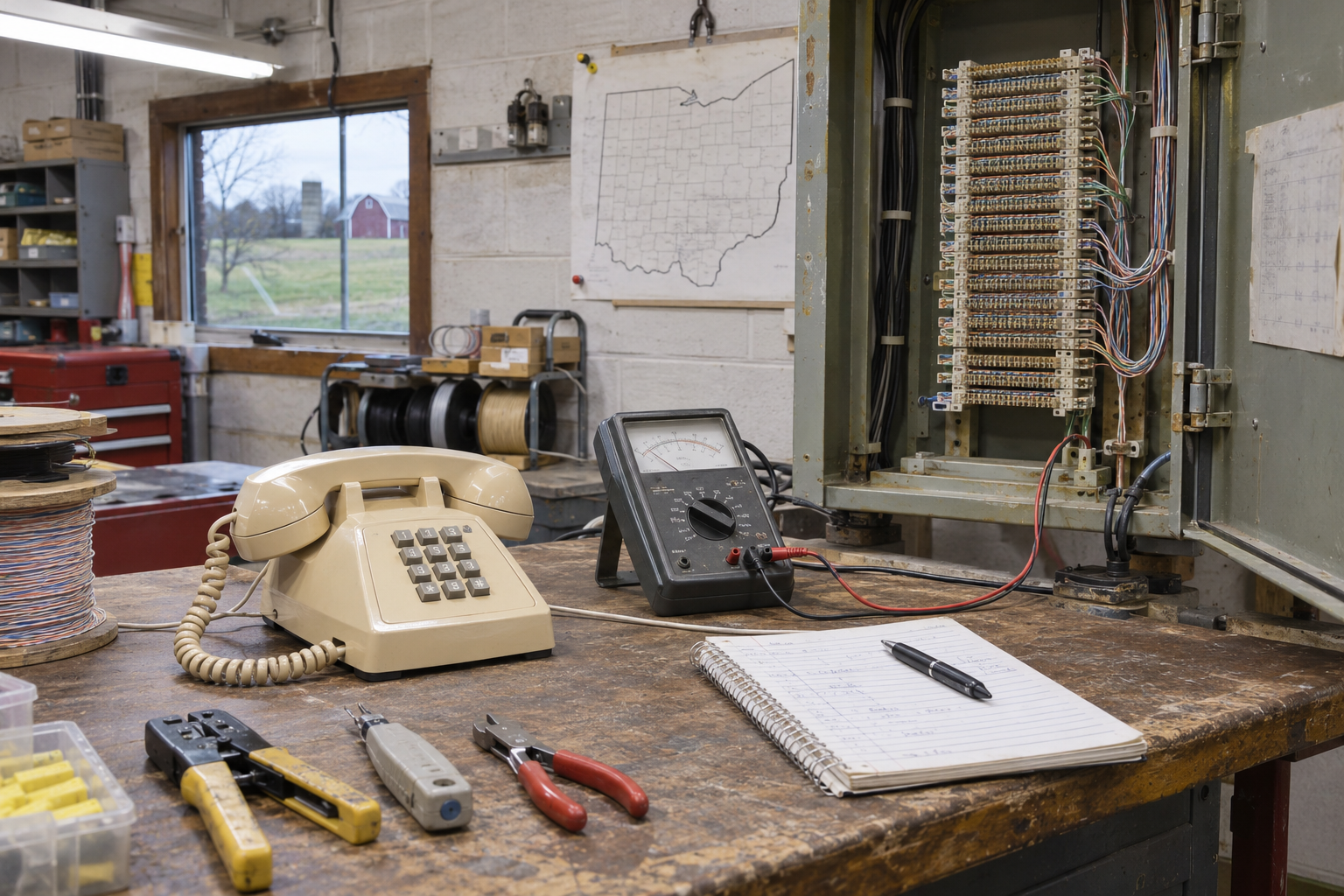
ROOK JUNCTION, Ohio — A rural telephone cooperative has moved 14 customers to new cable pairs after their landlines rang a second time following ordinary calls and played brief household conversations from years earlier. Emergency service and mobile calls were not affected, and the cooperative has credited the customers for one month of local service.
The affected copper lines serve a six-block neighborhood built around the former Rook Junction rail depot. Most customers keep landlines for relatives or poor mobile reception. Technician Cal Venn said the first report came Thursday from Elsie Pell, whose telephone rang less than a minute after she finished speaking with her sister.
Pell answered and heard herself as a child asking whether supper was ready. A second voice, which she identified as her mother, told her to wash coal dust from her sleeves before sitting down. Pell's mother died in 1998, and the family kitchen where the exchange occurred was removed during a 2006 addition.
Other customers reported the same two-call sequence. The first conversation was current and connected normally. The second arrived without caller identification and lasted from 12 to 88 seconds. It contained ordinary talk associated with the receiving home: a grocery list, an argument about homework, a dog being called inside and one side of a birthday greeting.
The repeats were not limited to current residents. A tenant heard two people discussing wallpaper removed before he bought the house. Another customer recognized her late husband's voice but not the woman answering him. Two households heard nothing beyond room noise and hung up; one later identified the ticking as a mantel clock stored in the attic.
Cooperative manager Iva Rusk asked customers not to record or share the calls while technicians checked for crossed lines. The company moved each number to a different pair, replaced a corroded terminal block and offered temporary wireless handsets. Rusk said no recording service is included on the accounts and no employee has access to archived household audio.
Old copper systems can carry crosstalk, radio interference and signals from answering machines or alarm equipment, said Mara Cole, a telecommunications engineer retained by the cooperative. Delayed audio may also remain in digital gateways for a short period. Cole said those conditions would not preserve conversations made before the gateway was installed or direct them to the house where they originally occurred.
Several customers found the calls comforting, while others disconnected their phones. Pell said hearing her mother's voice was clear but not useful and declined a request to wait for another call. The cooperative has arranged free wellness checks for two older subscribers who normally rely on daily family calls and do not want to answer the line until testing ends.
After the cable move, 13 numbers behaved normally. The fourteenth belonged to an empty house held by an estate. Technicians placed a test phone on a workshop bench, connected that number through the new pair and called it once. The second ring played a man reading baseball scores while dishes were stacked nearby. Estate records identify him as a former owner who died in 1974.
Rusk disconnected the test phone from the wall and removed its batteries. It rang again while lying beside the open terminal block. This time the same man stopped reading, set down a newspaper and asked someone in the room why the telephone had been taken out of the house. A chair moved across the recorded floor. The line went quiet before anyone answered him.