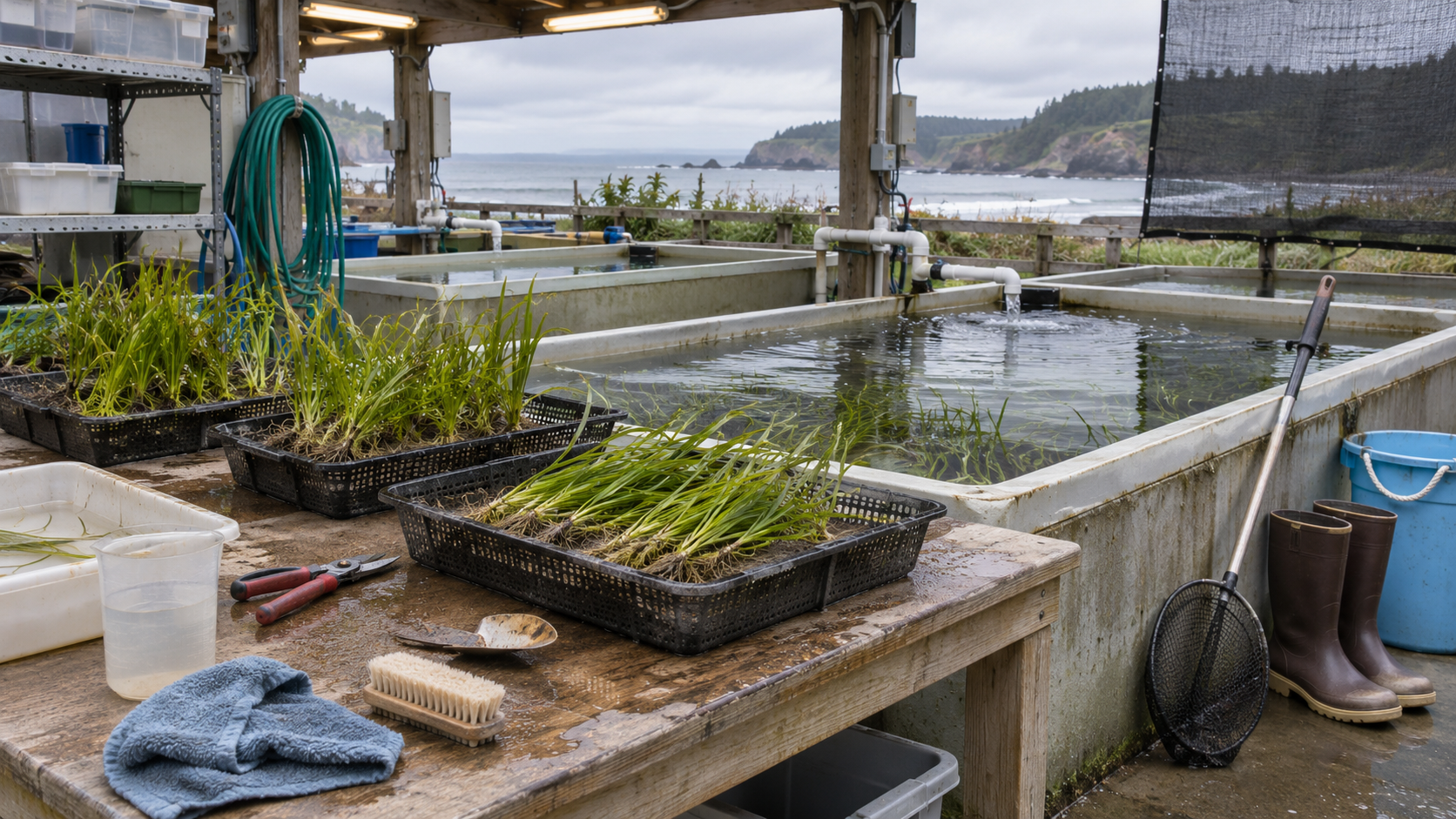
TERN COVE, Oregon — A coastal research laboratory has paused an eelgrass transplant project after cut blades rejoined unrelated shoots and continued growing across separate restoration trays. Field planting scheduled for Friday has been postponed, and the laboratory said no altered grass has been placed in the estuary.
The Tern Cove Estuary Laboratory raises eelgrass collected under state permits for use in damaged tidal beds. Technicians normally trim broken leaf tips, rinse sediment from the roots and secure groups of six shoots to small biodegradable frames. Project lead Maren Orr said the first attachment appeared Monday in a tray prepared for the south inlet site.
A loose blade that had been cut from one plant lay across a healthy shoot from another collection bed. By the next morning, the cut end had formed a narrow green seam around the standing blade. Both remained flexible, and the loose piece lifted with the rooted plant when a technician moved it to clean water.
Workers separated the pieces with sterile scissors and placed them in different tanks. Each cut surface joined the nearest living eelgrass within several hours. Some formed end-to-end connections; others wrapped around the middle of a blade and widened into flat collars. Blades left alone on bare mesh did not move toward the plants, but ordinary tank circulation carried several close enough to make contact.
The attachments crossed collection areas and plant age. A pale nursery shoot joined a darker adult leaf taken from nearly four miles away. Two trimmed tips linked themselves into a closed loop with no roots. That loop remained green for three days in filtered seawater, although tissue samples showed no obvious source of stored energy beyond what a cut leaf would normally contain.
Orr stopped preparation after technicians found three transplant frames connected by a continuous braid. The lab moved its 214 shoots into six tanks, assigned separate tools to each one and notified the state habitat office and two nonprofit partners. Grant work will continue through mapping and sediment analysis while the planting delay is reviewed.
Eelgrass can heal small wounds and spread through branching underground stems, said Irena Bell, a marine botanist who examined photographs and fresh samples. Detached leaves may also host algae or bacterial films that make surfaces adhere. Bell said those processes do not ordinarily rebuild vascular tissue between severed leaves, especially leaves from genetically unrelated plants.
The response has complicated routine decisions rather than harmed the stock. Researchers cannot tell whether joined plants would survive tides, carry disease between beds or remain distinct individuals for the project's survival count. A restoration permit requires each planting unit to be traceable to its collection area, a requirement the braided frames no longer meet.
On Wednesday, Orr colored the water in three tanks with separate harmless tracing dyes. The red, blue and yellow water did not cross the tank walls. By afternoon, however, new growth at the tips of joined blades carried narrow bands of all three colors in the same order, including a plant that had never left the blue tank.
Staff cut that plant free and placed it in a covered specimen jar without circulating water. It produced no additional bands overnight. The severed braid in the original tanks continued to lengthen, passing over the rims through damp drain cloth and joining again in the floor channel below.
The laboratory closed the channel and lifted the connected grass onto a stainless-steel table Thursday morning. When the last strand cleared the water, every blade folded toward the same empty place at the center of the braid. The leaves have remained green there, arranged around a space roughly the size of a human hand that none of the plants has entered.