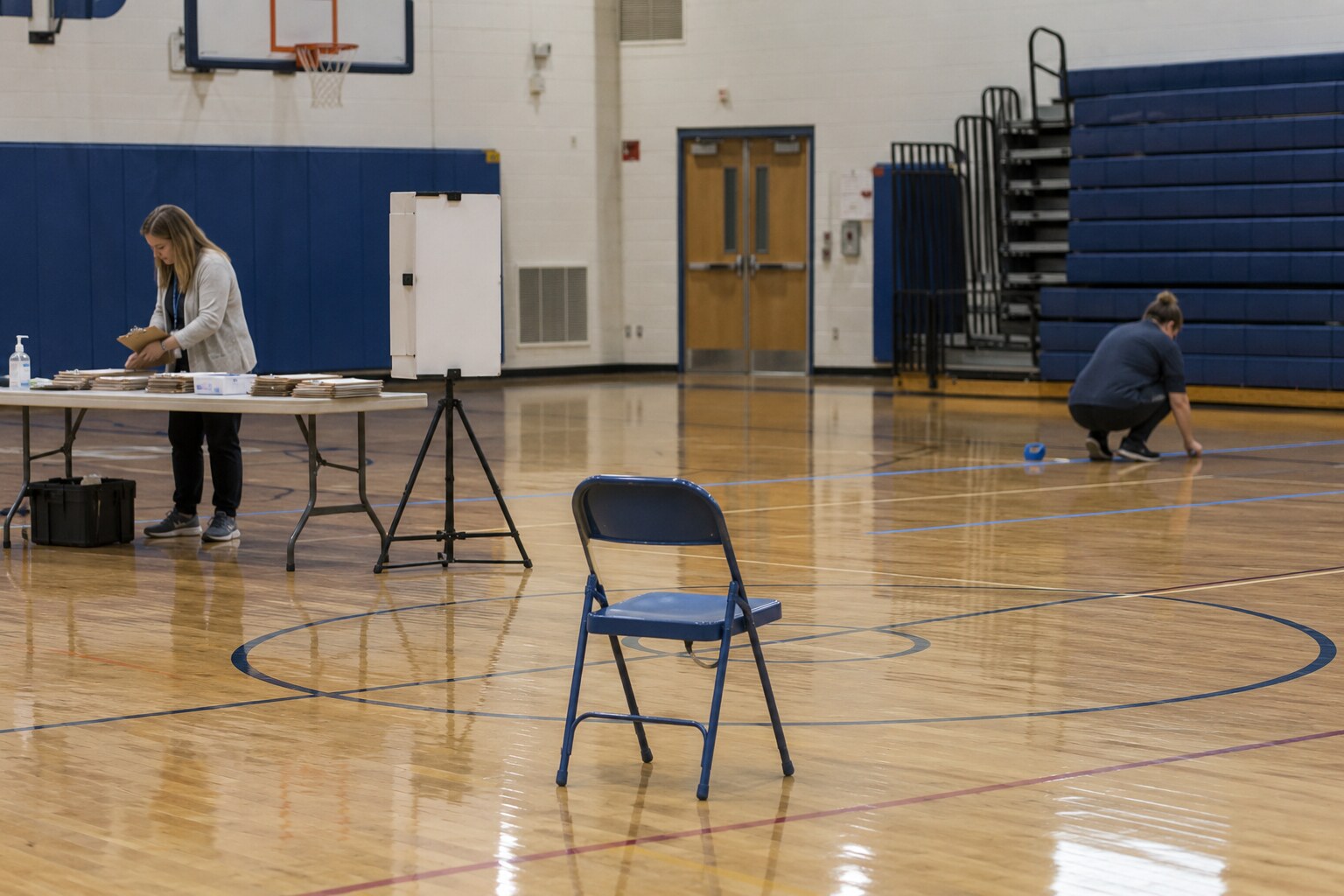
VELA GROVE, Minnesota — The school district is repeating vision screenings for 63 elementary students after children and staff failed to identify a blue folding chair placed in the center of the gym, even as they walked around it and kept balls from striking it. Screenings resumed Monday in two classrooms, and the district has reported no injury or loss of vision.
The chair was set out Friday to mark the waiting area for annual distance and depth-perception checks. School nurse Ina Pell said she unfolded it near the center circle while aides taped lanes across the court. It was an ordinary steel chair from a rack used for assemblies, with blue vinyl matching the folded bleachers.
When the first class entered, students divided around the chair without being directed. None sat down or brushed against it. Asked why the line split, several said there was open floor ahead. A teacher sent to move the chair walked to the center circle, stopped beside it and returned saying the floor was clear.
Pell could still see the chair from the screening table. She crossed the gym, touched its back and asked three adults to describe what was beneath her hand. They named the painted circle, her wristwatch and the far basketball hoop. One aide rested a clipboard on the seat without appearing to notice that it stayed above the floor.
The district ended the screenings and moved students to lunch in their classrooms. Security video shows the chair throughout the morning. It also shows 11 children changing course before reaching it and a foam ball rebounding from one leg. Children who watched the recording later said the ball made an unexplained turn; they did not identify the chair in the image.
Individual eye exams found normal acuity, color response and peripheral vision in a sample of 18 students and six employees. An optometrist brought in by the district could see the chair when she entered the empty gym alone. After two staff members joined her, she said its outline became difficult to hold in attention, though she continued feeling the cold metal beneath her fingers.
Attention can suppress an expected object when people are focused on another task, said Hester Linn, a university researcher who studies visual perception. Clothing, floor markings and a familiar room can also make an object blend into its setting. Linn said those effects do not usually persist after observers are directed to touch the object or view a recording several times.
Custodian Len Orr removed the chair after dismissal by walking backward from the equipment rack while holding a red moving blanket over it. He said he could feel its weight and hear the feet scrape but repeatedly lost track of what he was carrying when he looked over his shoulder. The chair is now covered in a locked maintenance room with three identical chairs that remain plainly visible.
Classes returned to the gym Monday with the center circle marked by a wide orange tape square. Teachers did not tell students where the chair had stood. During recess, children ran games normally but continued splitting around the empty square, leaving a space about three feet wide. Two said the space felt occupied without suggesting by what.
At the end of the period, a student rolled a rubber playground ball straight through the marked area. The ball curved around the place where the chair had been, crossed the circle and resumed its original line. It did not slow or strike anything. Orr swept the floor and lifted the tape afterward; the broom bent around the same empty patch, leaving one chair-shaped section of varnish untouched.