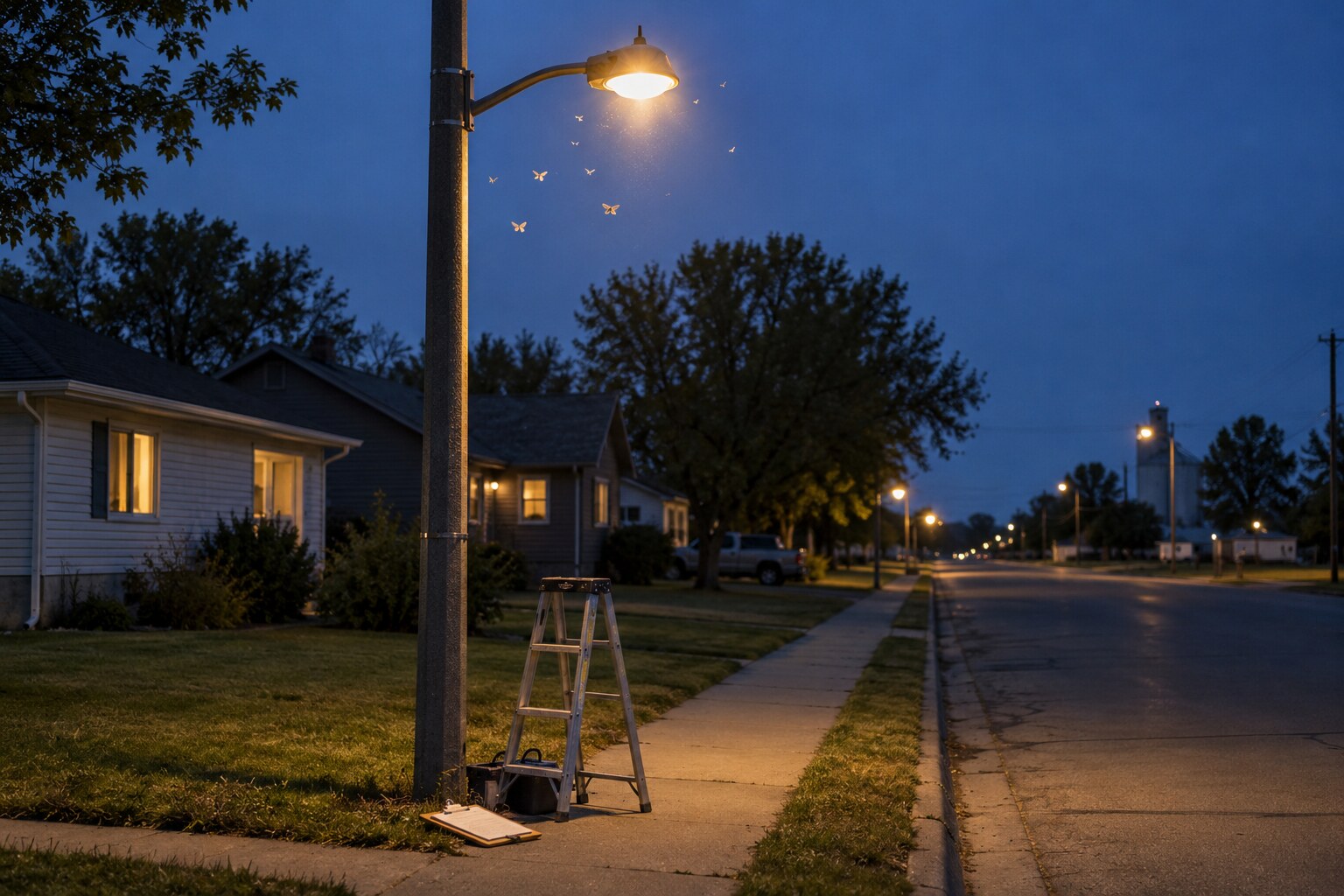
VESPER PLAIN, North Dakota — The city has delayed replacement of 12 older streetlights on Willow Street while a wildlife specialist documents an unusually concentrated moth gathering and branch-shaped shadows beneath the fixtures. The lights remain operational, and public works officials said the block is open to residents and traffic.
The replacement was scheduled because the metal-halide fixtures use more electricity and require frequent ballast repairs. Crews planned to install shielded LEDs over two days, beginning Thursday. Public works foreman Len Kurr stopped removal after workers found several hundred pale moths resting inside and around the first lamp housing.
The insects were identified as common underwings and related late-season moths, species that can gather near artificial light. What drew residents outside, however, was the pattern on the pavement. Instead of small moving wing shadows, the lamp cast the outline of broad branches and leaves across two yards and half the street.
The pattern resembled the canopy of an American elm removed from Willow Street in 1979 after storm damage and disease, said resident Celia Mort. A photograph in the local historical room shows the tree near the same corner. Mort, who was a child when it came down, recognized a low branch that had grown over her family's driveway.
Moths can interrupt a beam in overlapping layers and create larger, irregular shadows, entomologist Farid Lehn said after visiting Thursday evening. He placed a white sheet beneath one fixture and photographed the insects as they circled. The dark pattern remained still while individual moth shadows crossed it in the expected direction.
Public works switched off the first lamp at the breaker. Its section of the canopy disappeared, but the remaining fixtures continued the branch lines across the block without a visible break. When each light was shut off in sequence, another portion vanished. The complete pattern returned when the lamps restarted, even though the moths had moved among them.
Residents differed on whether the display was disruptive. Several brought chairs outside and described the restored shade as comforting. Others objected to people gathering near windows after dark. The city asked visitors to remain on the public sidewalk and prohibited collecting moths without permission from property owners.
The delay will cost the city about $1,400 for equipment rental and a second contractor visit, Kurr said. The utility has agreed to keep the old circuit energized through Friday. Crews inspected poles, underground conductors and lamp housings and found no projector, cutout or material that could form the pattern.
Lehn collected six moths that had died naturally beneath the lamps. Their wings carried ordinary mottled markings when viewed directly. Under a laboratory light, each specimen cast the shadow of a different leaf, including veins and torn edges absent from the wings. The leaves appeared to come from the same tree but from different stages of the season.
The city will complete one more evening count before deciding whether to proceed. Kurr said the fixtures cannot remain indefinitely because replacement parts are scarce, but crews may leave one lamp in place if it can be operated safely. The historical society has asked to photograph the full pattern before any work resumes.
After the moths dispersed before dawn Saturday, the branch shadows faded with the streetlights. The pavement beneath them remained dry except for several leaf-shaped patches of dew. At the curb where the old elm once stood, one patch held a narrow line of yellow leaves pressed into wet concrete. No matching tree grows on the block.