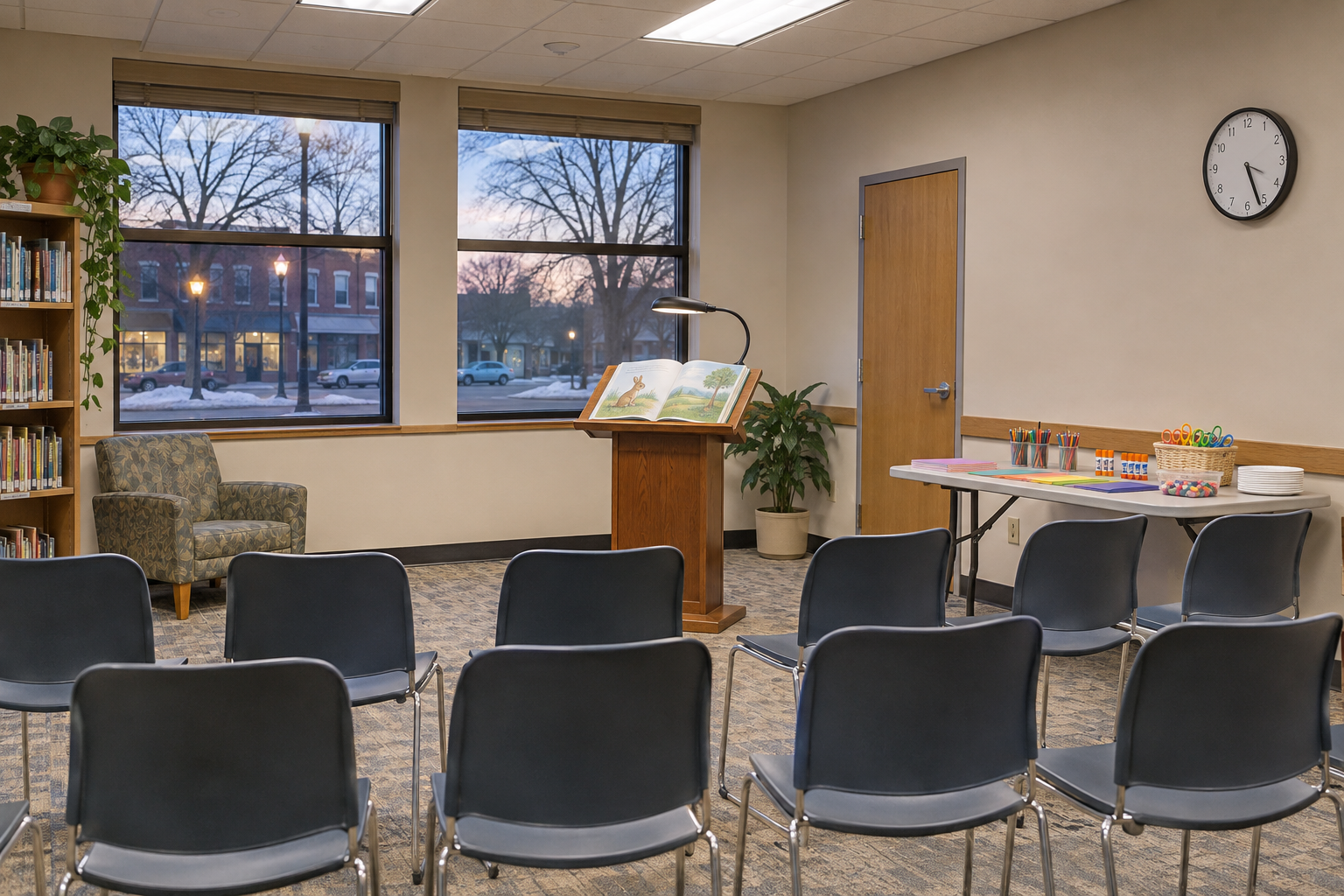
WEST RILL, Minnesota — The public library has moved its evening read-aloud from a community room after 19 adults and children failed to remember the same six-minute interval, though they continued reading, drawing and rearranging chairs during it. No one reported illness, and daytime programs remain on schedule.
West Rill Public Library holds a family reading hour each Wednesday at 6:30. Librarian Lena Orr reads a chapter while children make paper figures at side tables and adults may browse nearby shelves. Orr said the room clock showed 6:41 when she began the fourth chapter of a familiar children's novel and 6:48 when she next looked up.
The chapter had ended, and Orr's bookmark had moved 11 pages. Eight children had completed paper houses from a craft kit, including glued roofs that normally require several minutes to dry. Three adults had shifted the chairs into a semicircle to make room for a late family. None remembered reading, cutting paper or moving furniture after 6:42.
The late family arrived at 6:46 and found the program in progress. They heard Orr reading in her ordinary voice and watched other attendees work quietly. When the chapter ended, the three visitors remembered the interval normally, but everyone already in the room described an immediate passage from its opening paragraph to the final sentence.
Library staff checked a ceiling camera used to confirm room occupancy after closing. The video showed the group moving continuously, without a jump in its time display. Orr turned pages and paused for laughter twice. The recording contained room noise but no speech from 6:42 to 6:48; mouths moved, and several children appeared to answer questions that could not be heard.
Director Mara Voss ended the session after confirming that parents were able to drive home and that children knew who had brought them. The library retained the craft pieces with permission, refunded one program fee and offered the meeting room to families who wanted to sit together before leaving. No participant was asked to recreate the missing interval.
Attention can narrow during familiar tasks, and groups often estimate elapsed time poorly, said Irena Bell, a cognitive psychologist who reviewed an anonymized account. People may also adopt another person's description of a gap after discussing it. Bell said that would not readily explain a shared boundary to the minute among attendees doing different tasks while newly arrived witnesses reported no interruption.
The library moved Thursday's adult literacy session to the main reading floor and unplugged the room clock. Staff found no odor, ventilation fault or electrical interruption. The building's fire panel, wireless network and checkout system recorded ordinary activity during the six minutes, including two books renewed from a computer in the affected room.
One renewal belonged to attendee Cal Noll, who said he did not use the computer that evening. The account activity was for the novel being read aloud, a library copy already checked out to Orr for the program. Its new due date appeared on Noll's receipt, while his account history showed no loan and Orr's copy remained assigned to her.
Voss returned the novel to the shelf and placed the receipt with the incident notes. The book now falls open between pages 46 and 47, where the binding exposes a narrow strip of clean paper with no page number. The eleven pages Orr remembers reading run from 42 to 52 and contain no missing text.
At 6:42 Thursday, the locked community-room camera showed the empty chairs moving a few inches across the carpet in the same order as the previous night. The movement ended at 6:48 with a semicircle facing the bare lectern. Staff left the room closed. The unplugged wall clock above the chairs had advanced six minutes.