WREN FALLS, Minnesota — Wren Falls Community College has paused a chorus oral-history project after participants listening to the same rehearsal recording reported hearing different familiar people speak between songs. The fall concert will proceed, but no additional interviews or group recordings will be made until the college reviews the files and its consent process.
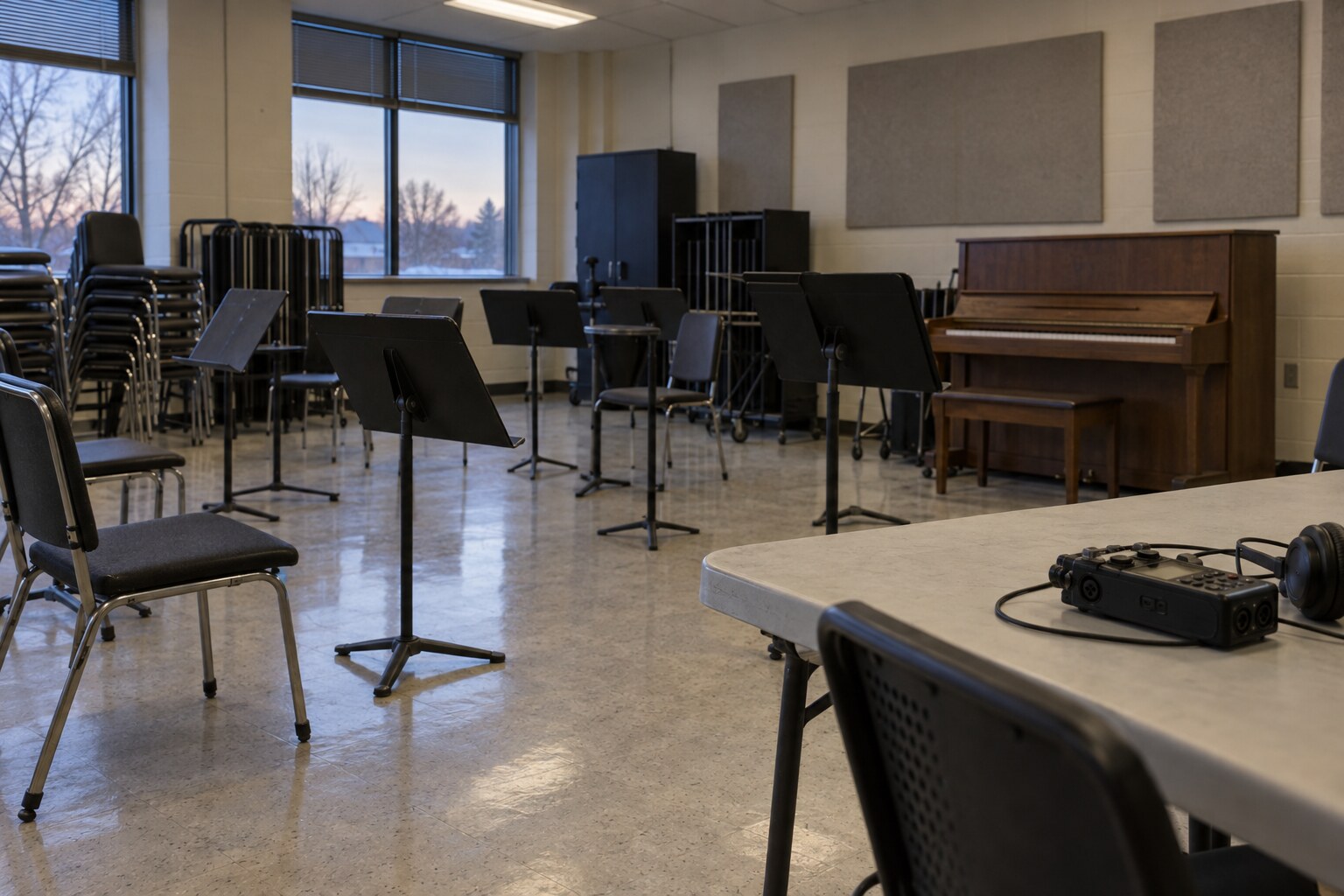
The 34-member North Room Chorus was recording folk songs and short recollections for the college archive. Members range in age from 19 to 82 and include students, employees and residents. Thursday's session used two digital recorders and three fixed microphones in the music department's regular rehearsal room.
Director Helen Vos stopped the group after its second song to adjust the seating. During a routine playback, alto Mina Derrow heard her father say her childhood nickname from the left speaker. Derrow's father died in 2014. Tenor Paul Geary, listening beside her, heard no nickname; he heard a former shop teacher tell him to remove his hat.
Vos replayed the passage without describing what either person had heard. Fifteen singers identified a familiar voice, and no two named the same speaker. Some heard a single word or laugh. Others reported brief practical instructions, including turning off an oven, returning a borrowed saw and taking a different bus home. Six heard only chairs and room tone.
The voices were not audible during the rehearsal. Participants had been seated quietly while Vos moved two chairs, and video from a wall-mounted camera shows no one speaking. Both audio recorders contain the same low sound at the point in question, though one was on a table and the other was clipped inside the closed piano.
Expectations can cause listeners to organize ambiguous noise into speech, especially when a sound resembles a known cadence, said Soren Lusk, an audiologist not affiliated with the college. Grief and familiarity can make a voice identification feel highly specific without making it accurate. Lusk said that explanation would be less complete if listeners independently heard verifiable statements not already known to them.
One instruction led Geary to call his neighbor about the borrowed saw. The neighbor found it in a shed where Geary's former teacher had stored tools before his death, although neither man knew it was there. College officials asked participants not to act on medical, financial or travel instructions heard in the recording and offered private withdrawal from the archive project.
Audio instructor Priya Senn copied the original files to offline storage and examined the passage without filtering it. The waveform contains a 17-second band of low, irregular noise below the choir's breathing. Removing the room's ventilation hum made the sound less speechlike. Isolating individual frequencies did not reveal a stable voice or word.
The college then held separate listening sessions using identical headphones and a checksum-verified copy. Derrow continued to hear her father. Geary heard the shop teacher only on his first replay and his own voice on the next two. Senn, who had not attended the rehearsal, heard a woman recite the room number of her elementary school library.
Administrators have sealed the project drive and will consult the college's privacy committee before allowing further access. Participants may request deletion of their interviews, though officials said removing one singer's microphone track would not alter the shared room recording. The chorus will rehearse without recording equipment this week.
Before the drive was sealed, Senn exported a silent segment from the beginning of the file to confirm the equipment clock. The 12 seconds contain no visible speech waveform. When played alone in the empty room, each occupied music stand gave a brief metallic vibration, one after another. The unassigned stand at the back vibrated last, and Derrow heard her own voice from it saying the nickname her father had used.